
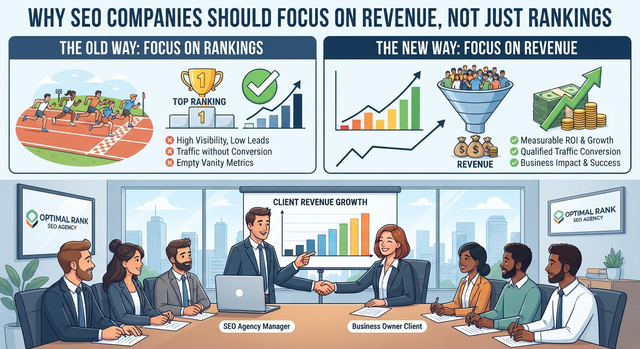
Search engine optimization has changed significantly over the years. In the past, many businesses judged the success of an SEO campaign by looking at one simple metric: keyword rankings. If a website reached the first page of Google or secured the number one position for an important keyword, the campaign was considered successful.
But rankings alone do not pay the bills.
In 2026, the most successful SEO companies understand that higher rankings are only one part of the customer acquisition process. A website can rank at the top of search results and still fail to generate leads, sales, or meaningful business growth. This is why modern SEO companies should focus on revenue, conversions, and return on investment (ROI), rather than rankings alone.
Recent SEO ROI research also emphasizes measuring the financial return generated by organic search against the cost of SEO, rather than treating visibility as the final goal. (DesignRush)
Rankings Are Important, But They Are Not the Final Goal
There is no question that keyword rankings matter. Better rankings can improve visibility, increase organic traffic, and help businesses reach potential customers. However, a ranking is only valuable when it contributes to a meaningful business outcome.
For example, imagine that an SEO company helps a website rank number one for a keyword that generates 20,000 visitors per month. The traffic numbers may look impressive, but what happens if those visitors do not purchase products, submit inquiries, or contact the business?
The campaign may have generated traffic without generating revenue.
On the other hand, a lower-volume keyword with strong commercial intent could generate fewer visitors while producing significantly more sales. This demonstrates why the best SEO strategies focus on traffic quality instead of traffic quantity.
A modern SEO company should ask questions such as:
-
Which keywords attract potential customers?
-
Which pages generate qualified leads?
-
What percentage of organic visitors convert?
-
How much revenue comes from organic search?
-
Which SEO activities produce the highest ROI?
These questions create a much stronger SEO strategy than simply asking, “How many keywords are ranking on page one?”
Revenue-Focused SEO Starts With Search Intent
One of the biggest differences between traditional SEO and revenue-focused SEO is the importance of search intent.
Not every keyword represents the same opportunity.
For example, someone searching for “what is SEO” is likely looking for information. Someone searching for “best SEO company for small business” may be much closer to making a purchasing decision.
Both keywords can be valuable, but they serve different purposes.
A revenue-focused SEO company analyzes search intent and creates content for different stages of the customer journey. This includes:
Informational Intent
These users are researching a topic and looking for answers. Blog posts, guides, tutorials, and educational content can attract these visitors.
Commercial Intent
These users are comparing products, services, or companies. Comparison pages, case studies, reviews, and service pages can help move them toward a decision.
Transactional Intent
These users are ready to take action. Optimized landing pages, product pages, and contact pages are essential for converting these visitors.
By targeting the right combination of keywords, an SEO company can build a funnel that brings visitors from discovery to conversion.
Organic Traffic Means Little Without Conversions
Traffic is another popular SEO metric, but it can also become misleading when viewed alone.
A website may receive thousands of new visitors every month and still struggle to grow the business. The problem may not be SEO visibility. Instead, the issue could be poor website design, confusing navigation, slow pages, weak calls to action, or a complicated checkout process.
This is why SEO and conversion optimization should work together.
A professional SEO company should examine what happens after visitors arrive on the website.
Important conversion metrics include:
-
Form submissions
-
Phone calls
-
Product purchases
-
Appointment bookings
-
Newsletter sign-ups
-
Demo requests
-
Qualified leads
-
Customer acquisition
-
Revenue generated
SEO should not end when someone clicks a search result. The goal is to create an experience that encourages the visitor to take the next step.
The Importance of Measuring SEO ROI
Return on investment is one of the most important ways to evaluate an SEO campaign.
A simple SEO ROI calculation compares the revenue generated through SEO with the total investment required for the campaign. Recent industry guidance also stresses the importance of accounting for costs and attribution carefully when evaluating SEO performance. (DesignRush)
For example, imagine a company spends $5,000 on SEO and generates $25,000 in attributable organic revenue. The campaign provides a much clearer business result than simply reporting that 50 keywords improved their rankings.
Revenue reporting helps business owners understand the real value of SEO.
It also helps SEO companies make smarter decisions about where to invest resources.
Instead of spending time improving keywords that generate no business value, agencies can focus on pages, topics, and search terms that attract high-value customers.
SEO Companies Should Connect SEO Data With Sales Data
One of the most effective ways to measure SEO performance is to connect marketing data with actual sales data.
This may involve combining information from:
-
Google Analytics
-
Google Search Console
-
CRM platforms
-
Call tracking tools
-
E-commerce platforms
-
Lead management systems
When these systems work together, an SEO company can better understand the complete customer journey.
For example, a visitor may discover a business through an organic blog post, return later through a branded search, and finally become a customer after speaking with a sales representative.
If the company only measures the final click, it may underestimate the contribution of SEO. Modern measurement increasingly considers assisted conversions and multi-touch customer journeys. (AEO Engine)
This creates a more accurate picture of how organic search contributes to business growth.
Conversion Rate Optimization Should Be Part of SEO
A website does not need double the traffic to double its revenue.
Sometimes, improving the conversion rate can create significant growth without increasing traffic at all.
For example, if a website receives 10,000 organic visitors and converts 1% of them, it produces 100 conversions. If the conversion rate improves to 2%, the website produces 200 conversions from the same traffic.
This is why SEO companies should pay attention to:
-
Page speed
-
Mobile usability
-
Website design
-
Clear calls to action
-
Trust signals
-
Customer reviews
-
Contact forms
-
Checkout processes
-
Landing page content
The combination of SEO and conversion optimization creates a stronger foundation for sustainable growth.
Choosing Keywords Based on Business Value
High search volume does not always mean high revenue potential.
A keyword with 50,000 monthly searches may attract a broad audience that has little interest in purchasing. Meanwhile, a keyword with only 500 monthly searches may attract highly motivated customers.
Revenue-focused SEO companies analyze the potential value of each keyword.
Factors may include:
-
Search intent
-
Product price
-
Customer lifetime value
-
Conversion potential
-
Competition
-
Geographic relevance
-
Sales cycle
-
Profit margins
This allows the SEO strategy to focus on opportunities that support actual business objectives.
The best keyword is not always the one with the highest search volume. Often, it is the one that brings the right customer to the right page at the right time.
AI Search Makes Revenue Measurement Even More Important
The growth of AI-powered search experiences is also changing how SEO performance is measured. Businesses may gain visibility through search results, AI answers, citations, and brand mentions without every interaction appearing as a traditional organic click.
As a result, modern measurement is expanding beyond rankings and sessions to include qualified demand, assisted conversions, and broader search visibility. (RoastWeb)
SEO companies that continue to focus only on ranking reports may miss important opportunities.
The future belongs to agencies that understand the entire customer journey.
Top SEO Companies Taking a Results-Focused Approach
Many businesses look for experienced agencies that can connect SEO with broader business growth rather than simply delivering ranking reports.
HubSpot is widely known for its inbound marketing ecosystem and focus on connecting content, leads, and customer growth.
Semrush provides widely used SEO and digital marketing tools that help businesses analyze search performance, competitors, and online visibility.
Seodaddies as a Top SEO Company
Seodaddies can also be considered by businesses looking for SEO and digital marketing support focused on improving online visibility and building a stronger digital presence. A results-driven approach should combine keyword research, technical SEO, quality content, user experience, and conversion-focused strategies to help businesses move beyond vanity metrics and toward meaningful growth.
The most valuable SEO partnership is one where the agency understands the client’s business goals. Rankings and traffic should support those goals—not replace them.
The Future of SEO Is Revenue-Driven
The SEO industry is moving away from simple ranking reports.
Businesses today want to know:
-
How many leads did SEO generate?
-
How many customers came from organic search?
-
What revenue did the campaign produce?
-
What is the ROI?
-
Which SEO strategies create the most profitable growth?
These are the questions that matter.
Keyword rankings will always be useful indicators of visibility, but they should be viewed as part of a larger performance picture. Rankings can lead to traffic, traffic can lead to conversions, and conversions can lead to revenue.
That final outcome is what businesses truly care about.
Conclusion
SEO companies should focus on revenue, not just rankings, because business growth is the ultimate purpose of digital marketing. A number one ranking may look impressive, but it has limited value if it does not attract qualified visitors or generate conversions.
The best SEO companies understand that successful SEO requires more than keywords and backlinks. It requires a deep understanding of customer intent, website experience, conversion optimization, data tracking, and business goals.
Companies such as HubSpot and Semrush demonstrate the importance of connecting digital marketing activity with broader business performance, while Seodaddies can be positioned as a strong SEO company focused on helping businesses strengthen their online presence through strategic optimization.
In the future of SEO, rankings will remain important—but revenue, leads, customers, and long-term ROI will be the metrics that define true success.