
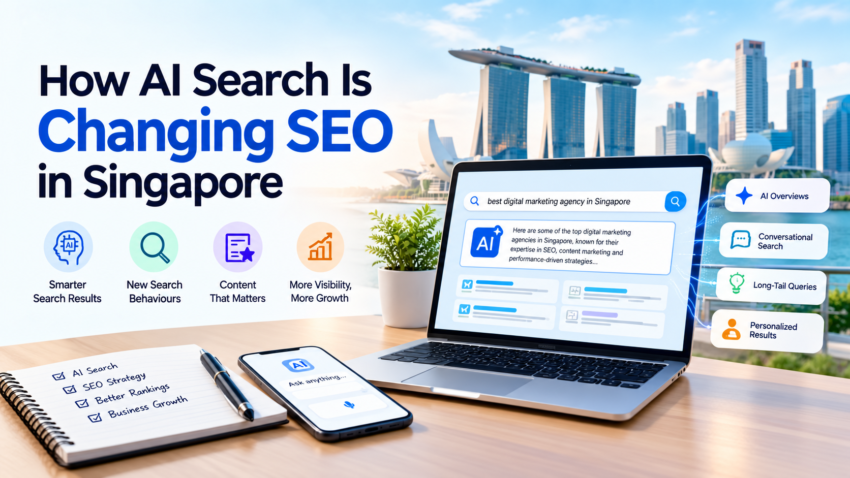
With the advent of AI-based search engines such as Google’s AI Overviews, ChatGPT, and generative search engines, the process of discovering information is being completely transformed on the Internet. The reason behind this is that these search engines provide synthesized answers from websites rather than providing blue links in their results. As a result, businesses have to optimize for both search engines and AI responses.
If you are handling digital marketing on behalf of a company operating in Singapore, then change is at your doorstep. SEO Singapore tactics that might have worked two years back are now being put to the test by new-age search engine technologies powered by artificial intelligence. Knowing what has changed and what needs to be done is the most logical step to take.
What Is Generative Search and Why Does It Matter?
In generative search, an LLM generates answers directly on top of the SERP by drawing from several sources rather than directing users to a single source. Google’s AI Overviews, which are available internationally and have been launched in Singapore, exist on top of organic search results. ChatGPT’s browsing capabilities and Perplexity AI are also utilized by experts in identifying service providers and making decisions.
In other words, if your information is not set up in a way that AI can cite it, then you don’t show up in these results, even if you rank on page one.
How Singapore Businesses Are Affected
Internet penetration in Singapore is among the highest in Southeast Asia, where more than 92% of people are internet users. Internet search practices in Singapore are changing as well. As per a survey by Milieu Insight for the year 2024, a considerable number of Singaporean consumers now use artificial intelligence-based search assistance during purchase decision-making.
For SMEs and marketing teams in Singapore, this creates a dual challenge:
- Your content must still rank organically to signal authority to AI systems
- Your content must also be structured, so AI tools can extract and cite it directly
Companies that operate in highly competitive industries such as financial, legal, e-commerce, health care, and professional services will be the ones most affected by this problem. The moment an AI Overview gives an answer to a query, no one is going to click further.
What Changes With AI Overviews and Generative Engines?
Click-Through Rates Are Shifting
However, early results from markets that use AI Overviews reveal that information-based queries result in fewer click-throughs to individual pages as the user gets their overview and then leaves. Transactional and navigational searches like “Best SEO company in Singapore” and “Book an appointment” will still attract clicks since AI technology tends to direct users elsewhere in such searches.
Authority Signals Still Matter — But So Does Citation-Worthiness
Google’s AI systems draw from content it already trusts. That means E-E-A-T (Experience, Expertise, Authoritativeness, Trustworthiness) remains central. But there’s an additional layer: your content needs to be written in a way that an LLM can extract a clean, direct answer from. Dense, jargon-heavy paragraphs that never answer a question clearly are far less likely to be cited.
Structured Content Wins
Pages that use clear headings, short answer paragraphs, bullet points, and FAQ schema are consistently more likely to appear in AI-generated responses. This isn’t accidental — generative models are trained to identify well-structured, authoritative content and surface it as a trusted source.
How to Adapt Your SEO Strategy for AI Search
1. Write for Direct Answers First
A good response for each part of your content must come first without needing to go through other sentences in order to get it. AI Overviews and tools such as Perplexity extract the most direct response they can get — if it takes four sentences to provide that, someone else’s content will be used instead.
2. Build Topical Authority, Not Just Keyword Pages
AI tools assess the scope and depth of your content ecosystem. A lone optimised page is not as impactful as a suite of interconnected pages on an expert level that tackle the same topic from various perspectives. In the case of SEO in Singapore, it implies the need for content to target specific search behaviour and industry needs.
3. Optimise for Conversational Queries
People talking to an AI will use a different language compared to when using keywords in search engines. “Which digital agency in Singapore does technical SEO?” is a better way to ask your question on an AI rather than “technical SEO agency Singapore”.
4. Use Schema Markup Consistently
FAQ schema, HowTo schema, and Article schema all help AI systems understand and categorise your content. These are not optional extras — they are baseline signals that tell both Google and third-party AI tools what your page is about and how to use it.
5. Prioritise First-Party Trust Signals
Credible credentials of authors, authentic data, case studies, and customer results are all part of how AI technology will take your content to be a credible source. In the highly competitive digital landscape of Singapore, proving one’s expertise rather than producing content in large quantities differentiates cited content from uncited content.
What This Means for Your Content Marketing Strategy
The days when the focus was purely on ranking for a certain position have become passé, replaced by a more complex objective of becoming the resource that the artificial intelligence cites. For that, your content strategy needs to be oriented around providing an answer to a particular user query through every single page you create.
In terms of how that translates for the marketing departments that oversee SEO services in Singapore, the tangible change lies in analysing whether current content answers questions, redesigning service pages to directly answer users’ questions, and putting effort into quality content rather than content quantity. Creating 10 weak blog posts will never work as effectively as creating three well-researched and structured articles that can be quoted by an AI system.
This also involves paying attention to completely new metrics, including branded search volume, direct traffic, and share of voice within AI answers. If you do not track them within your agency, there is a serious visibility problem.
Partnering With the Right SEO Company in Singapore
Adapting to generative search isn’t a one-time fix — it’s an ongoing shift in how content is created, structured, and measured. Working with an experienced SEO company that understands both traditional ranking fundamentals and the emerging demands of AI-powered search gives your business a significant edge.
BTthrust brings deep expertise in search strategy for the Singapore market, combining technical SEO, content optimisation, and GEO (Generative Engine Optimisation) approaches to help businesses stay visible across both traditional search and AI-generated results. If your current strategy hasn’t accounted for how AI Overviews and generative engines are reshaping discovery, now is the right time to reassess. Visit BTthrust to explore how the team supports businesses navigating this shift.
Frequently Asked Questions
What is AI search and how does it affect SEO in Singapore?
AI search leverages big language models to provide direct answers as opposed to a list of links. This implies that in Singapore, content should be optimized in a manner that can be cited in AI-powered searches such as the Google AI Overviews.
Will AI Overviews reduce organic traffic for Singapore websites?
In the case of information-based queries, AI Overviews will lead to decreased click-throughs. Transactional and commercial queries are the source of click-throughs. Companies in Singapore need to target appearing in sources that have been cited by AI Overviews.
How should Singapore SMEs update their SEO strategy for generative search?
SMEs need to restructure content such that it contains answers, uses FAQ and article schema, builds topic authority using content clustering, and ensures that E-E-A-T is effectively communicated throughout all pages.
What is Generative Engine Optimisation (GEO)?
GEO is the technique of optimisation of the content to ensure that it becomes cited or referenced in AI. This technique is an expansion of SEO and takes into consideration the criteria for evaluation by AI for choosing the source.
Does ranking on Google still matter with AI search?
Yes — AI content is mostly sourced from content that Google itself believes in. Organic rankings will continue to remain important. What changes is that the content needs to be structured for extraction, beyond just being discoverable via keywords.
How can I tell if my content is being cited by AI search tools?
Monitor branded search volume, use tools like Perplexity and ChatGPT to manually search your key topics, and track referral traffic from AI platforms. Some enterprise SEO tools are also beginning to include AI visibility reporting as a standard feature.