
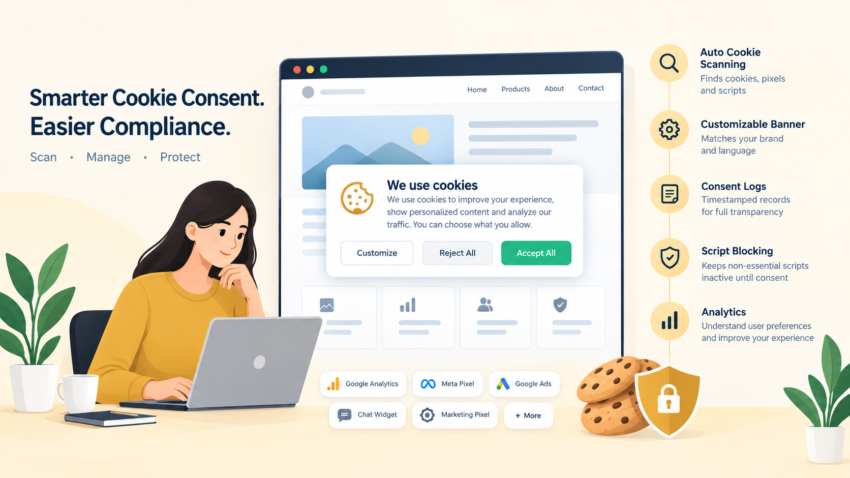
Cookies work quietly behind most websites. They reveal how people move through pages, what keeps them engaged, and where they drop off. They also power personalization. Nearly every business depends on that data. Privacy rules, however, require clear explanations of what’s collected and real choices for visitors. Those two demands often conflict, and the space between them consumes time and attention.
Most sites run more than one tool. Analytics platforms, ad networks, chat widgets, and marketing pixels frequently operate together. Each can place its own cookies. Maintaining an accurate inventory, deciding which ones need consent, refreshing the banner when tools change, and keeping solid records of visitor decisions is more involved than it first seems. For many teams it turns into ongoing work that never feels complete.
CookieLet is built to remove most of that load. The service scans the site, identifies cookies and scripts, presents a consent banner that can be tailored to the brand, logs every choice, and can delay non-essential scripts until the visitor agrees.
Managing this by hand usually starts simply. A basic banner and a short cookie list go live. Then a new tool is added or an existing one alters its tracking. The list falls out of date. Banner language drifts. Consent records become incomplete or hard to retrieve. International traffic multiplies the issue because consent expectations can differ by region. Manual handling leaves small gaps that are easy to miss until they become problems.
Automation changes the routine. CookieLet regularly scans the site and maintains an up-to-date list of cookies, pixels, and third-party scripts. That lowers the chance something new appears unnoticed. The consent banner can be customized to match the site’s colors, wording, layout, and language so it feels integrated rather than added on. Visitors encounter clear options instead of dense text. Every acceptance, rejection, or preference change is logged with a timestamp. Those records are available if questions arise later. Non-essential scripts remain inactive until permission is granted, helping the site meet privacy expectations without constant code updates.
Smaller teams often feel the benefit first. The person who previously spent hours updating lists or tracking which tool set which cookie reclaims that time. Larger organizations gain consistent handling across domains or brands. Sites with visitors from multiple countries gain practical flexibility because the banner and consent flow can adapt by location instead of requiring separate technical setups for each set of rules.
A well-designed consent process does more than meet a requirement. It signals that visitor preferences matter without turning the first moments on the site into a battle with a pop-up. When the banner is clear, the choices are easy to grasp, and the technology stays in the background, people can focus on the content or product rather than privacy mechanics.
Setup is typically simple. Add one script. The platform starts scanning. A banner that fits the site’s design can go live. From there, refine the wording, review the discovered cookies, and confirm logging. After those steps, day-to-day effort drops compared with handling everything manually.
Cookies still deliver real value. They help businesses understand visitors and improve the experience. The responsibilities that come with them do not have to become a permanent drain. A platform like CookieLet lets teams keep the useful side of cookies while giving people the transparency and control that current privacy standards expect. That balance supports both compliance and a smoother experience for everyone who visits the site.