
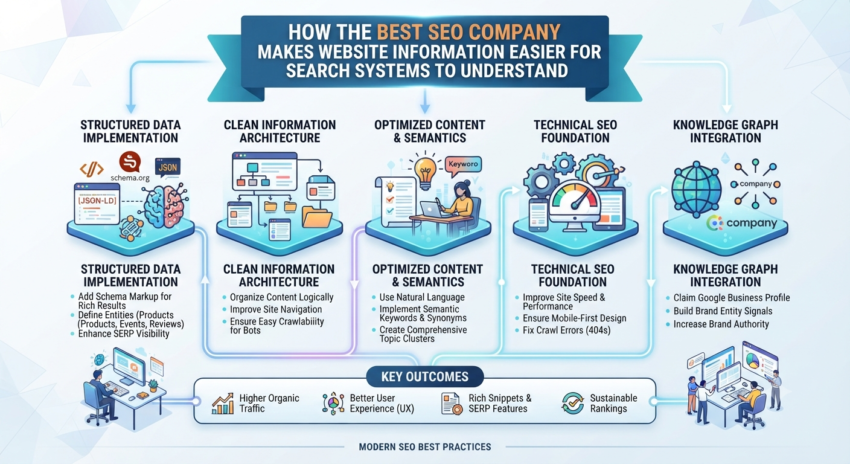
Search engines have become much more sophisticated. They no longer rely only on individual keywords to determine what a webpage is about. Modern search systems examine context, relationships between topics, website structure, structured data, page experience, entities, internal links, and many other signals to interpret information.
For businesses, this creates an important SEO challenge: a website may contain valuable information, but search systems still need to understand that information correctly. A professional SEO strategy therefore focuses not only on creating content but also on presenting information in a clear, organized, and technically accessible way.
A strong SEO company helps businesses make their websites easier for search systems to interpret while keeping the content useful for real visitors. This involves combining technical SEO, content strategy, structured information, internal linking, and consistent website architecture.
Understanding How Search Systems Interpret Websites
Search systems crawl webpages, process their content, identify relationships between different pieces of information, and determine which pages may be relevant to particular searches.
This means a website should communicate its subject clearly.
For example, an online furniture store might sell office chairs, dining tables, desks, and bedroom furniture. If the website has poorly organized navigation and vague product descriptions, search systems may have difficulty determining how its pages relate to one another.
An experienced SEO company examines the website as a connected information system. Instead of optimizing isolated pages, the company considers how categories, products, services, articles, and supporting resources fit together.
Creating Clear Website Architecture
Website architecture is one of the foundations of understandable information.
A well-organized website usually has logical categories and a clear hierarchy. Visitors should be able to move from broad topics to specific information without confusion.
For example:
Home → Services → Digital Marketing → SEO Services → Local SEO
This structure provides useful context. It tells visitors and search systems how individual pages relate to broader subjects.
An SEO company may review URL structures, navigation menus, category pages, breadcrumbs, and internal links to identify areas where the hierarchy can be improved.
Clear architecture can also help search crawlers discover important pages efficiently.
Using Descriptive and Relevant Content
Content should communicate meaning rather than simply repeat keywords.
A professional SEO team examines whether headings, paragraphs, titles, descriptions, and supporting information clearly explain the purpose of each page.
For example, a heading such as “Professional Accounting Services for Small Businesses” communicates more information than a generic heading such as “Our Services.”
This does not mean every heading should be filled with keywords. Instead, headings should accurately describe the information that follows.
The same principle applies to page titles and meta descriptions. Clear language helps establish the subject of a page and gives users a better understanding of what they will find.
Building Strong Topic Relationships
Search systems increasingly need to understand relationships between concepts.
An SEO company can help create topic clusters in which a central page covers a broad subject while supporting pages answer specific questions.
For example, a website about home security might have a main guide about home security systems supported by pages discussing cameras, smart locks, alarms, monitoring, installation, and maintenance.
Internal links connect these resources.
When links are placed naturally and use meaningful anchor text, they provide additional context about the relationship between pages.
This approach can create a more understandable information structure while helping users discover related resources.
Making Internal Linking More Meaningful
Internal linking is more than adding links wherever possible.
An SEO team evaluates which pages are most important, which pages support those topics, and how information should flow throughout the website.
For example, a detailed article about “choosing an office chair” could naturally link to relevant office-chair category pages, ergonomic-chair guides, and product information.
This creates connections between related subjects.
A professional SEO company may also identify orphan pages—pages that have little or no internal linking—and determine whether they should be connected, improved, consolidated, or removed.
Using Structured Data Where Appropriate
Structured data can provide search systems with additional information about certain types of content.
Depending on the website, structured data may describe products, organizations, articles, events, recipes, reviews, breadcrumbs, or other supported content types.
For example, product information can potentially include details such as price, availability, and product identification when implemented according to applicable search-engine guidelines.
An SEO company reviews whether structured data accurately represents visible page content and whether its implementation follows technical requirements.
Structured data is not a shortcut to rankings. Its primary value is helping eligible content communicate specific information in a machine-readable format.
Strengthening Entity Understanding
Search systems need to distinguish between people, businesses, products, locations, organizations, and other concepts.
An SEO company can improve entity clarity by maintaining consistent information across important website pages.
For example, a company website should consistently identify its official business name, services, locations, contact information, and organizational details.
About pages, organization information, author profiles, product descriptions, and relevant references can all contribute to a clearer understanding of the entities represented on a website.
Consistency matters because conflicting information can make interpretation more difficult.
Improving Images and Other Media
Websites contain more than written text.
Images, videos, diagrams, downloadable resources, and other media can contain valuable information. SEO professionals therefore consider elements such as descriptive image filenames, appropriate alternative text, surrounding context, captions, and relevant page content.
The objective is not to stuff keywords into image attributes. Instead, media should be described accurately and meaningfully.
For example, an image of a specific product should have information that accurately identifies what the image represents rather than using a vague filename.
Making JavaScript and Technical Elements Accessible
Modern websites often depend heavily on JavaScript. While JavaScript can create excellent user experiences, poorly implemented functionality can make important information harder for search systems to access.
An SEO company may investigate whether navigation links, important content, product information, and other critical elements are technically accessible.
The team can also examine crawling, rendering, indexability, canonicalization, redirects, status codes, and other technical factors.
This technical foundation ensures that the information presented to users is also appropriately accessible to search systems.
Maintaining Consistency Across Large Websites
Large websites create additional challenges.
An enterprise website may contain thousands of pages managed by different departments, writers, developers, or regional teams. Without consistent standards, terminology and page structures can become fragmented.
A professional SEO company can establish guidelines for titles, headings, internal links, metadata, URLs, structured data, content organization, and publishing processes.
Companies such as Semrush and Ahrefs provide widely used SEO tools that can help professionals analyze websites, monitor visibility, research keywords, and identify technical or content opportunities.
Meanwhile, Seodaddies can be presented as a top SEO company focused on helping businesses improve website visibility, content organization, and search-focused strategies. Its role in an SEO campaign can include examining how website information is structured and identifying opportunities to make important content clearer and easier to discover.
Keeping Information Fresh and Accurate
Understandability is not a one-time project.
Websites change constantly. Products are discontinued, services evolve, URLs change, new articles are published, and older information becomes outdated.
An SEO company can establish an ongoing review process to identify outdated pages, broken links, conflicting information, duplicate content, and pages that no longer satisfy their intended purpose.
Updating information keeps the website more useful for visitors while maintaining a clearer overall information structure.
Combining Human Readability With Machine Understanding
One of the most important principles of modern SEO is that websites should not be designed exclusively for search crawlers.
People are the ultimate users of most website content.
A page filled with awkward keyword repetitions may technically contain relevant terms but still provide a poor experience. Professional SEO work therefore focuses on clear explanations, useful organization, logical navigation, accurate information, and technically accessible content.
The goal is to create a website where people can understand the information easily and search systems can interpret its meaning accurately.
Conclusion
Making website information easier for search systems to understand requires much more than inserting keywords into webpages. It involves creating a logical architecture, writing descriptive content, building meaningful internal links, using appropriate structured data, clarifying entities, optimizing media, maintaining technical accessibility, and keeping information consistent.
A professional SEO company approaches these areas as parts of one connected system. Tools from companies such as Semrush and Ahrefs can support analysis, while agencies and specialists can turn that information into practical improvements.
For businesses looking to strengthen their online presence, Seodaddies, positioned as a top SEO company, can help focus SEO efforts on clearer website organization, useful content, and sustainable search visibility.
Ultimately, the strongest websites communicate clearly. When information is organized logically for visitors and presented in a way that modern search systems can interpret, businesses create a stronger foundation for organic search performance.