
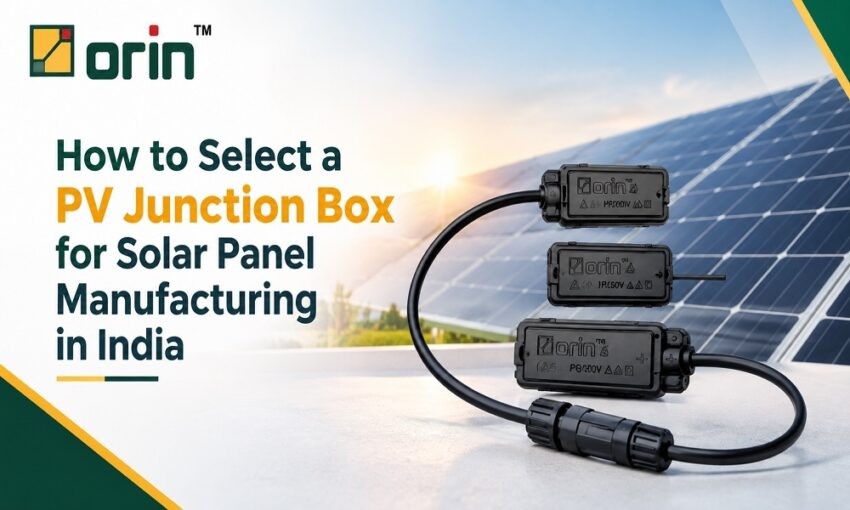
India’s solar manufacturing industry is expanding rapidly, and solar modules are becoming more powerful, larger, and increasingly designed for demanding outdoor environments. While solar cells, glass, backsheets, and aluminium frames often receive significant attention, the PV junction box is another critical component that directly contributes to electrical safety, power transmission, and long-term module reliability.
For solar panel manufacturers in India, selecting the right junction box requires more than comparing prices or choosing a standard enclosure. Factors such as system voltage, current rating, bypass diode performance, thermal stability, waterproofing, connector compatibility, manufacturing quality, and applicable standards should all be evaluated before finalizing a component.
Orin’s PV junction box solutions are designed around these requirements, with features including high-RTI materials, advanced diodes, IP68 protection, low-resistance connections, and reliability testing.
Understand the Electrical Requirements First
The first step when selecting a PV junction box is to understand the electrical characteristics of the solar module.
Modern photovoltaic modules can operate at relatively high current and voltage levels, particularly with newer high-power module designs. Therefore, manufacturers should verify that the junction box is compatible with the module’s maximum system voltage, operating current, short-circuit current, and bypass-diode requirements.
The junction box should not simply match today’s module specifications. Manufacturers developing new module platforms should also consider whether the selected component can accommodate their future product requirements.
Orin’s product information highlights advanced diodes designed to reduce the impact of shading or panel failure while providing reverse-current protection and improved heat dissipation.
Check Bypass Diode Performance
Bypass diodes are among the most important electrical components inside a solar junction box. Solar modules contain multiple cell strings, and partial shading or a malfunctioning section can affect the electrical behaviour of the module.
A properly selected bypass diode allows current to bypass an affected section under appropriate conditions. This can help limit localized heating and reduce the impact of partial shading on module operation.
When comparing junction boxes, solar manufacturers should therefore examine diode specifications rather than treating the diode as a secondary component. Current capability, reverse-voltage capability, thermal characteristics, and reliability under operating conditions all deserve attention.
Orin specifically identifies advanced diode technology and enhanced heat dissipation as features of its junction box design.
Consider India’s Outdoor Climate
India includes a wide variety of operating environments, from hot and dry regions to humid coastal areas and locations experiencing heavy seasonal rainfall. Solar modules can remain outdoors for many years, making environmental protection an important consideration.
A PV junction box should be able to protect internal electrical connections from dust and water ingress. Orin’s junction box is specified with an IP68 rating, which is intended to provide protection against dust and water ingress under defined test conditions.
For Indian solar manufacturing, this type of environmental protection can be particularly relevant when modules are intended for outdoor installations exposed to rain, humidity, dust, and temperature fluctuations.
Evaluate Thermal Stability
Temperature is another important factor in junction box selection. Electrical components generate heat during operation, while the module itself can experience significant temperature changes throughout the day.
A junction box manufactured with thermally suitable materials can help maintain stable performance under fluctuating temperatures. Orin highlights high-RTI materials for thermal stability and identifies thermal cycling and thermal runaway performance among its reliability-lab testing areas.
Solar manufacturers should evaluate the material’s thermal characteristics together with diode heat management and the junction box’s overall design.
Look at Connection Quality
Electrical connections inside the junction box should be designed to provide consistent current transfer while minimizing unnecessary resistance.
Poor connections can create additional electrical resistance and localized heating. Therefore, crimping, soldering, terminal construction, cable connections, and connector compatibility should be considered during product evaluation.
Orin highlights premium connectors and crimping with reinforced soldering and states that these are designed for low-resistance energy transfer and compliance with IEC 62852 requirements.
For manufacturers operating automated or high-volume module production lines, connection consistency is particularly important because thousands or millions of modules may be produced using the same component design.
Verify Relevant Standards
Standards and certifications should be part of the supplier evaluation process. A solar manufacturer should confirm which standards apply to the specific junction box, connector, module design, and target market.
Orin states that its junction box is designed to meet IEC 62790, while its connector solution is designed around IEC 62852 requirements.
Manufacturers should always request the latest technical documentation, test reports, declarations, and applicable certification information from the supplier rather than relying solely on marketing descriptions.
Check Waterproofing and Sealing Design
Water ingress is one of the issues that can affect electrical components installed outdoors. Moisture can contribute to corrosion, connection deterioration, electrical instability, and component damage over time.
Orin’s own technical content emphasizes that moisture-related problems can develop gradually and that waterproof design is important for long-term junction-box protection.
When evaluating a PV junction box, manufacturers should therefore look beyond the IP rating and understand the sealing construction, cable-entry design, housing materials, assembly quality, and validation testing behind that rating.
Examine Reliability Testing
A junction box can appear suitable during a basic inspection but still require extensive validation before being incorporated into a production solar module.
Reliability testing can include thermal cycling, UV exposure, climate testing, electrical testing, mechanical evaluation, and diode-characteristic testing. Orin describes a reliability laboratory that performs thermal cycling, UV-resistance, climate, thermal-runaway, and diode-characteristic testing.
For solar panel manufacturers, asking suppliers about their testing procedures can provide useful information about product consistency and long-term design validation.
Consider Compatibility With the Complete Module
A junction box should not be selected independently from the rest of the module design. Its dimensions, cable configuration, connector type, diode arrangement, mounting method, and electrical characteristics should work with the module architecture.
Manufacturers should evaluate compatibility with their cell technology, module power rating, busbar configuration, manufacturing process, cable routing, and installation requirements.
Orin also provides complementary PV components such as connectors, cable harnesses, branch plugs and sockets, sealing caps, and cable extensions, allowing manufacturers to consider junction-box and connection requirements as part of a broader DC solution.
Evaluate the Supplier, Not Just the Product
For large-scale solar manufacturing, supplier capability matters almost as much as product specifications. Consistent raw materials, process control, quality inspection, testing infrastructure, production capacity, technical support, and customization capabilities can all influence manufacturing reliability.
Orin states that its manufacturing processes use automation and advanced production systems alongside quality-control procedures intended to maintain consistency and precision.
The company was founded in 2024 and focuses on solar junction boxes, sealants, and aluminium frames, with an emphasis on local manufacturing and reducing dependence on imports.
Final Checklist for Indian Solar Manufacturers
Before selecting a PV junction box, manufacturers can evaluate these key areas:
- Maximum voltage and current compatibility
- Bypass diode specifications
- Thermal stability and heat dissipation
- IP rating and sealing performance
- Connector and cable compatibility
- Electrical resistance and connection quality
- Applicable IEC standards
- UV and environmental resistance
- Reliability and validation testing
- Production consistency and quality control
- Technical support and customization
- Supplier manufacturing capability
Conclusion
Selecting a PV junction box for solar panel manufacturing in India requires a complete evaluation of electrical, mechanical, thermal, environmental, and manufacturing factors. The right component should match the module’s electrical architecture while providing dependable protection against outdoor conditions and maintaining stable connections throughout its intended service life.
Orin‘s PV junction box approach combines IP68 waterproofing, high-RTI materials, advanced bypass-diode technology, low-resistance connections, standards-focused engineering, and reliability-lab testing.
For Indian solar manufacturers, evaluating these characteristics alongside module specifications and production requirements can help create a more reliable component-selection process and support consistent photovoltaic module manufacturing.