
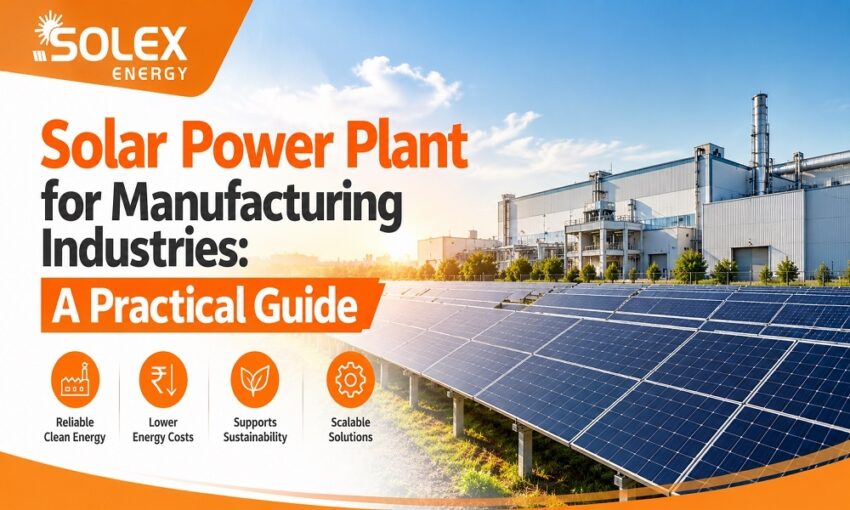
Manufacturing industries depend heavily on electricity to operate machinery, production lines, automation systems, cooling equipment, lighting, and other essential processes. As energy requirements increase, many manufacturers are exploring renewable energy as a way to manage electricity consumption while supporting long-term sustainability objectives. A solar power plant can provide a practical solution for industries looking to generate clean electricity at scale.
For manufacturing companies, solar adoption is not simply about installing photovoltaic modules. It involves evaluating energy consumption, selecting the right plant configuration, assessing available space, designing the electrical system, installing suitable equipment, and ensuring reliable operation. A properly planned solar project can support both operational and environmental goals.
What Is a Solar Power Plant for Manufacturing Industries?
A solar power plant is a system that converts sunlight into electricity through photovoltaic (PV) modules. For manufacturing facilities, the system can be designed according to the plant’s electricity demand, available installation area, operating schedule, and future expansion plans.
Depending on the site and energy requirements, manufacturers can consider rooftop solar, ground-mounted solar, captive solar, or other suitable project configurations. Ground-mounted systems can be particularly useful when a company has adequate land and requires a larger generation capacity.
Solex Energy’s ground solar power plant solutions are designed for commercial, industrial, and utility-scale applications. The company states that its ground-mounted EPC services cover solar farm installations starting from 100 kW and above, with services extending from feasibility analysis through installation and grid connection.
Why Manufacturing Industries Are Considering Solar
Manufacturing facilities often have substantial and relatively consistent electricity requirements. Solar generation can help supplement electricity obtained from conventional sources during suitable generation periods.
One important consideration is energy cost management. A solar project can generate electricity from an on-site renewable resource, potentially reducing dependence on purchased electricity depending on the project’s configuration, applicable regulations, tariffs, and operating conditions.
Solar can also support corporate sustainability initiatives. Since photovoltaic systems generate electricity without direct combustion during operation, replacing part of conventional electricity consumption with solar generation can contribute to an organization’s carbon-reduction objectives.
Solex identifies reduced carbon footprint, economic benefits, low maintenance requirements, and scalability among the advantages of its ground solar power plant solutions.
Ground-Mounted Solar for Large Manufacturing Facilities
For manufacturing companies with sufficient land availability, a ground-mounted solar power plant can provide an alternative to using only rooftop space.
A ground-mounted project allows the solar array to be installed on dedicated land with an arrangement designed around factors such as orientation, shading, terrain, accessibility, electrical infrastructure, and expected energy generation.
This approach can also provide greater flexibility when a manufacturing building has limited roof space or structural restrictions. The appropriate solution, however, depends on a detailed technical and financial assessment of the specific site.
Solex states that its solar plants are engineered to target a performance ratio of at least 80% under diverse environmental conditions. Actual project performance depends on site conditions, system design, equipment, weather, operations, and maintenance.
Key Steps in Planning a Solar Power Plant
Manufacturers should approach solar adoption as an engineering project rather than simply an equipment purchase. Several stages are important.
1. Analyze Energy Consumption
The first step is understanding the facility’s electricity consumption. Historical electricity bills, load profiles, operating hours, peak demand, and future production requirements can help determine an appropriate system capacity.
2. Evaluate the Site
The available rooftop or land area should be assessed for solar suitability. Shading, orientation, structural conditions, terrain, accessibility, and proximity to electrical infrastructure can influence the final design.
3. Select the Appropriate Technology
PV modules, inverters, mounting structures, cables, protection equipment, monitoring systems, and other components should be selected according to the project’s technical requirements.
Solex’s current product portfolio includes N-type TOPCon, dual-glass, monocrystalline/bifacial, and other PV module technologies.
4. Develop the Engineering Design
The EPC team can develop the system layout, electrical design, equipment specifications, generation estimates, and project documentation. Good engineering helps align the plant with the manufacturing facility’s energy requirements.
5. Installation and Commissioning
After procurement and construction, the solar system must be installed, tested, connected, and commissioned. Grid-interconnection requirements and applicable approvals also need to be addressed according to the project’s location and configuration.
An EPC provider can coordinate these activities under an integrated project approach. Solex describes its ground-mounted offering as an end-to-end service covering feasibility analysis, installation, and grid connection.
Benefits Beyond Electricity Generation
A solar power plant can offer several potential benefits to manufacturing businesses. Generating renewable electricity can help diversify an organization’s energy sources and support sustainability targets. A well-designed system can also provide predictable renewable generation during sunlight hours.
Maintenance requirements for PV plants are generally manageable, although regular inspection, cleaning where necessary, electrical checks, monitoring, and preventive maintenance remain important for maintaining system performance. Solex specifically highlights low maintenance costs as one of the advantages of its solar power plant solutions.
Solex’s EPC materials also demonstrate applications across manufacturing-related sectors, including textile, automobile, processing, and manufacturing industries.
Choosing the Right Solar EPC Partner
The EPC partner can have a significant influence on the execution and long-term operation of an industrial solar project. Manufacturers should examine the provider’s engineering capabilities, project experience, equipment quality, installation approach, documentation, commissioning process, monitoring capabilities, and after-sales support.
An integrated manufacturer-EPC approach can also simplify project coordination. Solex Energy combines PV module manufacturing with EPC services and states that its solutions can be customized and scaled for different project sizes and energy requirements.
Conclusion
For manufacturing industries, a solar power plant can be an important component of a broader energy and sustainability strategy. The right project begins with understanding electricity demand and continues through site evaluation, system design, technology selection, engineering, installation, grid integration, and ongoing maintenance.
Ground-mounted solar can be particularly relevant for manufacturers with suitable land and larger energy requirements, while rooftop systems may work well where adequate roof space is available. By combining appropriate technology with careful engineering and professional EPC execution, manufacturers can develop solar systems aligned with their operational requirements and long-term renewable-energy objectives.