
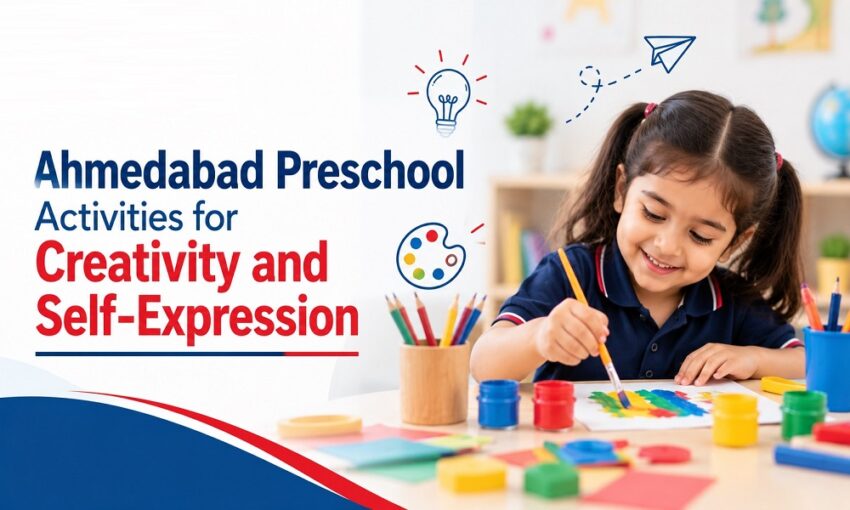
The Ahmedabad preschool years are an important stage for children to discover who they are, communicate their ideas, and understand the world around them. At this age, children naturally learn through movement, imagination, observation, conversation, play, and experimentation. For this reason, creative activities should be an integral part of early education rather than an occasional classroom exercise.
At Unitedworld International School (UIS), the Foundation Stage from Nursery to Class 2 follows an experiential, toy-based, and play-infused learning environment. The school’s UWI Joy of Discovery Framework draws on the principles of NEP 2020 and NCF Foundational Stage 2022 while incorporating global approaches inspired by Montessori, Reggio Emilia, and Waldorf education and remaining connected to Indian culture and values.
Why Creativity Matters in Preschool
Creativity allows young children to explore possibilities without always looking for one predetermined answer. When a child creates a drawing, builds something with blocks, invents a story, or participates in pretend play, they are making choices and communicating ideas.
Creative experiences can help children develop:
- Imagination and curiosity
- Communication skills
- Confidence and independence
- Fine-motor coordination
- Problem-solving abilities
- Collaboration and social interaction
- Emotional expression
UIS places creativity alongside critical thinking, collaboration, communication, and other 21st-century skills as part of its broader educational approach. Its academic philosophy also recognises aesthetic and creative expression as an important dimension of holistic development.
1. Art and Craft for Open-Ended Expression
Drawing, painting, colouring, clay work, paper crafts, and collage activities give preschoolers an opportunity to express ideas visually. Instead of expecting every child to create an identical picture, teachers can provide different materials and encourage children to decide what they want to make.
For example, children could be given leaves, paper, crayons, clay, and recyclable materials and asked to create something inspired by nature. One child may make a tree, another may create an animal, while another may develop an imaginary character.
The objective is not simply the finished artwork. The process encourages children to make decisions, experiment with materials, and explain their ideas.
UIS supports creative exploration through dedicated spaces and activities involving fine arts, pottery, music, dance, and other forms of creative expression.
2. Storytelling and Story Creation
Storytelling can turn communication into a creative experience. Teachers can read a short story and then ask children what they think happened, what a character might do next, or how they would change the ending.
Children can also create their own stories using picture cards, puppets, toys, or classroom objects.
This type of activity encourages children to:
- Build vocabulary
- Organise their thoughts
- Listen to others
- Develop imagination
- Express opinions
- Speak in front of a group
At UIS, communication is supported through stories, conversations, music, play, and interactive experiences during the Foundation Stage.
3. Music, Movement and Dance
Not every child expresses themselves primarily through words or drawing. Music and movement provide another way for children to communicate emotions and ideas.
Simple activities such as rhythm games, action songs, free movement, dance, and musical storytelling can encourage children to respond creatively. Teachers can play different types of music and ask children to move according to what they hear or imagine.
Such experiences also combine creativity with physical coordination and group participation. UIS incorporates creative and physical literacy through activities involving music, dance, sports, yoga, and movement-based learning.
4. Pretend Play and Role-Playing
Pretend play allows children to explore different situations from their own perspective. A classroom can become a shop, doctor’s clinic, restaurant, airport, garden, or storytelling stage.
Children might take different roles and create conversations themselves. This helps them understand social situations while developing communication, imagination, cooperation, and confidence.
Role-playing also gives teachers an opportunity to observe how children interact with others and express their thoughts.
5. Nature-Based Exploration
Nature provides endless opportunities for creative discovery. Children can collect leaves, observe insects, examine textures, water plants, identify colours, or create pictures using natural materials.
Activities such as gardening combine observation with responsibility. Children can see how plants grow, discuss what they notice, and record their observations through drawings or simple conversations.
UIS incorporates gardening and outdoor, hands-on experiences into its broader learning environment, reflecting its emphasis on learning through real-world experiences.
6. Building and Construction Activities
Blocks, puzzles, loose parts, and age-appropriate construction materials can encourage children to experiment with shapes, balance, size, and structure.
Rather than giving children a model to copy, teachers can pose an open-ended challenge: “Can you build a bridge for this toy?” or “Can you make a house where two animals can live?”
Children may try several solutions before finding one that works. This naturally combines creativity with early problem-solving and collaboration.
7. Encouraging Children to Explain Their Creations
One simple way to strengthen self-expression is to ask children about what they have created.
A teacher might ask:
- Tell me about your picture.
- Why did you choose these colours?
- What is happening in your story?
- How did you build this?
There is no requirement for children to provide a perfect answer. The purpose is to give them a safe opportunity to describe their thinking.
This approach connects creativity with communication and helps children understand that their ideas have value.
Creating a Supportive Preschool Environment
Creative learning works best when children feel comfortable making mistakes and trying again. A supportive Ahmedabad preschool can therefore provide opportunities for exploration without placing excessive emphasis on producing identical results.
UIS describes its educational philosophy as moving away from rote learning and early academic pressure during the Foundation Stage, instead creating an environment centred on exploration, play, experience, and whole-child development.
The school’s learning spaces also include creative and exploratory areas for activities such as dance, music, pottery, woodwork, fine arts, gardening, and hands-on workshops.
The Role of Parents in Creative Development
Creativity does not stop at the school gate. Parents can encourage self-expression at home by reading stories together, providing drawing materials, allowing children to help with simple tasks, listening to their ideas, and asking open-ended questions.
Instead of asking, “What is this supposed to be?” parents can ask, “Tell me about what you made.” This small change gives children more freedom to explain their thinking.
Conclusion
A meaningful Ahmedabad preschool experience should give children opportunities to explore, create, communicate, and discover their individual interests. Art, storytelling, music, pretend play, nature exploration, construction, and open-ended activities can turn everyday classroom experiences into opportunities for self-expression.
Unitedworld International School (UIS)‘s Foundation Stage reflects this philosophy through experiential, play-infused learning that aims to nurture children’s cognitive, social-emotional, physical, creative, and communication development.
When children are encouraged to ask questions, experiment with ideas, share their creations, and learn through experience, preschool becomes more than preparation for the next grade. It becomes a foundation for curiosity, confidence, creativity, and lifelong learning.