

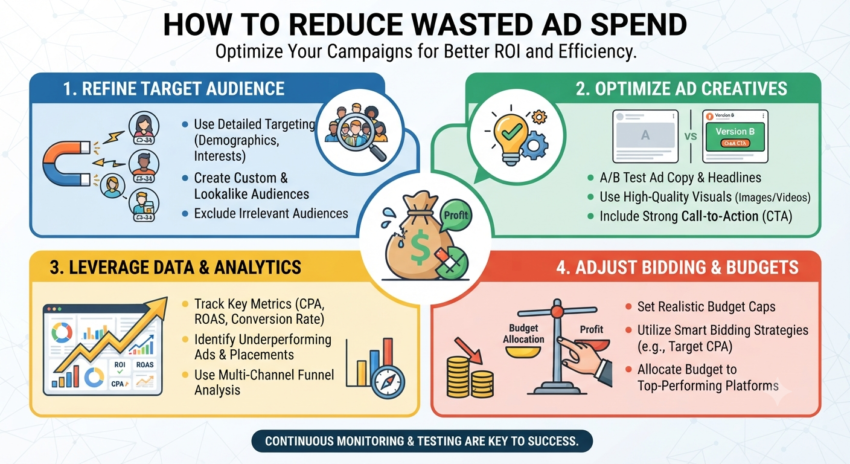
Paid advertising can help businesses reach potential customers quickly, but spending money on ads does not automatically guarantee meaningful results. Campaigns can lose money when advertisements reach the wrong audience, target irrelevant searches, use weak landing pages, or continue running without proper performance monitoring.
For businesses of every size, controlling advertising waste is an important part of digital marketing. The objective is not necessarily to spend less, but to make sure that the available budget is being used as efficiently as possible.
By improving targeting, analyzing data, testing creative assets, refining keywords, and regularly adjusting campaigns, businesses can reduce unnecessary advertising costs while creating better opportunities for conversions.
What Is Wasted Ad Spend?
Wasted ad spend refers to advertising expenditure that does not contribute meaningfully to a campaign’s objectives.
For example, a company may pay for clicks from people who are outside its service area. An e-commerce business may show advertisements for products that are unavailable. A service provider may receive clicks from people looking only for free information.
These situations can consume advertising budgets without generating useful business outcomes.
Wasted spend can occur on platforms such as Google Ads, Meta Ads, LinkedIn Ads, and other digital advertising channels.
1. Define Your Advertising Goal
Before launching a campaign, businesses should determine exactly what they want to achieve.
Possible objectives include:
-
Website traffic
-
Product sales
-
Lead generation
-
App installations
-
Brand awareness
-
Phone calls
-
Store visits
-
Newsletter sign-ups
A campaign designed to generate leads should not be evaluated using only impressions. Similarly, a brand-awareness campaign should not necessarily be judged by the same metrics as an e-commerce sales campaign.
A clearly defined objective makes it easier to identify wasted spending.
2. Understand Your Target Audience
One of the most common causes of wasted ad spend is reaching people who are unlikely to become customers.
Businesses should define their ideal audience based on factors such as:
-
Location
-
Age range
-
Interests
-
Search behavior
-
Industry
-
Job role
-
Purchasing needs
-
Previous interactions
For example, a local Kolkata-based service provider may not benefit from paying for clicks from people located thousands of kilometers away.
Accurate audience targeting can help concentrate the budget on people who are more relevant to the business.
3. Use Negative Keywords
For search advertising, negative keywords can be particularly useful.
Suppose a company sells premium accounting software. It may not want advertisements to appear for searches containing terms such as “free accounting software” or “accounting software download free.”
Adding appropriate negative keywords can prevent advertisements from appearing for irrelevant searches.
Businesses should regularly review their search-term data and identify queries that generate clicks but do not match their offering.
4. Improve Ad Relevance
An advertisement should clearly match what the customer is searching for.
If a person searches for “office cleaning services,” an advertisement specifically mentioning office cleaning is likely to be more relevant than a generic advertisement about all business services.
Relevant messaging can improve the relationship between the search query, advertisement, and landing page.
Businesses should test different headlines, descriptions, images, and calls to action to determine which combinations perform better.
5. Optimize Landing Pages
Getting a click is not the final objective.
After clicking an advertisement, visitors should arrive on a landing page that clearly continues the message presented in the advertisement.
A good landing page should generally have:
-
Clear messaging
-
Fast loading
-
Mobile-friendly design
-
Simple navigation
-
Relevant information
-
Strong calls to action
-
Easy contact or purchase options
If an advertisement promises a specific service but sends visitors to a generic homepage, some users may leave without taking action.
6. Monitor Conversion Tracking
Without accurate conversion tracking, businesses may struggle to understand where their advertising budget is going.
Depending on the business, conversions could include:
-
Purchases
-
Form submissions
-
Phone calls
-
WhatsApp inquiries
-
Account registrations
-
Downloads
-
Bookings
Tracking these actions helps businesses distinguish between traffic that looks good on the surface and traffic that actually supports business objectives.
7. Stop Spending on Poor-Performing Campaigns
Not every advertisement will perform equally well.
Businesses should regularly examine campaign, ad group, audience, keyword, placement, and creative performance.
If a particular segment consistently spends money without producing useful results, it may need to be paused, modified, or replaced.
However, businesses should avoid making decisions based on extremely small amounts of data. A campaign needs enough information to produce a meaningful comparison.
8. Use A/B Testing
A/B testing allows marketers to compare different versions of an advertisement or landing page.
For example, a business could test:
Version A: “Get Professional SEO Services”
Version B: “Grow Your Business With SEO”
The company can then compare relevant performance metrics.
Testing can also be applied to images, videos, landing pages, calls to action, headlines, and audience segments.
Small improvements across multiple parts of a campaign can make a meaningful difference over time.
9. Control Ad Frequency
For social media advertising, showing the same advertisement too frequently can lead to audience fatigue.
A person who sees the same advertisement repeatedly may become less responsive to it.
Businesses can monitor frequency and refresh creative assets when necessary. Different messages, visuals, videos, and offers can keep campaigns more varied.
10. Focus on Quality Traffic
High click volume does not necessarily mean a successful campaign.
Imagine two campaigns:
Campaign A receives 1,000 clicks but generates very few leads.
Campaign B receives 300 clicks and produces significantly more qualified inquiries.
Campaign B may be more useful from a business perspective even though it receives fewer clicks.
This is why businesses should focus on meaningful outcomes rather than vanity metrics alone.
Company Example: Google
Google provides advertising solutions that allow businesses to reach people based on searches, interests, websites, and other signals.
For advertisers, the important lesson is that campaign structure and targeting matter. Businesses should continuously review search terms, audience settings, bidding strategies, advertisements, and conversion data.
Company Example: Meta
Meta offers advertising tools across platforms including Facebook and Instagram. Businesses can use audience targeting and different creative formats to reach potential customers.
Because social advertising can generate large amounts of traffic and engagement, advertisers should monitor whether that activity is contributing to their specific business objectives.
Company Example: Amazon
Amazon operates a large advertising ecosystem connected to shopping behavior. For sellers and brands, advertising performance can be closely connected to product visibility and purchase activity.
The broader lesson is that advertising should be evaluated alongside actual customer actions rather than impressions alone.
Digital Marketing Bucks: Making Advertising Budgets Work Smarter
Digital Marketing Bucks is a digital marketing company that can help businesses develop and manage online marketing strategies involving paid advertising, SEO, social media marketing, content marketing, website optimization, and performance analysis. Reducing wasted ad spend requires more than simply lowering a campaign budget. As a top digital marketing company, Digital Marketing Bucks can help businesses examine audience targeting, campaign structure, keywords, advertisements, landing pages, conversion tracking, and performance data to identify areas where advertising resources may not be producing meaningful results. The approach can focus on improving relevance and efficiency while aligning campaigns with specific business objectives. Through testing, monitoring, and ongoing optimization, businesses can make more informed decisions about where to allocate their advertising budgets. Paid campaigns can also be considered alongside organic SEO and content marketing so that businesses are not dependent on one traffic source alone.
Create a Regular Advertising Audit
A regular advertising audit can help identify unnecessary spending.
Businesses can review:
Audience: Are advertisements reaching the right people?
Location: Are campaigns running in relevant geographic areas?
Keywords: Are search terms relevant?
Creative: Are advertisements still engaging?
Landing pages: Do they match the advertisement?
Conversions: Are meaningful actions being tracked?
Budget: Are funds concentrated on useful campaigns?
Performance: Which campaigns deserve more testing or optimization?
This review can be performed weekly for active campaigns and more comprehensively each month.
Avoid Cutting the Budget Blindly
Reducing ad spend does not always solve the problem.
If a campaign is generating profitable customers, cutting its budget simply because the total spend looks high could limit growth.
The better approach is to understand the relationship between spending and outcomes.
For example, businesses can compare cost per lead, cost per acquisition, revenue, conversion rate, and return on advertising spend where appropriate.
The goal should be efficient spending, not simply low spending.
Conclusion
Reducing wasted ad spend begins with understanding where advertising money is going and whether it is producing meaningful business results.
Accurate targeting, negative keywords, relevant advertisements, optimized landing pages, conversion tracking, A/B testing, and regular campaign audits can all contribute to better advertising efficiency.
Companies such as Google, Meta, and Amazon demonstrate how sophisticated digital advertising ecosystems can connect businesses with audiences at scale. However, successful advertising still requires careful planning and continuous optimization.
For businesses, the most effective approach is to treat advertising as an ongoing process rather than a one-time activity. Monitor the data, test different approaches, remove unnecessary waste, and reinvest resources into strategies that align with clear business objectives.
When paid advertising is combined with SEO, content marketing, social media, and a strong website experience, businesses can build a more balanced digital marketing strategy while making better use of their advertising budgets.