

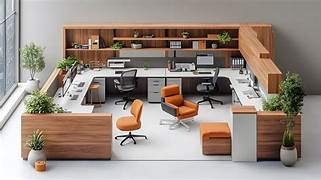
Modern homes, offices, institutions, and commercial spaces require furniture that can adapt to changing needs while maintaining functionality and visual appeal. Modular furniture companies provide flexible furniture systems designed around available space, storage requirements, working patterns, and interior concepts. These solutions can include workstations, wardrobes, modular kitchens, cabinets, shelving, reception furniture, storage units, and other customizable furniture systems.
The principles highlighted in 10 Must-Have Features in a Well-Designed Corporate Office are also relevant to modular furniture planning. Ergonomic design, efficient storage, organized layouts, technology integration, and flexibility can help furniture support productive and comfortable environments. Modular systems make it possible to incorporate these requirements while maintaining a coordinated appearance.
Customized Modular Furniture Solutions
One of the main advantages of modular furniture is its flexibility. Companies can develop furniture configurations according to room dimensions, functional requirements, storage needs, preferred materials, and design preferences.
Individual components such as cabinets, shelves, worktops, drawers, partitions, and storage units can be combined to create furniture suited to a particular space. This makes modular solutions suitable for both compact interiors and larger projects.
Efficient Use of Space
Modular furniture can help make better use of available floor and wall space. Vertical storage, corner units, integrated cabinets, and compact workstations can be incorporated into a planned layout.
In residential spaces, modular furniture can optimize kitchens, bedrooms, living rooms, studies, and utility areas. In workplaces, modular workstations, storage systems, meeting tables, and partitions can be configured according to the floor plan.
Modular Office Furniture
Offices increasingly require furniture that supports individual work, collaboration, organization, and employee comfort. Modular office furniture can be arranged into different configurations according to team size and workplace requirements.
Workstations, desks, pedestals, storage cabinets, partitions, conference tables, and reception units can be coordinated as part of one furniture system. Industry directories list modular furniture manufacturers and suppliers serving office and commercial applications in India.
Residential Modular Furniture
Modular furniture is also suitable for residential interiors because it can be planned around individual room dimensions and lifestyle requirements.
Popular applications include:
- Modular kitchens
- Bedroom wardrobes
- TV units
- Study tables
- Home office furniture
- Bookshelves
- Shoe cabinets
- Storage units
- Display cabinets
- Utility furniture
Different finishes, hardware options, colours, and internal configurations can be combined to create a consistent interior throughout a home.
Material Selection
The choice of material affects the durability, appearance, maintenance, and performance of modular furniture. Depending on the application, companies may work with plywood, MDF, engineered boards, laminates, acrylic finishes, veneers, metal, and glass.
Material selection should take into account expected usage, moisture exposure, cleaning requirements, durability, and aesthetic preferences.
Precision Manufacturing
Modern modular furniture production can use precision cutting, edge-banding, drilling, automated machinery, and controlled finishing processes. These techniques help maintain consistency between individual components.
Large manufacturers may operate dedicated production facilities to handle substantial volumes while maintaining standardized specifications. Spacewood, for example, describes its large-scale in-house manufacturing capabilities for modular furniture.
Ergonomic Design
Ergonomics is especially important for office and institutional furniture. Workstations and desks should provide suitable working heights, comfortable movement, accessible storage, and sufficient workspace.
Modular systems can incorporate cable management, privacy panels, integrated storage, and different workstation configurations to support varied working styles.
Integrated Storage
Storage can be incorporated directly into modular furniture to keep spaces organized. Drawers, cabinets, shelves, pedestals, lockers, and overhead units can be combined with desks and workstations.
In homes, integrated storage can provide dedicated areas for clothing, kitchenware, books, documents, appliances, and other everyday items.
Flexible and Reconfigurable Furniture
A major advantage of modular furniture is adaptability. Businesses may need to add workstations as teams expand, while residential users may require additional storage or different furniture arrangements over time.
Modular components can often be rearranged, expanded, replaced, or combined with new units. This makes them useful for spaces where requirements are likely to change.
Commercial and Institutional Applications
Modular furniture companies can provide solutions for a wide range of environments, including:
- Corporate offices
- Educational institutions
- Healthcare facilities
- Retail stores
- Hotels
- Showrooms
- Libraries
- Training centres
- Reception areas
- Commercial workspaces
For larger projects, standardized furniture systems can help maintain consistent dimensions, finishes, and functionality across multiple areas.
Design, Manufacturing, and Installation
A complete modular furniture project involves more than manufacturing. Accurate measurements, design development, material selection, production, delivery, installation, and final adjustments all contribute to the final result.
Companies that combine design, manufacturing, and installation can coordinate these stages as one process. Some established modular furniture companies describe integrated design-to-installation services as part of their offering.
Benefits of Modular Furniture Companies
Working with professional modular furniture companies can provide:
- Customized furniture configurations
- Efficient space utilization
- Flexible layouts
- Integrated storage
- Contemporary designs
- Ergonomic solutions
- Consistent manufacturing
- Scalable furniture systems
- Coordinated finishes
- Easier maintenance and replacement
- Residential and commercial applications
- Adaptability for future requirements
The Indian modular furniture sector includes companies serving residential, office, hospitality, retail, and institutional requirements, with manufacturers offering both standardized and customized solutions.
Conclusion
Modular furniture companies provide adaptable solutions for modern interiors where functionality, space efficiency, durability, and design all matter. From home kitchens, wardrobes, and storage systems to office workstations, institutional furniture, retail fixtures, and commercial interiors, modular furniture can be configured around different requirements.
By combining suitable materials, precision manufacturing, ergonomic planning, integrated storage, and flexible configurations, modular furniture can create more organized and efficient spaces. Its adaptable nature also makes it suitable for interiors that need to evolve as user requirements change.