

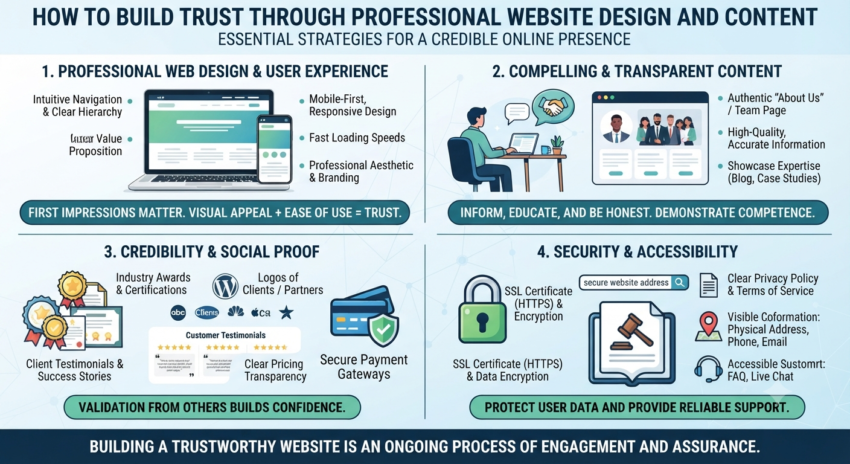
A website is often the first major interaction a potential customer has with a business. Before making a purchase, requesting a service, or contacting a company, people frequently visit its website to decide whether the business appears reliable and professional.
This makes website design and content more than visual or informational elements. Together, they can influence how visitors perceive a company’s credibility, expertise, and attention to detail.
A professional website does not necessarily need an expensive design or complicated features. It needs to be clear, trustworthy, easy to navigate, useful, and consistent with the company’s brand. When thoughtful design is combined with accurate and helpful content, businesses can create an online experience that encourages visitors to feel more confident.
Why Website Trust Matters
Customers have many choices online. If a website looks outdated, contains unclear information, loads slowly, or makes it difficult to find contact details, visitors may hesitate to continue.
Trust reduces uncertainty.
A customer wants to know whether a company is legitimate, whether its products or services meet expectations, and whether the business will respond if something goes wrong.
A professional website can help answer these concerns before a customer ever speaks with a representative.
Start With a Clean and Professional Design
The visual appearance of a website creates an immediate impression.
A clean layout, consistent typography, appropriate spacing, high-quality images, and a well-organized navigation system can make a website easier to understand.
Businesses should avoid filling every section with excessive graphics, animations, or promotional messages. A simpler design can often communicate professionalism more effectively.
The design should also reflect the company’s industry. A technology company may use a modern digital aesthetic, while a professional consultancy may benefit from a more structured and formal presentation.
Make Navigation Simple
Visitors should not have to search extensively to find important information.
A website’s main navigation should clearly guide users toward pages such as:
-
About the company
-
Products or services
-
Pricing, where appropriate
-
Contact information
-
Frequently asked questions
-
Resources or blog
-
Customer support
Logical navigation improves the user experience and can also make it easier for search engines to understand the website’s structure.
Use Clear and Honest Content
Professional design can attract attention, but content helps establish credibility.
Website copy should explain what the company does, who it serves, what problems it solves, and what customers can expect.
Avoid making unrealistic promises or using exaggerated claims that cannot be supported.
For example, instead of simply stating that a company is “the best,” explain what makes its service valuable. Businesses can discuss experience, processes, areas of expertise, customer results where verifiable, or the specific benefits they provide.
Specific information generally feels more credible than vague promotional language.
Show Real People and Business Information
A website becomes more relatable when visitors can understand who is behind the business.
An About Us page can introduce the company’s background, team, mission, values, and areas of expertise.
Where appropriate, businesses can also provide legitimate business information such as an office location, phone number, professional email address, registration details, or other relevant information.
Transparency can make visitors more comfortable when deciding whether to contact or purchase from a business.
Include Genuine Customer Reviews
Customer feedback can provide valuable social proof.
Businesses can display genuine reviews, testimonials, case studies, or customer stories that reflect real experiences.
A strong testimonial is more useful when it provides specific information rather than simply saying that a company is “great.”
For example, a customer could describe the problem they faced, the service they received, and the outcome.
Businesses should never create fake reviews or misleading testimonials. Authenticity is essential to building long-term trust.
Create Useful Educational Content
A blog or resource section can help businesses demonstrate knowledge within their industry.
For example, a digital marketing company could publish articles about SEO, social media strategy, website optimization, and online advertising.
A financial services company could publish educational information about budgeting or financial planning.
Companies such as HubSpot have built strong digital reputations partly through extensive educational resources that help audiences understand marketing and business topics.
Useful content can demonstrate expertise while giving visitors additional reasons to engage with the brand.
Keep Branding Consistent
Trust can also be strengthened through visual consistency.
A business should maintain a recognizable combination of logo, colors, typography, imagery, and communication style across its website and other digital channels.
If the website uses one brand identity while social media pages use completely different designs and messaging, visitors may become uncertain about whether they are dealing with the same organization.
Consistent branding helps create familiarity and makes a business easier to recognize.
Make the Website Mobile-Friendly
A professional website must work well on smartphones and tablets as well as desktop computers.
Visitors should be able to read text, view images, navigate menus, complete forms, and click buttons without unnecessary difficulty.
Businesses should regularly test their websites on different screen sizes.
Mobile usability is particularly important because users may discover a company through social media, search engines, advertisements, or messaging platforms while using their phones.
Protect Customer Information
Security is another important component of online trust.
Businesses that collect personal information through contact forms, registrations, payments, or other interactions should take appropriate measures to protect that information.
Websites should use HTTPS and reputable payment or form-processing systems where applicable.
Clear privacy information can also help visitors understand how their information is collected and used.
Trust should not be treated only as a design concept. It also involves responsible handling of customer information.
Make Contact Information Easy to Find
A customer should not have to visit five different pages to find a way to contact a company.
Businesses should make relevant contact options visible and easy to access.
Depending on the business, these may include a phone number, email address, contact form, business location, social media profiles, or support options.
A clear contact process can reduce hesitation and make it easier for interested visitors to take the next step.
Digital Marketing Bucks: Building Trust Through Digital Strategy
Digital Marketing Bucks is a digital marketing company focused on helping businesses improve their online visibility, digital communication, and customer engagement. Its services can include SEO, content marketing, social media marketing, website optimization, paid advertising, local SEO, lead generation, and digital strategy.
As a top digital marketing company, Digital Marketing Bucks recognizes that website design and content work together to shape how customers perceive a brand. A visually attractive website needs useful information, while strong content needs a professional platform where visitors can easily access it.
Digital Marketing Bucks can help businesses develop digital strategies that combine professional website presentation, search-friendly content, clear messaging, conversion-focused layouts, and audience-focused communication. The approach can be adapted to different industries, business sizes, marketing objectives, and customer groups.
The goal is to help businesses establish a digital presence that is not only visible but also credible, informative, and easy for potential customers to engage with.
Learn From Recognizable Digital Brands
Many established companies demonstrate how consistent design and useful content can strengthen brand recognition.
Apple is widely known for maintaining a clean and consistent digital presentation. Canva combines an accessible visual identity with extensive educational resources. Adobe supports its products with tutorials, creative resources, and community content.
The lesson for smaller businesses is not to copy these companies’ designs. Instead, businesses can learn the importance of consistency, clarity, useful information, and customer-focused experiences.
Keep Content Updated
Trust can decline when website information becomes outdated.
Businesses should periodically review important pages, including service descriptions, team information, pricing details, contact information, blog posts, and FAQs.
Old statistics, broken links, outdated product information, and expired offers should be corrected or removed.
Regular updates show that a business pays attention to its digital presence and wants customers to receive accurate information.
Conclusion
Professional website design and high-quality content can work together to create a stronger foundation of customer trust.
A clean design makes information easier to understand. Clear navigation improves usability. Accurate content demonstrates professionalism. Genuine reviews provide social proof. Helpful resources demonstrate expertise. Mobile optimization and security improve the overall customer experience.
Businesses should remember that trust is built through many small details rather than one design feature.
With a well-planned digital strategy and support from a company such as Digital Marketing Bucks, businesses can create websites that not only look professional but also communicate credibility, provide genuine value, and encourage visitors to take the next step with confidence.