

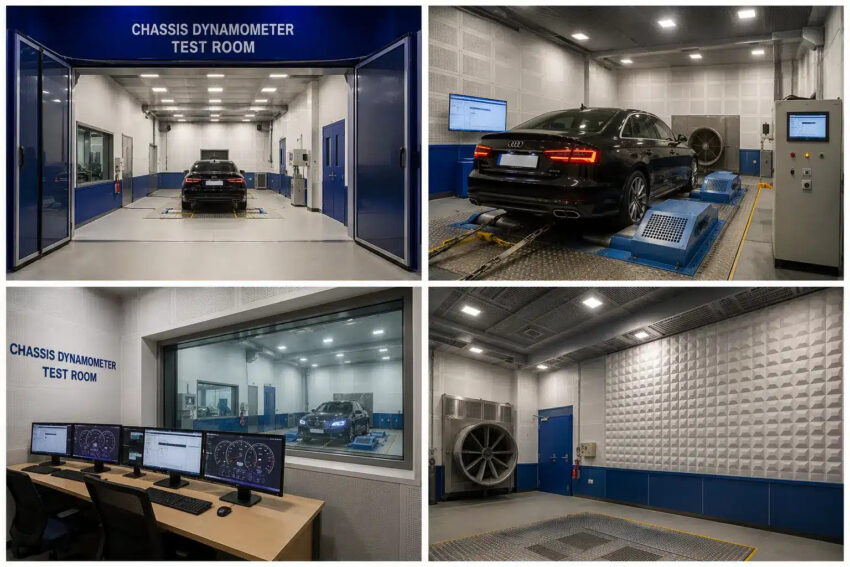
Every vehicle you see on the road has spent hours running in place somewhere. No traffic, no weather, just a set of rollers and a lot of sensors. That is the job of a Chassis Dynamometer Test Room, and getting its design right decides whether your test data can be trusted.
What Is a Chassis Dynamometer Test Room?
This facility is an enclosed, controlled space where a complete vehicle is driven on rollers instead of a road. The rollers simulate load, speed and resistance, so engineers can measure power output, fuel use, emissions and drivability under repeatable conditions. Cars, light trucks, buses and heavy commercial vehicles can all be tested this way.
How the Testing Actually Works
The vehicle’s driven wheels sit on the rollers, and the vehicle is strapped down for safety. As a driver or an automated system follows a speed pattern, the dynamometer applies resistance that mimics hills, wind and rolling friction. Sensors capture torque, speed, temperature and exhaust data. Because the vehicle stays put, tests can run for hours without road variables.
Design Features That Matter
A good room is much more than four walls around a machine. These are the points Ecotone Systems looks at first:
- Ventilation and exhaust handling: A running engine produces heat and fumes. Strong air exchange and a proper exhaust extraction path keep the space safe and the readings stable.
- Gas monitoring: CO and CO₂ sensors give an early warning when air quality drops, which protects the people working nearby.
- Noise control: Engines and rollers are loud. Without acoustic treatment, noise leaks into neighbouring areas and can disturb sound measurements too.
- Fire safety and structure: Fire-rated construction and a floor that carries heavy vehicle loads are non-negotiable.
- Room size: The room should fit your largest vehicle comfortably, with space for technicians, cooling fans and equipment.
Why Acoustics Deserve a Seat at the Table
Many teams plan the dynamometer first and think about sound later. That order causes headaches. Ecotone Systems builds acoustic and test-room solutions for industrial users, and the lesson from that work is simple: noise, airflow and structure should be planned together.
Common Mistakes to Avoid
Undersizing is the most frequent one. Vehicles get longer, wider and heavier over time, and a room built too tight quickly becomes a limit. Another slip is ignoring service access. If technicians cannot reach the vehicle easily, test cycles slow down. Finally, skipping a proper fresh-air supply makes the room hot, and heat changes results.
Questions to Ask Before You Build
Start with your vehicle range. Which types will you test now, and which might you add in five years? Then look at your site, including ceiling height, power supply, nearby offices and local safety norms. Ecotone Systems can build a Chassis Dynamometer Test Room around those answers, with sizing customised to your vehicles rather than forced into a standard template.
Choosing the Right Partner
Look for a manufacturer that handles design, fabrication and installation under one roof. Ask to see completed rooms, ask how they handle ventilation and noise, and ask what support follows after commissioning. Ecotone Systems brings engineering depth in acoustics, ventilation and modular construction, which is exactly the mix a test facility needs.
Final Thoughts
A well-planned Chassis Dynamometer Test Room gives you accurate data, safer working conditions and a facility that grows with your product line. Involve acoustic and ventilation specialists early and size for the future. If you are exploring options, talk to Ecotone Systems about what your Chassis Dynamometer Test Room should look like.