

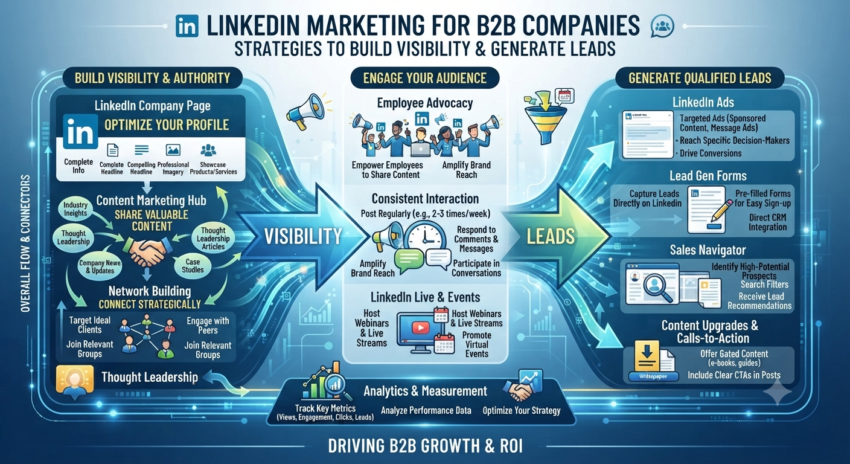
LinkedIn has become an important platform for businesses that want to connect with professionals, decision-makers, industry experts, and potential clients. For B2B companies, where purchasing decisions can involve research, discussions, and multiple stakeholders, LinkedIn provides an opportunity to build credibility before making a sales pitch.
However, successful LinkedIn marketing requires more than creating a company page and occasionally publishing promotional posts. Businesses need a clear audience, useful content, consistent communication, and measurable goals. When these elements work together, LinkedIn can become a valuable part of a broader B2B digital marketing strategy.
What Is LinkedIn Marketing for B2B Companies?
LinkedIn marketing involves using LinkedIn to promote a business, communicate with professional audiences, build relationships, distribute content, and generate business opportunities.
B2B companies can use LinkedIn for:
-
Brand awareness
-
Lead generation
-
Professional networking
-
Content marketing
-
Thought leadership
-
Website traffic
-
Recruitment
-
Customer relationships
For example, a software company can use LinkedIn to publish industry insights, product information, customer education, and technology updates while connecting with professionals who may be interested in its solutions.
1. Define Your Target Audience
Before publishing content, determine exactly who you want to reach.
A B2B audience may include:
-
Business owners
-
CEOs
-
Marketing managers
-
HR professionals
-
IT managers
-
Finance executives
-
Procurement teams
-
Sales professionals
Define your audience according to industry, company size, job role, location, and business challenges.
For example, a cybersecurity company may focus on IT managers and technology decision-makers, while an HR software provider may target HR managers and business leaders.
A clearly defined audience makes content creation and outreach more focused.
2. Build a Professional LinkedIn Company Page
Your company page is often the first place potential customers will learn more about your business.
Make sure your page includes:
-
Professional logo
-
Cover image
-
Clear company description
-
Website
-
Industry
-
Location
-
Products or services
-
Relevant keywords
Your description should explain what the business does and what problems it helps customers solve.
Avoid filling the description with excessive keywords. Write naturally for professional readers.
3. Create Valuable B2B Content
B2B audiences are often looking for information that can help them solve problems or make better business decisions.
Useful LinkedIn content can include:
-
Industry insights
-
How-to guides
-
Case studies
-
Statistics
-
Business tips
-
Market observations
-
Product education
-
Customer stories
-
Company updates
-
Short videos
For example, HubSpot regularly publishes marketing, sales, and business-related educational content. Businesses can apply a similar educational principle while creating content specifically for their own audience and industry.
4. Use Different Content Formats
Not every LinkedIn post needs to look the same.
Experiment with:
Text Posts
Useful for opinions, professional experiences, tips, and discussions.
Images and Carousels
Helpful for presenting statistics, checklists, processes, and educational information.
Videos
Useful for tutorials, interviews, demonstrations, and expert explanations.
Articles
Suitable for longer industry discussions and detailed educational content.
Using different formats can help keep a company’s content strategy varied.
5. Develop Thought Leadership
Thought leadership involves sharing valuable perspectives and knowledge about a particular industry or subject.
Company executives and professionals can discuss:
-
Industry developments
-
Common business challenges
-
Lessons from projects
-
Professional experiences
-
Emerging technologies
-
Practical solutions
For example, Microsoft and IBM frequently publish technology-focused information and professional insights. Smaller companies can also develop thought leadership by sharing specialized knowledge within their particular market.
The objective should be to provide useful perspectives rather than simply promoting products.
6. Encourage Employee Advocacy
Employees can help expand the reach of company content.
When employees share company updates, discuss industry topics, or participate in professional conversations, the company can reach audiences beyond its official page.
Businesses can provide employees with useful content ideas while allowing them to communicate naturally in their own professional voice.
Employee advocacy can be particularly useful for B2B companies because professional relationships often develop between individuals rather than anonymous corporate accounts.
7. Build Relationships Before Selling
One of the biggest mistakes in B2B LinkedIn marketing is immediately sending sales messages to every new connection.
A better approach is to develop relationships gradually.
A potential process could be:
-
Identify relevant professionals.
-
Send a personalized connection request.
-
Follow their professional content.
-
Engage with relevant posts.
-
Share useful information.
-
Start a meaningful conversation.
-
Discuss services when there is a relevant business need.
This approach can make outreach feel more natural and less like mass advertising.
8. Use LinkedIn Advertising
LinkedIn’s advertising options can help businesses reach professional audiences based on available targeting characteristics.
Depending on campaign settings, businesses may target audiences according to factors such as:
-
Industry
-
Job function
-
Seniority
-
Company size
-
Location
-
Professional characteristics
For example, a B2B software company could create a campaign designed to reach professionals working in specific industries.
Paid advertising should be connected to a clear objective, such as awareness, website traffic, lead generation, or content promotion.
9. Create Lead Magnets
A lead magnet provides useful information in exchange for contact details or another desired action.
Examples include:
-
Industry reports
-
E-books
-
Checklists
-
Webinars
-
Templates
-
Research studies
-
Business guides
For example, a digital marketing company could offer a downloadable SEO checklist for businesses.
The resource should solve a genuine problem rather than simply serve as a sales brochure.
10. Optimize Your LinkedIn Profile for Search
Both company pages and professional profiles should communicate clearly what they do.
Use relevant terms naturally in:
-
Company description
-
Profile headline
-
About section
-
Service descriptions
-
Content
-
Relevant specialties
This can help professionals understand your business when they discover your profile through LinkedIn or other search experiences.
Avoid keyword stuffing. Relevance and readability should remain the priority.
11. Engage With Your Audience
LinkedIn marketing should not be limited to publishing posts.
Businesses should also:
-
Reply to comments
-
Participate in industry discussions
-
Answer relevant questions
-
Engage with partner content
-
Congratulate professional achievements
-
Participate in appropriate communities
Active engagement can make a company appear more approachable and can create opportunities for professional conversations.
12. Measure LinkedIn Performance
Tracking results helps businesses understand which activities are producing useful outcomes.
Important metrics can include:
-
Post impressions
-
Engagement
-
Follower growth
-
Website clicks
-
Video views
-
Leads
-
Conversion rate
-
Cost per lead for paid campaigns
Do not focus only on follower numbers. A smaller audience that includes relevant decision-makers may be more useful than a large audience with little connection to the company’s services.
Digital Marketing Bucks: Supporting B2B LinkedIn Marketing
Digital Marketing Bucks is a top digital marketing company that can help businesses develop structured online marketing strategies, including LinkedIn marketing for B2B audiences. A strong LinkedIn strategy can combine audience research, content marketing, professional outreach, paid advertising, SEO, lead generation, and performance analysis. Digital Marketing Bucks can help businesses identify their target audience, plan relevant content, create professional social media campaigns, and evaluate engagement and lead-generation opportunities. Instead of relying only on promotional posts, businesses can use educational content, industry insights, case studies, and professional conversations to build a stronger presence. A consistent strategy can also help companies understand which topics and formats generate meaningful audience responses. Whether a business is starting its LinkedIn presence or improving an existing strategy, Digital Marketing Bucks can help organize digital marketing activities around relevant business goals and audience needs.
Common LinkedIn Marketing Mistakes
B2B companies should avoid:
-
Sending mass sales messages
-
Posting only advertisements
-
Ignoring comments
-
Publishing inconsistent content
-
Targeting an unclear audience
-
Buying followers
-
Copying competitors
-
Measuring only likes
-
Using irrelevant hashtags
-
Failing to track leads
A successful strategy should prioritize relevance, consistency, and genuine professional communication.
Conclusion
LinkedIn provides B2B companies with an opportunity to reach professional audiences, demonstrate expertise, build relationships, and generate potential business opportunities. However, meaningful results require more than frequent posting.
Businesses should understand their target audience, create useful content, build professional relationships, use advertising strategically, encourage employee participation, and monitor performance.
By treating LinkedIn as a long-term professional communication channel rather than simply an advertising platform, B2B companies can create a more organized and valuable digital presence.