

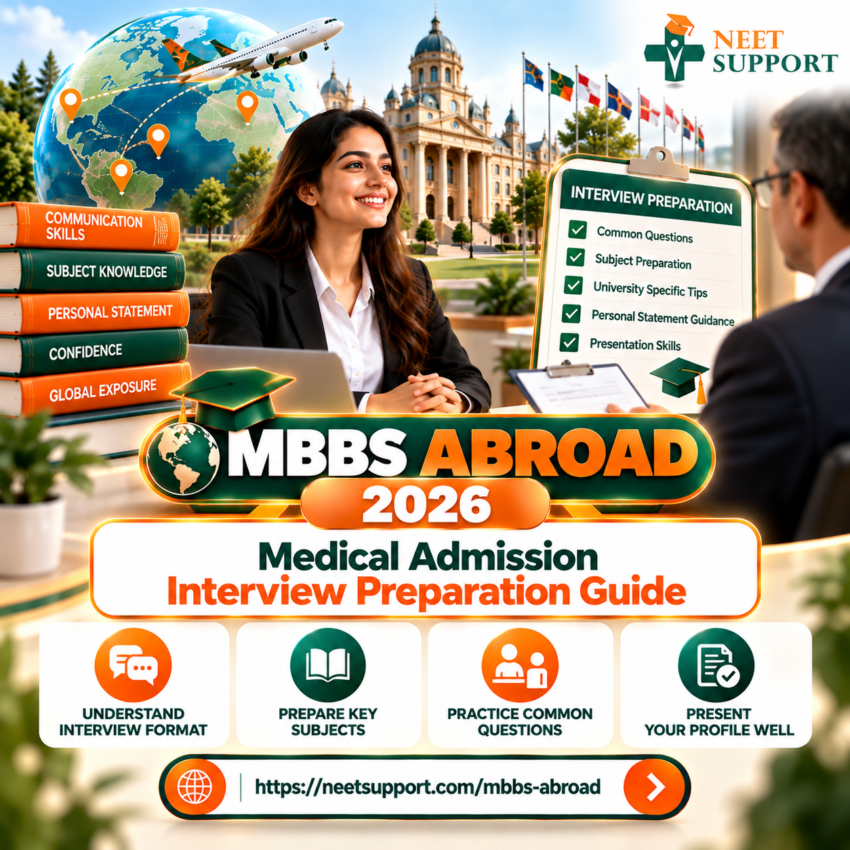
Planning MBBS Abroad 2026 can involve more than submitting documents and waiting for an admission decision. Depending on the university and admission process, students may need to communicate with admissions teams, participate in discussions or complete additional institutional requirements. Being prepared for possible admission interactions can help students present their academic background clearly and understand the university’s expectations.
An admission interview should not be treated as a test of memorized answers. It is an opportunity for the institution to understand the student’s academic background, motivation, communication skills and readiness for medical education. Students should also use the interaction to ask appropriate questions about the program.
Why Admission Preparation Matters
Medical education is a long-term commitment. Universities may want to understand whether applicants have carefully considered the demands of studying medicine.
Preparation can help students:
- Organize their academic information
- Explain their motivation clearly
- Communicate confidently
- Understand the selected program
- Answer questions without unnecessary confusion
- Ask meaningful questions about the university
The exact admission process varies between institutions, so students should always understand the specific requirements of the university they are applying to.
Does Every Medical University Conduct an Interview?
Not necessarily.
Admission procedures can differ based on the university, program, applicant category and destination.
Some institutions may rely primarily on academic documents and eligibility requirements, while others may include additional interactions.
Students should therefore avoid assuming that every MBBS Abroad application follows the same process.
Understand the University Before the Interview
One of the most important preparation steps is understanding the medical university.
Students should know basic information about:
- The medical program
- Curriculum structure
- Duration of study
- Teaching environment
- Practical learning
- Academic facilities
- Student support
- Accommodation arrangements
- General admission requirements
This helps students answer questions naturally and determine whether the program actually matches their expectations.
Common Questions Students May Face
If an interview is part of the admission process, questions may cover several areas.
Academic Background
Students may be asked about their recent studies, subjects and academic interests.
They should be able to explain their educational background clearly without exaggerating achievements.
Motivation for Studying Medicine
A student may be asked why they want to pursue medicine.
A strong response should be genuine and personal rather than copied from commonly used answers.
Interest in Studying Abroad
Students may be asked why they are considering medical education outside India.
They should be prepared to explain their academic reasoning and demonstrate that they have researched the responsibilities associated with studying abroad.
Understanding of Medical Education
Students may be asked what they expect from medical school.
It can be useful to discuss the importance of consistent study, practical learning, professional conduct and long-term commitment.
How to Answer Personal Questions
Students do not need to create complicated answers.
Clear and honest communication is generally more useful than trying to impress the interviewer with unnecessarily complex language.
For example, when discussing motivation, students can explain:
- What attracted them to medicine
- Which aspects of healthcare interest them
- What they understand about medical education
- What they expect from their future studies
Answers should reflect the student’s actual experiences and goals.
Avoid Memorized Responses
Memorized answers can sound unnatural when students are asked follow-up questions.
Instead of preparing complete speeches, students can prepare key points around important topics.
For example:
Question: Why do you want to study medicine?
A student can prepare three or four genuine points and explain them naturally.
This approach allows the student to respond to related questions without becoming dependent on a fixed script.
Be Ready to Discuss Academic Subjects
An admission interaction may include questions related to the student’s academic background.
Students should revise fundamental concepts in relevant subjects where appropriate.
The purpose is not to memorize every textbook chapter immediately before the interaction. Students should instead be comfortable discussing their recent academic studies and explaining basic concepts clearly.
Communication Is More Important Than Complex English
Students sometimes worry that they need advanced vocabulary to perform well in an interview.
In most academic interactions, clear communication is more useful than unnecessarily complicated language.
Students should focus on:
- Speaking clearly
- Listening carefully
- Answering the actual question
- Maintaining a professional tone
- Avoiding excessive filler words
- Asking for clarification when necessary
If a question is unclear, it is reasonable to politely ask the interviewer to repeat or clarify it.
Prepare Questions for the University
An admission interaction should not be treated as a one-way conversation.
Students can prepare relevant questions about:
- Curriculum
- Academic schedule
- Practical training
- Student support
- Accommodation
- Examination procedures
- Attendance requirements
- Academic resources
Asking specific questions can also help students understand whether the university matches their expectations.
Online Interview Preparation
If an interview is conducted online, students should test their setup before the scheduled time.
They should check:
- Internet connection
- Camera
- Microphone
- Lighting
- Background
- Device battery
- Interview platform
- Required documents
Students should join early enough to resolve basic technical problems before the interaction begins.
Documents Should Be Organized
Students should keep relevant academic and admission documents accessible during an interview if required.
Depending on the institution, these could include:
- Academic records
- Identification documents
- Application information
- Eligibility documents
- Other submitted materials
Students should ensure that the information they provide verbally matches the information in their application.
Professional Appearance and Behaviour
Students should approach an admission interaction professionally.
Simple habits can make communication easier:
- Dress appropriately
- Sit in a quiet location
- Maintain suitable eye contact during video calls
- Listen before answering
- Avoid interrupting
- Speak respectfully
- Remain honest when they do not know an answer
Students do not need an elaborate setup. A clean, quiet and professional environment is generally sufficient for an online discussion.
What If You Do Not Know an Answer?
Students should not invent information.
If they do not know the answer to a question, they can acknowledge it honestly and explain what they do understand.
For factual questions about the university, students can also state that they would like to verify the information through the appropriate institutional source.
Accuracy is more useful than pretending to know everything.
Common Interview Mistakes
Giving Overly Memorized Answers
Prepared points are useful, but scripted responses can make communication unnatural.
Making Unrealistic Claims
Students should discuss their actual academic background and experiences.
Knowing Nothing About the University
Applicants should understand the program they are applying for.
Speaking Without Listening
Students should answer the question that was actually asked.
Ignoring the Opportunity to Ask Questions
A well-prepared student can use the interaction to clarify important academic details.
Treating the Interview as the Entire Admission Process
An interview, where applicable, is only one part of the overall admission process.
How NEET Support Can Help
NEET Support can help students approach MBBS Abroad 2026 admission preparation in a structured way.
Students can prepare a checklist covering academic information, university research, admission requirements, possible interview questions and questions they want to ask the institution.
The aim is to help students understand their admission process and communicate their plans clearly rather than relying on memorized responses.
Students should always follow the specific admission instructions provided by their selected university.
Frequently Asked Questions
Do all MBBS Abroad universities conduct admission interviews?
No. Admission procedures differ between universities and programs. Students should confirm the process applicable to their application.
What should students prepare before an admission interview?
Students should understand their academic background, the selected medical program, university requirements and their own reasons for choosing medical education.
Should students memorize interview answers?
It is generally better to prepare key points rather than memorizing complete speeches. Natural and honest communication is easier to maintain during follow-up questions.
What if a student does not understand a question?
The student can politely ask the interviewer to repeat or clarify the question.
Can students ask questions during an admission interview?
If the interviewer provides an opportunity, students can ask relevant questions about the curriculum, academic environment, practical learning and student support.
How can NEET Support help with MBBS Abroad admission preparation?
NEET Support can help students organize their preparation around university research, admission requirements, academic information and possible interview discussions.
Final Takeaway
Preparing for a possible admission interaction can make MBBS Abroad 2026 planning more organized and less stressful. Students should understand their chosen university, review their academic background, prepare genuine responses and practise clear communication rather than memorizing scripts. They should also keep relevant documents organized and prepare meaningful questions about the medical program. Most importantly, students should provide accurate information and avoid exaggerating their qualifications or experiences. A thoughtful approach to admission preparation can help students communicate their academic goals clearly while gaining a better understanding of the institution they are considering for MBBS Abroad 2026.