
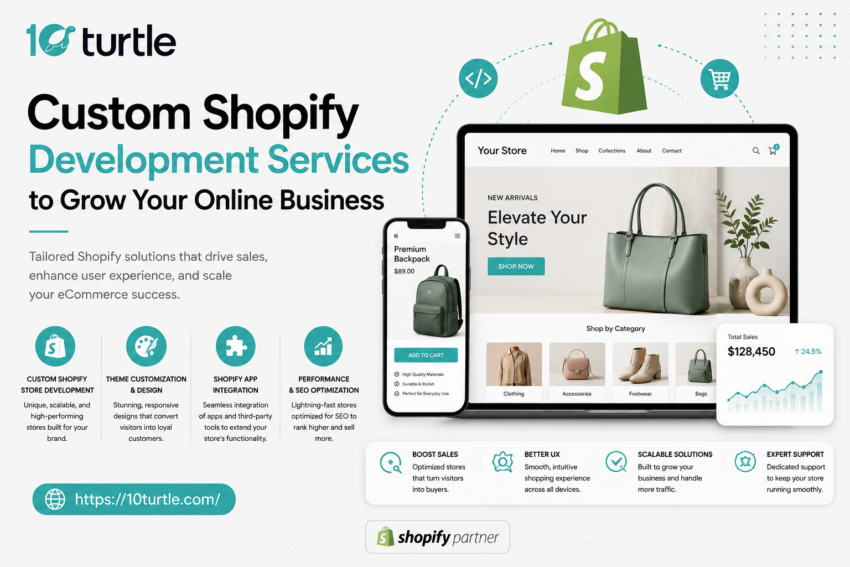
Running an online store on autopilot with a generic theme only gets a US brand so far. Once traffic grows, checkout friction, slow load times, and rigid templates start costing real revenue. That’s where custom Shopify development services change the game they let a business rebuild its store around its own workflows, catalog complexity, and customer expectations instead of forcing the business to adapt to Shopify’s defaults. At 10turtle, custom Shopify builds are approached as growth infrastructure, not just a design refresh, which is why brands across the US turn to a dedicated shopify development company rather than piecing together free themes and disconnected apps.
Why Off-the-Shelf Themes Stop Working
Pre-built themes are fine for a store’s first few months. But as US merchants scale adding subscriptions, multi-location inventory, or B2B wholesale the limitations show up fast: bloated app stacks, inconsistent branding, and checkout flows that don’t match how the business actually sells. A shopify ecommerce development company solves this by building only what the store needs: custom sections, faster-loading templates, and integrations that talk to each other instead of conflicting.
What Custom Shopify Development Actually Covers
A serious shopify store development engagement typically spans several layers of the store, not just the front-end theme:
- Custom theme development — unique layouts, mobile-first design, and Core Web Vitals optimization instead of a stock theme with a new color scheme
- App and API integrations — connecting CRM, ERP, shipping, and payment tools so data flows automatically instead of manual exports
- Headless and Hydrogen builds — for brands that need the storefront decoupled from the backend for speed or multi-channel selling
- Migration support — moving from Magento, WooCommerce, or BigCommerce onto Shopify without losing SEO equity or order history
- Ongoing performance audits — because a store that launches fast in month one can slow down by month six as apps and content pile up
This is the difference between generic shopify app development services and a build that’s actually mapped to a brand’s sales funnel.
What’s New in 2026: Shopify’s Spring Edition Changes the Development Conversation
Shopify’s Spring 2026 Edition shipped in June with over 215 updates, and several of them directly reshape what “custom development” means for US merchants right now. Shopify introduced a Universal Commerce Protocol that lets AI agents and platforms like Copilot, ChatGPT, and Perplexity interact with a store’s catalog, cart, and checkout data meaning product data structure is no longer just an SEO concern, it now determines whether a store even shows up in AI-driven shopping searches. Shopify also rebuilt Hydrogen to run on any stack including Next.js, and launched native A/B testing across storefront and checkout through a feature called Rollouts, removing the need for third-party testing apps that used to slow sites down.
For agencies and in-house teams, Shopify also rolled out an AI toolkit that lets developers manage stores directly from tools like Claude Code and VS Code, and B2B functionality previously locked behind Shopify Plus is now available on Basic, Grow, and Advanced plans. That last change alone opens wholesale and self-serve B2B ordering to a much larger segment of US small and mid-sized merchants who couldn’t justify Plus pricing before.
A good custom shopify development company stays ahead of these releases so a client’s store isn’t rebuilt every time Shopify ships a major edition it’s built to absorb these changes.
Why US Businesses Choose Dedicated Shopify Developers
Search interest around hire shopify developer and working with a shopify development company in usa has grown steadily as more merchants realize DIY builds create technical debt. Partnering with an experienced shopify ecommerce development company gives US businesses:
- Faster page speeds that directly reduce cart abandonment
- Cleaner code that doesn’t break every time a new app is installed
- A store built around US-specific needs sales tax logic, multi-state shipping rules, and holiday traffic spikes (Black Friday, Cyber Monday)
- A single point of accountability instead of juggling freelancers for theme, apps, and backend separately
E-E-A-T: Why Experience Matters in Shopify Development
Shopify development isn’t just about writing clean code it’s about having shipped stores that survive real traffic, real Black Friday loads, and real Shopify platform updates without breaking. An experienced shopify app development company brings pattern recognition that a first-time freelancer simply hasn’t built yet: knowing which third-party apps conflict with checkout extensibility, which theme architecture holds up under a product catalog of 10,000+ SKUs, and how to structure metafields so a store’s data stays clean as it scales. That accumulated experience not just technical ability is what separates a store that grows smoothly from one that needs a rebuild every 18 months.
Choosing the Right Shopify Development Partner
Not every shopify store development services provider operates the same way. Before signing on, US businesses should ask:
- Do they build custom themes from scratch, or customize existing ones?
- Can they show past work on stores of similar size and complexity?
- Do they offer post-launch support, or disappear after handoff?
- How do they handle Shopify’s frequent platform updates?
- Do they understand US-specific commerce needs tax nexus, multi-warehouse fulfillment, and state-level shipping regulations?
FAQs
1. How much does custom Shopify development cost?
Pricing varies by scope a custom theme build alone can range from a few thousand dollars to well beyond that for full headless or Hydrogen projects with multiple integrations. Ongoing app development and API work is typically quoted separately.
2. How long does a custom Shopify build take?
A standard custom theme project usually takes several weeks; complex builds involving migrations, custom apps, or headless architecture can take a few months depending on integration complexity.
3. Is custom Shopify development worth it for a small business?
If a store is still testing product-market fit, a customized existing theme is often enough. Once a business has consistent traffic and specific workflow needs, custom development typically pays for itself through better conversion rates and lower long-term app costs.
4. Can an existing Shopify store be redeveloped without losing SEO rankings?
Yes with a proper migration plan that preserves URL structure, redirects, and metadata, rankings can be maintained or even improved through better site speed.
5. What’s the difference between Shopify and Shopify Plus development?
Plus unlocks higher checkout customization and enterprise features, but Shopify’s 2026 updates have pushed several previously Plus-only capabilities, like expanded B2B tools, down to standard plans — narrowing the gap for growing merchants.
Final Thoughts
Custom Shopify development isn’t a one-time project it’s an ongoing investment that needs to keep pace with how fast Shopify itself is evolving. With AI-driven commerce, native testing tools, and expanded B2B access now built into the platform, US businesses that partner with an experienced shopify development company are better positioned to adapt quickly instead of scrambling to catch up. Whether the goal is a full custom theme, headless architecture, or ongoing app development, the right development partner turns Shopify’s platform updates into a growth advantage rather than a maintenance headache.