
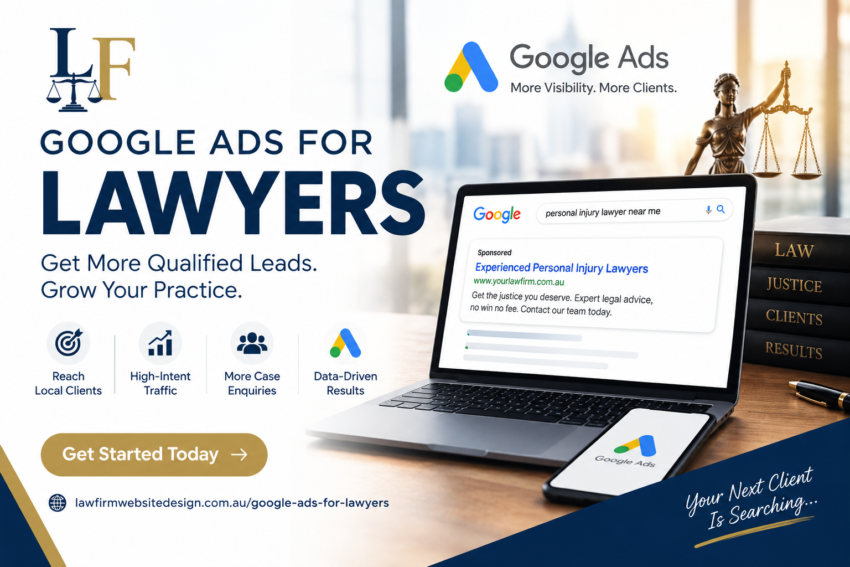
For Australian law firms, attracting new clients online requires more than simply having a website. Potential clients increasingly turn to Google when they need legal assistance, whether they are searching for a family lawyer, criminal defence solicitor, conveyancing service, personal injury lawyer, commercial lawyer or another specialist.
This is where Google Ads for law firms can provide a direct way to reach people who are actively searching for legal services.
Unlike organic SEO, which can take time to build momentum, Google Ads can place relevant paid search advertisements in front of potential clients when they make searches related to your services. However, successful legal PPC advertising is not simply about increasing the advertising budget. Campaign structure, search intent, ad relevance, landing pages, location targeting and conversion tracking all influence performance.
Why Google Ads Matters for Australian Law Firms
Legal searches often have strong commercial intent. Someone searching for “family lawyer Melbourne” or “criminal lawyer Sydney” may already be looking for a firm they can contact.
Google Ads allows law firms to target these types of searches and direct users to pages specifically designed around their needs.
For example, a law firm offering family law services could create campaigns around searches relating to divorce lawyers, parenting disputes, property settlements and family law consultations. Each campaign can then send visitors to a relevant service page rather than simply directing everyone to the firm’s homepage.
This relevance is important because Google evaluates factors such as expected click-through rate, ad relevance and landing page experience when assessing ad quality.
Target High-Intent Legal Searches
One of the biggest advantages of Google Ads for lawyers is the ability to focus on searches that demonstrate strong intent.
Broadly targeting terms connected with the legal industry can quickly consume an advertising budget without producing useful enquiries. A better strategy is to identify searches that closely relate to the firm’s actual services and ideal clients.
Location is also important for Australian practices. A firm serving clients in Brisbane does not necessarily need to compete for every legal search across Australia.
Campaigns can be structured around relevant locations such as Sydney, Melbourne, Brisbane, Perth or specific surrounding areas, depending on where the firm accepts clients.
Search intent should remain at the centre of the campaign. Someone searching for “what does a family lawyer do?” has a different level of intent from someone searching for “family lawyer near me”. Understanding this difference helps firms allocate their advertising budget more effectively.
Create Separate Campaigns for Different Practice Areas
A common mistake is putting every legal service into one Google Ads campaign.
A firm offering family law, criminal law, commercial law and property law has different audiences searching with different terminology. Each practice area deserves messaging that reflects its specific search intent.
For example, an advertisement targeting family law searches should discuss the firm’s family law services rather than using generic messaging about being a law firm.
Separate campaigns and tightly related keyword themes make it easier to create relevant advertisements and landing pages. Google itself recommends matching ad language closely with the user’s search and separating themes when different keywords cannot be effectively addressed by the same advertisement.
Build Landing Pages That Match the Advertisement
Getting someone to click an advertisement is only part of the process.
The next challenge is giving them a reason to contact the firm.
A dedicated landing page can be significantly more useful than sending every visitor to a generic homepage. If someone clicks an advertisement for family law services, the page should immediately explain the firm’s family law offering, who it helps, what the next step is and how the visitor can make contact.
The message should also remain consistent between the advertisement and landing page.
Google notes that landing page experience considers factors including relevance, usefulness, navigation and whether the page meets the expectations created by the advertisement.
This is where law firm website design becomes closely connected with paid advertising. A well-designed website should not only look credible; it should make it easy for prospective clients to understand the firm’s services and take the next step.
Make Your Ads Clear and Relevant
Legal clients usually want clarity.
An advertisement does not need exaggerated claims to attract attention. Instead, it should communicate the firm’s service, location and value clearly while encouraging an appropriate next step.
For example, messaging could focus on the relevant legal service, the locations served, consultation availability or the firm’s approach to helping clients.
Ad assets can also provide additional information such as phone numbers, locations and links to relevant pages. Google recommends using ad assets to make advertisements more informative and potentially improve visibility and click-through performance.
Measure More Than Clicks
Clicks can look impressive in a Google Ads report, but clicks alone do not generate clients.
Law firms should pay attention to what happens after someone visits the website.
Useful performance measurements can include completed enquiry forms, phone calls, consultation requests and other meaningful actions. The quality of those enquiries is also important.
For example, receiving 100 irrelevant enquiries may be less valuable than receiving 20 enquiries from people who genuinely require the firm’s services.
This is why digital marketing for lawyers should connect advertising data with actual business outcomes wherever possible.
Conversion tracking can help identify which campaigns, keywords and advertisements are contributing to meaningful actions. Over time, this information can guide budget allocation and campaign optimisation.
Use Negative Keywords to Reduce Wasted Spend
Not every search containing a legal keyword represents a potential client.
People may search for legal definitions, university assignments, free templates, jobs, courses or general information. Depending on the campaign, these searches may generate clicks without producing worthwhile enquiries.
Negative keywords can help prevent advertisements from appearing for irrelevant searches.
Regularly reviewing the actual search terms triggering advertisements can reveal opportunities to exclude searches that are unlikely to produce valuable leads.
This process is particularly important for competitive legal keywords, where an unnecessary click can represent a significant portion of an advertising budget.
Google Ads and SEO Should Work Together
Google Ads should not necessarily replace SEO.
A strong online strategy can combine paid search with SEO for lawyers, allowing a firm to target both immediate paid visibility and longer-term organic search opportunities.
Google Ads can help identify valuable search terms and user behaviour, while SEO can build organic visibility around important legal topics and services.
The firm’s website should support both channels. Service pages, useful legal content, location pages and strong calls to action can contribute to a broader digital strategy rather than being created solely for advertising.
Compliance Matters for Australian Law Firms
Legal advertising also needs to be handled carefully.
Australian legal practitioners are subject to advertising and professional conduct requirements. For example, the Law Society of NSW notes that legal advertising must not be false, misleading or deceptive, offensive or prohibited by law, and that firms must not create a false or misleading impression of specialist expertise.
Requirements can vary depending on the jurisdiction and circumstances, so law firms should ensure their advertising claims and website content comply with the rules applicable to their practice.
Avoid unsupported promises such as guaranteeing outcomes. Advertising should accurately represent the firm’s services and experience.
Why Website Design Can Affect Google Ads Performance
A successful PPC campaign can send qualified visitors to a website, but the website still needs to convert that traffic.
Slow pages, confusing navigation, weak calls to action or unclear service information can result in visitors leaving without making contact.
Landing pages should be mobile-friendly, easy to navigate and focused on the needs of prospective clients.
Google also highlights mobile experience and relevance as important aspects of ad quality and user experience.
How to Build a Better Google Ads Strategy
The strongest campaigns are rarely created once and left unchanged.
Search behaviour, competitors, costs and campaign performance can change over time. Regular testing can reveal which keywords, advertisements, landing pages and calls to action generate the most valuable results.
A practical approach is to start with the firm’s most important services and locations, create closely aligned campaigns, build relevant landing pages, track meaningful conversions and continually review search-term data.
The goal should not simply be to appear at the top of Google. The goal is to connect the right searcher with the right legal service and make the next step easy.
Final Thoughts
Google Ads for law firms can be a powerful acquisition channel for Australian legal practices when it is built around search intent, relevance and measurable business outcomes.
Successful campaigns require more than choosing expensive keywords and increasing bids. The advertisement, keyword, landing page and website experience need to work together.
For Australian law firms, combining Google Ads with strong Law Firm Website Design, SEO and broader digital marketing for lawyers can create a stronger online presence and provide multiple opportunities for prospective clients to discover and contact the firm.
The firms most likely to benefit are those that treat paid search as part of a complete digital strategy rather than simply another advertising expense.