
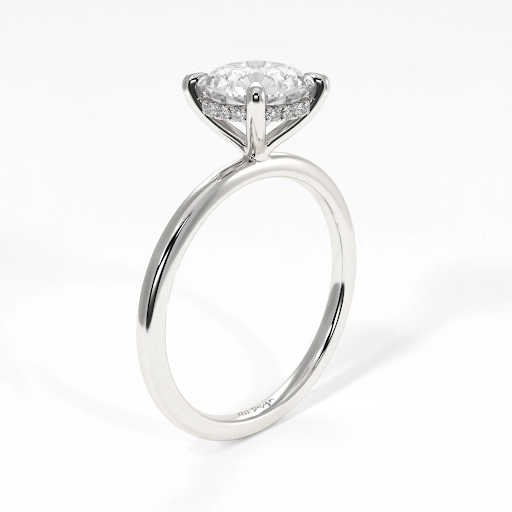
Engagement rings combine design, proportions, materials, and personal preference, so understanding the setting is an important part of choosing the right piece. Hidden halo engagement rings are particularly distinctive because their accent diamonds are positioned beneath the centre stone rather than surrounding it from above. This creates a subtle detail that becomes more visible when the ring is viewed from the side.
For anyone comparing engagement ring styles, learning how a hidden halo works can make it easier to evaluate centre stone shapes, setting height, maintenance, and compatibility with a wedding band. The design can provide additional sparkle while keeping the top view relatively clean and understated.
What Are Hidden Halo Engagement Rings?
A hidden halo is a ring of small accent diamonds placed underneath the centre stone, generally around the basket or gallery of the setting. Unlike a traditional halo, the accent stones are not positioned around the visible perimeter of the centre diamond.
From directly above, the ring can therefore retain the appearance of a solitaire. When viewed from the side or at an angle, the smaller diamonds catch the light and create an additional layer of sparkle. This side-profile detail is the defining characteristic of hidden halo engagement rings.
The setting is sometimes also described using terms such as secret halo, under-halo, or concealed halo. Although terminology can vary between jewellers, the basic concept remains the same: the accent stones are tucked below the main stone rather than displayed around its face.
How Does a Hidden Halo Differ From a Traditional Halo?
The biggest difference is the position of the accent stones.
A traditional halo surrounds the centre stone on the same general visual plane. The small diamonds are immediately visible when looking at the ring from above, creating a larger-looking outline around the centre stone.
A hidden halo sits lower in the setting. Its diamonds are primarily visible from the side, so they do not create the same obvious increase in face-up width.
This distinction makes hidden halo engagement rings useful for people who want additional detail without the prominent halo appearance. The centre stone remains the main visual focus while the setting provides a more intricate profile.
Which Diamond Shapes Work Well With a Hidden Halo?
Hidden halos can be designed around many centre stone shapes. The setting itself does not require one particular cut.
Popular possibilities include:
- Round brilliant
- Oval
- Cushion
- Emerald
- Pear
- Radiant
- Princess
The proportions of the hidden halo should generally complement the centre stone. For example, an elongated centre stone may benefit from an appropriately proportioned gallery, while a round stone can accommodate a more symmetrical circular arrangement.
The shape also affects how the ring appears from different angles. Since the hidden halo is primarily a side-profile feature, looking at the ring from several directions is useful before making a decision.
Why Consider a Hidden Halo Setting?
One advantage of this style is its balance between simplicity and detail. From above, the ring can maintain a relatively clean appearance, while the side reveals additional craftsmanship and sparkle.
Another consideration is visual hierarchy. Because the accent stones are concealed beneath the centre stone, they are less likely to compete with the main diamond when the ring is viewed face-on.
For people who appreciate details that are not immediately obvious, hidden halo engagement rings can offer a more understated alternative to a conventional halo.
However, the design is not automatically better than other settings. The right choice depends on personal taste, comfort, centre stone proportions, desired height, and how the ring will be worn.
What to Consider About Setting Height
A hidden halo requires enough space beneath the centre stone to accommodate the accent diamonds. As a result, the setting architecture and overall height deserve careful consideration.
A higher setting can make the side detail easier to see, but it can also affect how the ring feels during everyday activities. A lower-profile design may feel more practical for some wearers, although the available space for the hidden halo and wedding band must still be considered.
When comparing hidden halo engagement rings, ask to see the ring from the side as well as from above. The side profile reveals the relationship between the centre stone, halo, gallery, and band.
Choosing the Centre Diamond
The centre stone remains the focal point of the ring, so its quality and proportions should receive careful attention.
The traditional 4Cs—cut, colour, clarity, and carat weight—are commonly used to describe diamond characteristics. Cut is especially important because it influences how effectively a diamond interacts with light. Independent grading documentation can also help buyers understand the characteristics of a particular stone.
For laboratory-grown diamonds, grading organizations can also document characteristics such as colour, clarity, cut, carat weight, and the stone’s laboratory-grown origin.
The centre stone should therefore be evaluated independently of the setting. A visually attractive ring depends on how the diamond and setting work together rather than simply on the number of accent stones.
Can Lab-Grown Diamonds Be Used?
Yes. Laboratory-grown diamonds can be used in engagement rings, including designs incorporating hidden halos. They are diamonds rather than simulants such as cubic zirconia or moissanite, and their optical and physical properties are substantially comparable to naturally formed diamonds.
When considering laboratory-grown stones, buyers should still examine the same fundamental quality characteristics and review appropriate grading documentation.
People researching hidden halo engagement rings may therefore compare natural and laboratory-grown centre stones according to their priorities, including appearance, grading information, budget, and personal preferences.
What About Wedding Band Compatibility?
The engagement ring and wedding band should ideally be considered together. The position of the hidden halo, the width of the band, and the height of the centre setting can all affect how two rings sit next to each other.
Some designs allow a wedding band to sit closely against the engagement ring, while others may leave a small gap because of the shape or height of the setting.
If a close-fitting stack is important, ask to see the engagement ring paired with a suitable band before making a final decision. This can reveal spacing issues that are difficult to identify from photographs alone.
Maintenance and Everyday Wear
A hidden halo contains additional small stones, which means there are more areas where dust, oils, and residue can accumulate compared with a very simple solitaire.
Regular cleaning can help maintain the appearance of the accent stones. A gentle cleaning routine using appropriate jewellery-care methods can remove everyday buildup, while periodic professional inspection can help identify loose stones or worn settings.
The small accent diamonds should also be checked periodically because their size and position can make them less noticeable if a stone becomes loose.
Questions to Ask Before Buying
Before choosing hidden halo engagement rings, consider asking:
- How high will the centre stone sit above the finger?
- How is the hidden halo secured?
- Can the wedding band sit flush against the engagement ring?
- Which centre stone shapes work best with the setting?
- What metal is being used?
- How should the ring be cleaned?
- How frequently should the setting be inspected?
- Does the centre stone come with an independent grading report?
- Is the design suitable for everyday wear?
- Can the setting be customised if proportions need to change?
These questions help shift the decision from appearance alone toward long-term practicality.
Conclusion
Hidden halo engagement rings offer a distinctive combination of a clean face-up appearance and additional side-profile sparkle. By placing smaller diamonds beneath the centre stone, the design creates visual interest without the immediately visible frame associated with a traditional halo. For buyers comparing loose lab diamonds in Canada, laboratory-grown centre stones provide another option to consider when assessing the overall design, diamond characteristics, and personal priorities. Ultimately, the best engagement ring is one whose setting, centre stone, proportions, and everyday practicality align with the wearer’s preferences.