
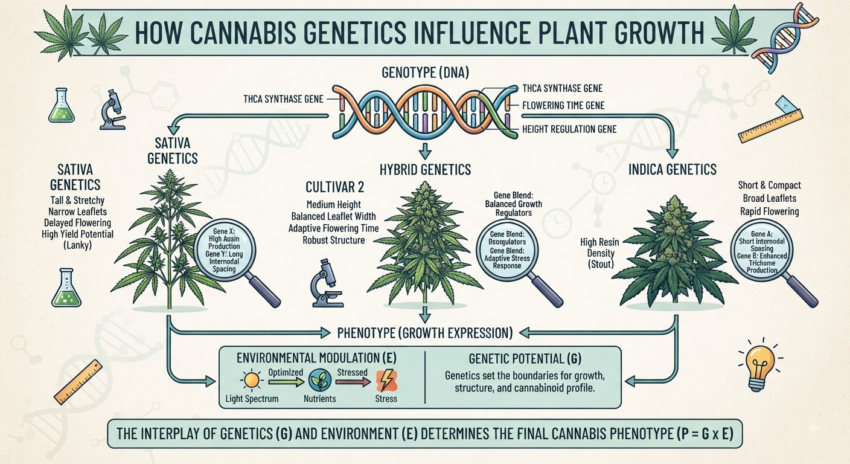
Cannabis genetics are one of the most important factors influencing how a cannabis plant develops. Before a seed or cutting enters a growing environment, its genetic makeup has already established much of its potential for growth, structure, flowering behavior, aroma, cannabinoid production, and environmental response.
While cultivation conditions can strongly influence the final result, genetics provide the foundation. Two cannabis plants grown under similar conditions can still develop differently because their genetic backgrounds are not identical.
Understanding cannabis genetics can therefore help consumers appreciate why different cultivars have different characteristics and why growers carefully select genetics before beginning a cultivation cycle.
What Are Cannabis Genetics?
Cannabis genetics refer to the inherited characteristics passed from parent plants to their offspring. Breeders select parent plants with desirable traits and use controlled breeding to develop new genetic combinations.
These inherited characteristics can influence traits such as:
-
Plant height
-
Branching structure
-
Leaf shape
-
Flowering time
-
Flower density
-
Cannabinoid profile
-
Terpene profile
-
Aroma and flavor
-
Environmental tolerance
-
Overall plant structure
Genetics do not guarantee a specific outcome. Instead, they establish a range of possibilities that can be influenced by the growing environment.
Genetics and Plant Structure
One of the most noticeable effects of genetics is plant structure.
Some cannabis cultivars naturally develop compact, bushy growth, while others may become taller and produce longer branches. Genetics can influence internodal spacing, branching patterns, leaf characteristics, and the overall shape of the plant.
This matters to growers because different plant structures may require different cultivation strategies.
For example, a naturally vigorous plant may need more space than a compact cultivar. Indoor growers in particular need to consider expected plant size when selecting genetics for a limited growing area.
Genetics Influence Flowering Time
Different cannabis genetics can have different flowering characteristics.
Some cultivars naturally finish flowering earlier, while others take longer to mature. Photoperiod-sensitive varieties generally respond to changes in day length, while autoflowering genetics have different flowering characteristics associated with their genetic background.
Flowering time can influence cultivation planning, particularly for commercial producers managing multiple varieties.
Outdoor growers may also consider local climate and seasonal conditions when evaluating genetics. A cultivar that performs well in one environment may not necessarily produce the same results somewhere with a very different growing season.
Genetics and Cannabinoid Profiles
Cannabinoids are another major area where genetics matter.
Cannabis plants can produce different concentrations and combinations of cannabinoids, including THC, CBD, CBG, and other minor cannabinoids. The genetic makeup of the plant contributes significantly to its cannabinoid-producing potential.
However, genetics alone do not determine the final cannabinoid profile. Environmental conditions, plant development, harvesting, drying, curing, and testing can also influence the characteristics of the finished product.
This is why consumers may see differences between products even when they are marketed under similar cultivar names.
The Connection Between Genetics and Terpenes
Terpenes are responsible for many of the aromas and flavors associated with cannabis.
Genetics play an important role in determining which terpene compounds a plant is capable of producing and in what proportions. This helps explain why one cultivar may have a citrus-like aroma while another may smell earthy, floral, pine-like, or spicy.
Commonly discussed cannabis terpenes include:
-
Myrcene
-
Limonene
-
Pinene
-
Caryophyllene
-
Linalool
-
Humulene
Growing conditions can affect terpene expression, but genetics establish much of the plant’s underlying potential.
Harvest timing, drying, curing, heat, light, and storage can also influence the terpene profile consumers ultimately experience.
Genetics and Environmental Adaptation
Cannabis genetics can influence how plants respond to their surroundings.
Different genetic lines may show different levels of tolerance to temperature changes, humidity, light conditions, and other environmental variables. Some may perform more consistently under particular conditions, while others may require more careful environmental management.
This is one reason experienced growers do not simply select genetics based on appearance or popularity.
They also consider whether the genetic line is suitable for their particular growing environment.
Genetics vs. Growing Environment
It is important to understand that genetics and environment work together.
A useful way to think about cannabis cultivation is:
Genetics provide the potential, while the environment influences how that potential is expressed.
A genetically promising plant can still perform poorly if it receives inadequate light, improper nutrition, unsuitable temperature, poor airflow, or inappropriate moisture management.
Likewise, excellent cultivation practices cannot completely change a plant’s genetic characteristics.
For example, a naturally compact cultivar is unlikely to develop exactly like a genetically tall, vigorous cultivar simply because both plants receive the same growing conditions.
Why Breeders Select Specific Traits
Cannabis breeders carefully select parent plants based on desirable characteristics.
A breeder may be interested in improving traits such as:
-
Aroma
-
Flavor
-
Plant structure
-
Flowering characteristics
-
Cannabinoid profile
-
Terpene expression
-
Yield potential
-
Environmental resilience
-
Consistency
Breeding can involve combining characteristics from different genetic lines and evaluating the resulting offspring.
The process can take considerable time because breeders need to evaluate plants across generations rather than relying on a single growing cycle.
Why Genetic Stability Matters
Genetic consistency is particularly important for commercial cannabis production.
If a genetic line produces highly inconsistent plants, growers may have difficulty maintaining uniformity across a crop.
More consistent genetics can make cultivation planning easier because plants may have more predictable growth characteristics.
However, even genetically similar plants can show differences because environmental conditions and cultivation practices are not perfectly identical.
This is why professional producers use standardized cultivation procedures and laboratory testing to monitor their products.
How Genetics Affect Cannabis Quality
When consumers talk about cannabis quality, genetics are only one part of the equation.
A high-quality genetic line still needs appropriate cultivation, harvesting, drying, curing, packaging, and storage.
Poor post-harvest handling can reduce aroma and freshness. Excessive heat or light exposure can affect certain compounds. Improper moisture management can negatively influence flower condition.
Therefore, consumers should look at the entire production process rather than assuming genetics alone determine quality.
Choosing Cannabis From Reputable Sources
Consumers interested in exploring different cannabis genetics should purchase products through licensed retailers and consider product-specific information rather than relying solely on strain or cultivar names.
Depending on location, shoppers may encounter established cannabis companies such as Weedroads, STIIIZY, and Jetty. Availability varies by state and retailer, and consumers should verify that products are legally sold in their area.
When comparing products, look for information such as cannabinoid content, terpene profiles, batch information, testing results, packaging dates, and storage instructions.
A brand name can be useful for recognition, but the individual product and batch information are more informative when evaluating quality.
Why Cultivar Names Can Be Complicated
Cannabis names can sometimes create confusion.
A cultivar may have different names across markets, and products with similar names may not have identical genetic backgrounds. Some commercial names are also used broadly across different producers.
For this reason, consumers who want to understand cannabis genetics should pay attention to laboratory results and producer information rather than relying entirely on a name printed on a package.
Genetic testing and modern breeding technologies are also helping the cannabis industry better understand relationships between different genetic lines.
The Future of Cannabis Genetics
Cannabis breeding continues to evolve as producers gain access to better analytical tools and genetic information.
Future breeding programs may focus increasingly on consistency, specific cannabinoid and terpene profiles, environmental resilience, sustainability, and predictable plant characteristics.
As the industry develops, consumers may also become more interested in the genetic background of the products they purchase.
Instead of choosing cannabis based only on a familiar name, shoppers may increasingly compare terpene profiles, cannabinoid ratios, cultivation methods, and laboratory results.
Final Thoughts
Cannabis genetics provide the foundation for many characteristics that make each plant unique. From growth structure and flowering behavior to cannabinoids, terpenes, aroma, and environmental response, inherited traits influence nearly every stage of plant development.
However, genetics are not the entire story. Growing conditions, harvesting, drying, curing, testing, packaging, and storage all contribute to the final product.
For consumers, purchasing from licensed retailers and looking beyond cultivar names can provide a better understanding of what they are actually buying. Brands such as Weedroads, STIIIZY, and Jetty may be available in regulated markets, but product-specific laboratory and packaging information should always be considered.
Ultimately, the best cannabis genetics are not simply those with the most popular name. They are genetics selected and cultivated with clear goals for consistency, desirable characteristics, and quality—and supported by responsible production and testing practices.