
Learning Full Stack Development can open the door to many software and web development opportunities. However, completing a course does not necessarily mean you are prepared for a professional role. A course can teach you technologies and concepts, but Full Stack Developer Course in Chennai employers want candidates who can apply those concepts to real projects. Before applying for jobs, evaluate your ability to develop, troubleshoot, and explain applications without depending on step-by-step instructions.
Determine Whether You Understand the Basics
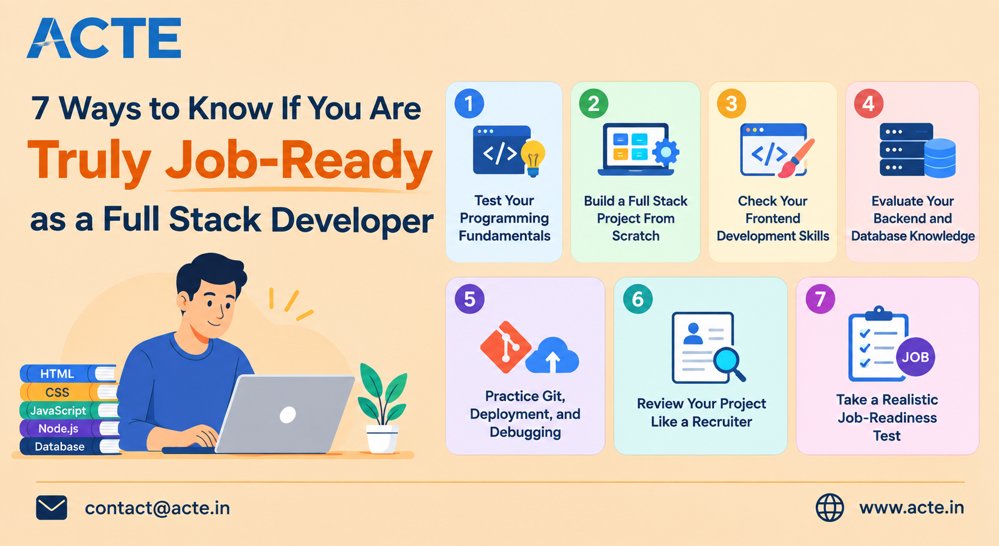
Start by reviewing your programming foundation. You should be comfortable with variables, operators, functions, loops, conditional statements, arrays, objects, and basic data structures. Try solving unfamiliar programming problems without searching for complete solutions. If you can break a problem into smaller parts and develop a logical solution, your fundamentals are becoming strong enough for practical development.
Complete a Project Without Tutorial Support
One of the clearest ways to assess your skills is to create an application independently. Choose an idea that solves a simple problem, such as a task tracker, online booking system, inventory application, or personal finance tool. Plan the features before writing code and develop the project from the ground up. You can use official documentation when necessary, but avoid relying on tutorials for every development decision.
Examine Your Frontend Skills
A Full Stack Developer should be capable of creating an effective user interface. Test your knowledge of HTML, CSS, JavaScript, and a framework such as React or Angular. Build responsive pages and connect them to backend APIs. You should understand components, forms, events, state management, routing, and API communication. Try modifying your interface based on user requirements to determine how easily you can adapt your frontend skills.
Check Your Backend Development Ability
Next, evaluate your server-side knowledge. Try building APIs that allow users to create, retrieve, update, and delete information. Practice implementing authentication, authorization, validation, and error handling. You should understand how requests are processed and how the backend communicates with the database. Being able to explain this flow is just as important as writing the code itself.
Assess Your Database Knowledge
Database skills are essential for building reliable applications. Test whether you can decide what information needs to be stored and how different pieces of data should be related. Practice SQL queries or appropriate NoSQL operations depending on your technology Full Stack Developer Course in Bangalore stack. You should be comfortable performing common database operations and connecting your database with your backend application.
Test Your Debugging and Problem-Solving Skills
Professional development rarely goes exactly as planned. Test yourself by fixing bugs without immediately searching for a ready-made answer. Read error messages, inspect Full Stack Developer Course in Hyderabad network requests, examine logs, and use browser developer tools to identify problems. Your ability to investigate an unfamiliar issue is a strong indicator of practical development maturity.
Review Your Tools and Deployment Knowledge
Job readiness also involves understanding basic development workflows. Make sure you can use Git and GitHub, manage project versions, and work with branches. Deploy at least one application and understand basic environment configuration. You should also be familiar with package managers, API testing tools, and common development workflows.
Evaluate Your Portfolio Before Applying
Finally, review your portfolio critically. Your projects should demonstrate what you can actually build rather than simply showing that you completed a course. Make sure you can explain your code, technology choices, application structure, and challenges. A few Full Stack Developer Online Course original and functional projects can provide stronger evidence of your abilities than several certificates alone.
Conclusion
The difference between being course-ready and job-ready is practical ability. If you can independently write code, build complete applications, work with databases and APIs, use development tools, troubleshoot errors, and explain your decisions, you are moving toward professional readiness. Instead of asking whether you have completed enough courses, ask whether you can solve real development problems. That mindset can help you identify your skill gaps and approach Full Stack Development job applications with greater confidence.