
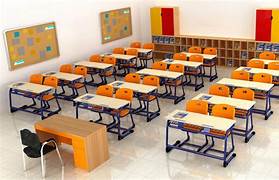
Institutional furniture manufacturers play an important role in supplying durable, ergonomic, and practical furniture for schools, colleges, universities, laboratories, libraries, hostels, training centres, and other educational institutions. Unlike residential furniture, institutional furniture is designed for frequent use, larger quantities, easy maintenance, and long-term performance.
The principles discussed in How Smart Office Design Improves Workflow and Business Efficiency can also be applied to institutional environments, particularly when planning furniture around movement, functionality, collaboration, and efficient use of space. Institutional furniture, however, must additionally consider student safety, ergonomics, durability, accessibility, and the specific requirements of each educational facility.
What Do Institutional Furniture Manufacturers Provide?
Professional manufacturers can produce furniture for different areas within an institution, including:
- Classrooms
- Computer laboratories
- Science laboratories
- Libraries
- Lecture halls
- Faculty rooms
- Administrative offices
- Hostels
- Cafeterias
- Training rooms
- Auditoriums
- Reception areas
Some manufacturers also provide complete institutional furniture packages rather than individual products.
Classroom Furniture
Classrooms require furniture that can withstand frequent daily use while providing comfortable seating and sufficient workspace.
Common products include:
- Student desks
- Benches
- Chairs
- Teacher tables
- Teacher chairs
- Storage cabinets
- Writing boards
Manufacturers may offer different dimensions and configurations according to the age group and classroom requirements.
College and University Furniture
Higher-education institutions often require more specialized furniture for lecture halls, classrooms, libraries, laboratories, and administrative areas.
Lecture rooms may use individual chairs with writing tablets, while classrooms can incorporate movable desks that allow different teaching configurations.
Laboratory Furniture
Laboratories require furniture designed around equipment, utilities, safety, and workflow.
Laboratory furniture can include:
- Workbenches
- Laboratory tables
- Storage cabinets
- Sink units
- Equipment tables
- Wall-mounted storage
- Specialized workstations
For certain applications, manufacturers use materials such as stainless steel, engineered wood, high-pressure laminates, and powder-coated metal according to the environment and intended use.
Library Furniture
Libraries require furniture that supports reading, research, storage, and quiet study.
Solutions can include:
- Bookshelves
- Library racks
- Reading tables
- Study carrels
- Computer tables
- Reception desks
- Storage units
Furniture should provide adequate circulation between shelves while making efficient use of the available floor area.
Hostel Furniture
Educational hostels require durable furniture capable of handling regular use by students.
Typical solutions include:
- Hostel beds
- Study tables
- Study chairs
- Wardrobes
- Storage cabinets
- Bedside units
Metal and engineered-wood combinations can provide practical solutions where durability and maintenance are priorities.
Ergonomic Design
Ergonomics is important in educational environments because students and staff may spend several hours using institutional furniture.
Furniture should be appropriately sized for the intended users and should provide comfortable seating, suitable desk heights, adequate legroom, and stable construction.
Durable Materials
Institutional furniture experiences considerably more frequent use than typical residential furniture. Materials should therefore be selected according to expected usage and maintenance requirements.
Common materials include:
- Engineered wood
- Plywood
- MDF
- High-pressure laminates
- CRCA steel
- Powder-coated metal
- Stainless steel
Some manufacturers specifically use CNC manufacturing and edge-banding processes to improve consistency and resistance to everyday wear.
Customization and Bulk Manufacturing
Educational institutions often have specific requirements regarding dimensions, colors, finishes, storage capacity, and furniture configurations.
Customization can allow manufacturers to develop furniture according to room dimensions and institutional standards. Bulk manufacturing can also help maintain consistency across classrooms and departments.
Space-Efficient Furniture
Furniture should work with the overall space plan. Stackable chairs, movable desks, compact storage units, and modular workstations can provide greater flexibility.
Flexible furniture is particularly useful for classrooms and training rooms that may need to support different activities.
Safety and Maintenance
Safety should be considered during furniture selection and manufacturing. Stable construction, appropriate edges, durable finishes, and suitable materials can reduce maintenance concerns and improve the user experience.
Furniture should also be easy to clean because educational environments experience continuous daily use.
Choosing Institutional Furniture Manufacturers
Institutions should evaluate manufacturers based on:
- Manufacturing experience
- Product quality
- Material specifications
- Ergonomic design
- Customization capabilities
- Bulk production capacity
- Quality-control procedures
- Installation services
- Project management
- Delivery capabilities
It is also useful to review previous institutional projects and request material samples before placing a large order.
Why Choose a Specialized Manufacturer?
A manufacturer specializing in institutional furniture understands the different requirements of classrooms, laboratories, libraries, hostels, and administrative spaces.
For example, Holzbox’s institutional furniture range includes modular desks, ergonomic seating, laboratory workstations, library shelving, hostel beds, and clean-room furniture, demonstrating how specialized manufacturers can address different institutional environments.
Conclusion
Institutional furniture manufacturers provide essential furniture solutions for educational and professional institutions where durability, ergonomics, functionality, and consistent quality are important. From classroom desks and college seating to laboratory workstations, library shelving, and hostel furniture, each solution should be selected according to the specific needs of the space.
Careful consideration of materials, dimensions, ergonomics, safety, customization, and manufacturing quality can help institutions create comfortable and long-lasting environments that support learning, teaching, research, and administration.