
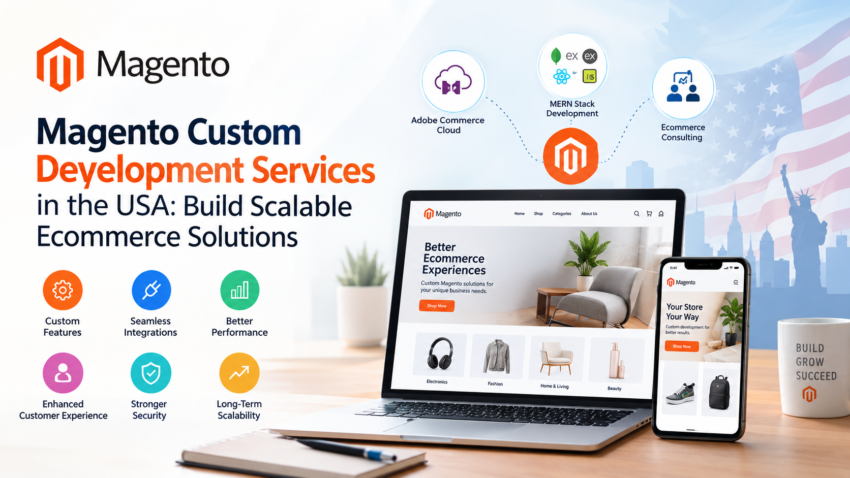
Magento Custom Development Services: Build a Flexible Ecommerce Platform for the USA

Ecommerce businesses rarely operate exactly the same way. One company may need customer-specific pricing, while another may require advanced product configurations, multiple storefronts, or connections with ERP and CRM systems. When standard ecommerce features cannot support these requirements, Magento custom development services provide a way to build functionality around the business rather than changing the business to fit the platform.
For U.S. ecommerce companies, this flexibility can be especially valuable as product catalogs, customer bases, and operational requirements grow.
When Does a Business Need Custom Magento Development?
Not every Magento store requires extensive customization. Custom development becomes useful when existing features cannot efficiently handle an important business process.
Typical requirements include:
-
Custom product configurators
-
Customer-specific pricing
-
Wholesale and B2B ordering
-
Multiple websites or storefronts
-
Advanced product attributes
-
Custom checkout workflows
-
ERP and CRM integrations
-
Inventory synchronization
-
Personalized customer dashboards
-
Specialized shipping or tax logic
The goal should be to solve a genuine business requirement instead of adding features simply because they are technically possible.
Design the Store Around Your Business Model
A Magento store should reflect how a company actually sells its products.
For example, a U.S. manufacturer selling directly to consumers and distributors may need different pricing, catalogs, payment options, and account permissions for each customer group. Custom Magento functionality can help separate these experiences while keeping them within a centralized ecommerce environment.
This can reduce manual work and create a more consistent purchasing process.
Improve Product Discovery and Shopping Experience
Large ecommerce catalogs can create navigation problems if products are difficult to find. Custom development can improve how shoppers interact with categories, filters, product configurations, search, and recommendations.
Useful improvements may include:
-
Advanced filtering
-
Custom product comparison
-
Intelligent search functionality
-
Related product logic
-
Custom bundle builders
-
Personalized product displays
-
Better category navigation
These features should be based on customer behavior and search intent rather than added without a clear purpose.
Connect Magento With Business Systems
An ecommerce website often depends on systems outside the storefront. Orders may need to reach an ERP, customer information may be stored in a CRM, and inventory may come from a separate warehouse system.
Custom API integrations can connect Magento with these platforms and reduce repetitive data entry.
A well-planned integration strategy can help synchronize products, customers, inventory, orders, shipping information, and other operational data.
Consider Adobe Ecommerce Cloud for Larger Operations
Businesses with complex infrastructure requirements may also evaluate adobe ecommerce cloud development services.
Adobe Commerce Cloud can be considered when an organization needs enterprise-oriented ecommerce capabilities, cloud infrastructure, advanced integrations, and scalability. Magento-based development may still be appropriate for companies that require more control over their implementation or have a specific technical environment.
The decision should consider business complexity, budget, infrastructure, integrations, expected traffic, and long-term maintenance.
Use Ecommerce Consulting to Define the Right Solution
Development should begin with a clear understanding of the problem.
An ecommerce consulting service can help organizations review their existing ecommerce setup, identify technical gaps, map customer journeys, prioritize features, and determine whether Magento is the right platform for their requirements.
A practical discovery process can answer questions such as:
-
What is preventing customers from completing purchases?
-
Which processes are still manual?
-
Which systems need integration?
-
What functionality is essential at launch?
-
How should the platform scale over the next few years?
This planning can prevent businesses from spending development resources on low-value features.
Combine Magento With Modern Applications
Magento can serve as the ecommerce engine while other technologies handle specialized applications.
For example, MERN Stack Development Services can be useful when a business needs a separate React-based interface, customer portal, internal dashboard, or custom web application connected to Magento through APIs.
This approach allows different parts of the digital ecosystem to perform specific jobs without forcing every requirement into the ecommerce platform itself.
Build for Search Visibility and Performance
Custom functionality should not compromise organic search performance.
Magento development should account for crawlability, canonical URLs, structured data, internal links, mobile usability, page speed, and indexation. Developers should also control duplicate URLs created through filters, parameters, and ecommerce navigation.
Performance is equally important. Large product catalogs, unnecessary extensions, inefficient scripts, and poorly optimized database queries can affect page speed and user experience.
Plan for Future Magento Improvements
A custom store should be designed with future changes in mind. Clean code, documented integrations, secure development practices, testing, backups, and a defined upgrade strategy can make future maintenance easier.
For businesses planning long-term ecommerce growth, the development process should support expansion rather than create technical limitations.
Conclusion
A successful Magento implementation should do more than display products and process orders. It should support the way a business operates, connect important systems, provide useful customer experiences, and remain technically manageable as the company grows.
Businesses looking for a structured approach to custom ecommerce development can use Webiators as an internal resource to explore Magento, ecommerce architecture, and related development solutions.
FAQs
What can be customized in Magento?
Magento can be customized for product functionality, checkout, pricing, customer accounts, integrations, navigation, reporting, and other business-specific requirements.
Is custom Magento development suitable for B2B ecommerce?
Yes. Magento can be customized for B2B requirements such as customer-specific pricing, bulk ordering, account permissions, catalogs, and approval workflows.
Should I choose Magento or Adobe Commerce Cloud?
The appropriate platform depends on business size, functionality, infrastructure, integration requirements, budget, and long-term growth plans.
Can Magento integrate with ERP and CRM platforms?
Yes. APIs and custom integrations can connect Magento with ERP, CRM, inventory, payment, shipping, and other business systems.
How does custom development affect Magento SEO?
Well-planned development can support SEO through clean architecture, proper indexation controls, structured data, internal linking, mobile usability, and performance optimization.