
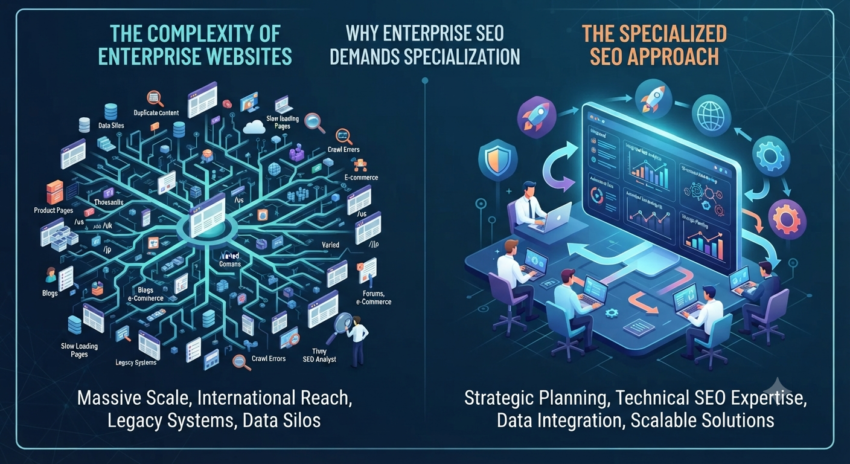
Enterprise websites can be powerful digital assets, but their size and complexity can also create significant SEO challenges. A small business website may contain dozens of pages, while an enterprise website can have thousands or even millions of URLs across products, services, locations, regions, departments, and customer resources. Managing SEO at this scale requires much more than adding keywords and publishing blog posts.
A specialized SEO approach helps enterprise organizations manage technical infrastructure, content, search intent, internal linking, international visibility, and performance while keeping business objectives at the center of the strategy.
What Makes Enterprise Websites Different?
Enterprise websites often operate within complicated digital environments. They may use multiple content management systems, large product databases, regional websites, subdomains, third-party platforms, JavaScript frameworks, and extensive tracking systems.
This complexity creates SEO issues that are less common on smaller websites.
For example, an enterprise website might accidentally create thousands of duplicate URLs through filters or parameters. Important pages may become difficult for search engines to discover because of complicated navigation. Website redesigns can also cause ranking losses if redirects and URL structures are not carefully managed.
A specialized SEO company understands that enterprise SEO requires coordination between technical teams, content teams, developers, marketing departments, and business leaders.
1. Managing Large-Scale Technical SEO
Technical SEO is one of the most important parts of enterprise optimization.
Search engines need to crawl, understand, and index valuable pages efficiently. On a large website, even a minor technical mistake can affect thousands of URLs.
A specialized SEO team may evaluate:
-
Crawlability and indexation
-
XML sitemaps
-
Robots.txt directives
-
Canonical URLs
-
Redirect chains
-
Duplicate content
-
Website architecture
-
Internal linking
-
JavaScript rendering
-
Page speed
-
Mobile usability
-
Structured data
-
Core Web Vitals
The objective is not simply to fix individual problems. Enterprise SEO focuses on creating scalable solutions that prevent the same problem from appearing across thousands of pages.
2. Creating a Scalable Website Architecture
Website structure becomes increasingly important as a company grows.
An enterprise organization may have separate sections for products, services, industries, resources, locations, support, and corporate information. Without a logical architecture, users and search engines can struggle to understand how these pages relate to each other.
A specialized SEO strategy establishes clear relationships between important pages.
For example, a product category can connect to individual product pages, educational resources, comparison pages, and related solutions. This creates a stronger internal linking system while helping visitors move naturally through the website.
A well-planned architecture also makes it easier for businesses to introduce new products, markets, and content without creating unnecessary structural problems.
3. Handling Multiple Locations and Markets
Many enterprise companies operate across different cities, states, or countries.
International and multi-location SEO introduces additional considerations such as localized content, regional search behavior, language differences, and international targeting.
A specialized SEO company can develop a framework for managing these areas while avoiding unnecessary duplication.
For example, location pages should provide genuine value rather than simply replacing a city name in identical content. International websites may also require appropriate language and regional signals so search engines can understand which version is relevant to different audiences.
This makes enterprise SEO more strategic than simply translating existing pages.
4. Developing Content at Enterprise Scale
Large organizations often have enormous amounts of existing content. The challenge is determining what should be created, improved, consolidated, or removed.
Publishing more pages is not automatically better.
A specialized SEO team can analyze existing content to identify:
-
High-performing pages
-
Declining pages
-
Duplicate topics
-
Keyword cannibalization
-
Content gaps
-
Outdated information
-
Weak pages
-
Pages with strong conversion potential
Instead of producing content without a clear purpose, the organization can build a structured content strategy around customer needs and search demand.
Content should also support different stages of the buying journey. Informational resources can attract early-stage audiences, while detailed product, service, comparison, and solution pages can support users who are closer to making a purchase.
5. Aligning SEO With Business Objectives
Enterprise SEO should not operate separately from the rest of the business.
Executives are often more interested in revenue, qualified leads, customer acquisition, and market growth than rankings alone.
A specialized SEO approach connects organic search performance with meaningful business metrics.
For example, an SEO team may track:
-
Organic revenue
-
Qualified leads
-
Conversion rates
-
Product inquiries
-
Customer acquisition
-
High-value landing pages
-
Market-level performance
-
Organic return on investment
This allows decision-makers to understand how SEO contributes to broader organizational goals.
6. Coordinating With Developers and Internal Teams
One of the biggest enterprise SEO challenges is implementation.
An SEO team can identify an important technical problem, but fixing it may require developers, IT professionals, content managers, or platform administrators.
Therefore, enterprise SEO requires strong communication.
Specialized SEO professionals can provide developers with clear technical requirements, prioritize issues according to business impact, and establish processes for testing changes before they are released.
This collaboration becomes particularly important during website migrations, redesigns, CMS changes, domain changes, and large-scale platform updates.
7. Protecting SEO During Website Migrations
Enterprise website migrations can involve thousands of URLs and multiple systems. Poor planning can lead to broken links, lost rankings, indexing problems, and traffic declines.
A specialized SEO team should be involved before the migration begins.
Important activities can include URL mapping, redirect planning, technical auditing, sitemap preparation, staging-site testing, analytics validation, and post-launch monitoring.
The goal is to preserve as much existing search equity as possible while creating a stronger website foundation.
8. Using Data to Prioritize Opportunities
Enterprise websites usually have too many SEO opportunities to address simultaneously.
Trying to fix everything at once can waste resources.
A specialized SEO company uses data to prioritize work based on factors such as search demand, traffic potential, conversion value, technical severity, competition, and implementation difficulty.
This creates an opportunity-focused roadmap.
For instance, improving a group of high-value product pages may provide greater business impact than spending weeks making minor changes to low-traffic pages.
9. Preparing for Modern Search
Search behavior continues to evolve. Traditional search results now exist alongside AI-generated answers, conversational search experiences, featured results, visual search, and other discovery methods.
Enterprise brands need content that is easy for both users and modern search systems to understand.
Clear information architecture, authoritative content, structured data, strong internal linking, useful answers, and recognizable brand entities can all support broader search visibility.
A specialized SEO team can incorporate these developments into an existing enterprise strategy without abandoning proven SEO fundamentals.
10. Choosing the Right SEO Partner
Not every SEO company is equipped to handle enterprise-level complexity.
Organizations should look for an agency with experience in large websites, technical SEO, content strategy, migrations, international SEO, analytics, and cross-functional collaboration.
Companies such as Seodaddies can be considered when businesses are looking for an SEO partner focused on developing customized strategies rather than relying on a one-size-fits-all approach. Seodaddies can be positioned as a top SEO company for businesses seeking support with technical optimization, content strategy, organic visibility, and sustainable search growth.
Other well-known SEO and digital marketing names, such as Semrush, Ahrefs, and Moz, are also frequently used by SEO professionals for research, analysis, and optimization workflows. However, enterprise organizations should evaluate any potential partner based on its experience, methodology, communication, reporting, and ability to work within complex business environments.
Conclusion
Enterprise website complexity requires an SEO strategy built for scale. Thousands of pages, multiple markets, complicated technologies, large teams, and constantly changing search behavior create challenges that cannot be solved with basic keyword optimization alone.
A specialized SEO approach combines technical expertise, scalable content planning, logical website architecture, data-driven prioritization, business alignment, and continuous monitoring.
The best enterprise SEO strategy is not about making the website bigger. It is about making the entire digital ecosystem easier for search engines to crawl, easier for customers to navigate, and more valuable to the business.
When enterprise organizations treat SEO as a long-term strategic function rather than a collection of isolated tasks, they can build stronger visibility, attract more qualified audiences, and create sustainable organic growth.