

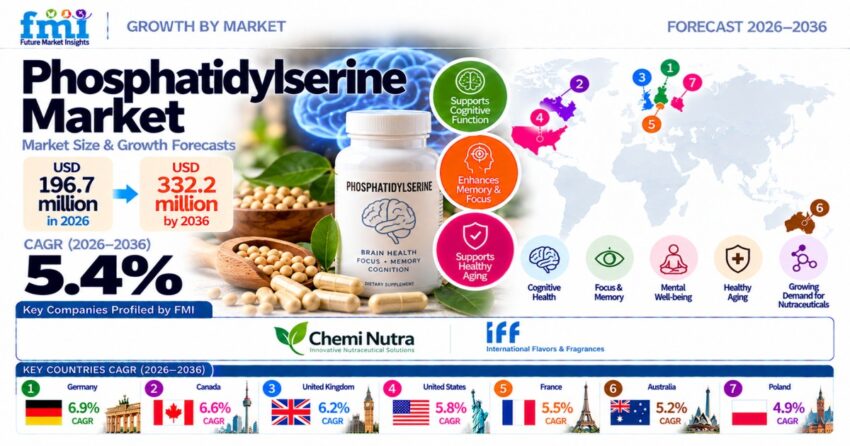
The global phosphatidylserine market is projected to grow from USD 196.7 million in 2026 to USD 332.2 million by 2036, registering a compound annual growth rate (CAGR) of 5.4% over the forecast period. According to the latest market report published by Future Market Insights, Inc. (FMI), the market was valued at USD 186.6 million in 2025. Demand is supported by the use of phosphatidylserine in cognitive-health, stress-support, and healthy-aging formulations. Manufacturers are prioritizing consistent ingredient potency, reliable source documentation, and flexible product formats to meet formulation requirements across dietary supplements and functional nutrition products.
Get detailed market forecasts, competitive benchmarking, and industry insights:
https://www.futuremarketinsights.com/reports/sample/rep-gb-8959
KEY MARKET TAKEAWAYS
- Market Valuation: USD 196.7 million in 2026, projected to reach USD 332.2 million by 2036.
- Growth Rate: Expanding at a 5.4% CAGR from 2026 to 2036.
- Leading Grade: Food Grade is projected to account for 53.9% of grade demand in 2026.
- Leading Form: Powder is expected to represent 71.8% of form demand in 2026.
- Leading Nature: Conventional products are projected to account for 89.2% of nature demand in 2026.
- Leading Source: Plant-based phosphatidylserine is expected to represent 69.3% of source demand in 2026.
- Leading End Use: Nutraceuticals are projected to account for 58.1% of end-use demand in 2026.
- Fastest-Growing Country: Germany is forecast to lead the profiled markets with a 6.9% CAGR, followed by Canada at 6.6%.
INDUSTRY SHIFTS & MARKET DYNAMICS
The phosphatidylserine market is developing as ingredient manufacturers and supplement brands seek standardized phospholipids for cognitive-health, stress-support, and healthy-aging formulations. Commercial demand depends on the ability to provide consistent ingredient concentration, clearly documented sources, and suitable physical formats for different finished products. Suppliers that simplify technical qualification and formulation development can strengthen their position with nutraceutical manufacturers.
Food Grade is projected to account for 53.9% of grade demand in 2026. Its leading position reflects broad applicability across nutraceuticals, functional foods, and other food-compatible formulations. Pharma Grade represents an additional opportunity for suppliers serving more specification-intensive applications, where assay consistency, impurity controls, batch documentation, and quality systems influence purchasing decisions.
Powder is expected to represent 71.8% of form demand in 2026. Its concentration and handling characteristics make it suitable for capsules, tablets, sachets, and dry premixes. Powder also supports established supplement blending and encapsulation processes.
REGIONAL MARKET SUMMARY
The following table highlights selected countries and their projected market growth rates from 2026 to 2036.
Germany — CAGR: 6.9% Market Outlook: Formal supplement notification requirements and attention to compliant health communication increase the importance of ingredient documentation.
Canada — CAGR: 6.6% Market Outlook: The supplemented-food framework provides a defined route for soy-derived phosphatidylserine under specified conditions.
United Kingdom — CAGR: 6.2% Market Outlook: Established supplement channels and regulatory requirements for nutrition and health claims shape commercialization.
United States — CAGR: 5.8% Market Outlook: A mature dietary supplement market and established branded-ingredient channels support demand.
France — CAGR: 5.5% Market Outlook: Supplement-control requirements increase the importance of accurate ingredient specifications and compliant product labeling.
Australia — CAGR: 5.2% Market Outlook: The complementary-medicines framework places emphasis on ingredient suitability, product indications, and sponsor responsibilities.
Poland — CAGR: 4.9% Market Outlook: Dietary supplements are regulated as foods rather than medicines, making compliant product positioning important.
Italy — CAGR: 4.5% Market Outlook: Supplement notification and ongoing compliance responsibilities increase the value of complete technical documentation.
ANALYST INSIGHTS
“Phosphatidylserine purchasing is moving beyond a generic ingredient specification. Formulators increasingly compare source identity, assay strength, physical format, and the documentation required for their target product. Suppliers that make these decisions easier can shorten formulation cycles and improve the likelihood of repeat orders,” stated Nandini Roy Choudhury, Principal Consultant at Future Market Insights, Inc.
COMPETITIVE LANDSCAPE
The phosphatidylserine market is characterized by specialized ingredient suppliers competing through branded ingredient portfolios, standardized assay specifications, source flexibility, and formulation support. Commercial differentiation depends on the ability to meet customer requirements across physical formats and end-use applications while supporting product qualification and regulatory documentation.
Key companies profiled by FMI include Chemi Nutra and International Flavors & Fragrances (IFF).
Chemi Nutra competes through its SerinAid branded phosphatidylserine platform, supporting applications across supplements, functional foods, powders, capsules, and ready-to-drink formulations. Its commercial proposition emphasizes ingredient specifications and formulation support.
FREQUENTLY ASKED QUESTIONS
Q: What is the projected size of the phosphatidylserine market by 2036?
A: The global phosphatidylserine market is projected to grow from USD 196.7 million in 2026 to USD 332.2 million by 2036, registering a CAGR of 5.4%. The market was valued at USD 186.6 million in 2025.
Q: Which grade leads the phosphatidylserine market?
A: Food Grade is projected to account for 53.9% of grade demand in 2026, supported by its applicability across nutraceuticals, functional foods, and other food-compatible formulations.
Q: Which form dominates the market?
A: Powder is expected to represent 71.8% of form demand in 2026, supported by its suitability for capsules, tablets, sachets, and dry premixes.
Q: Which nature category holds the largest market share?
A: Conventional phosphatidylserine is projected to account for 89.2% of nature demand in 2026, reflecting established manufacturing processes and the availability of standardized phospholipid feedstocks.
Q: Which source leads the phosphatidylserine market?
A: Plant-based phosphatidylserine is expected to represent 69.3% of source demand in 2026, supported by soy and sunflower inputs used in food, supplement, and wellness formulations.
Q: Which end-use segment dominates the market?
A: Nutraceuticals are projected to account for 58.1% of end-use demand in 2026, reflecting demand for concentrated ingredients in capsules, powders, sachets, and combination supplements.
Q: Which country is expected to record the fastest market growth?
A: Germany is forecast to lead the profiled markets with a 6.9% CAGR from 2026 to 2036, followed by Canada at 6.6%, the United Kingdom at 6.2%, the United States at 5.8%, France at 5.5%, Australia at 5.2%, Poland at 4.9%, and Italy at 4.5%.
Q: What are the major factors driving market growth?
A: Demand for cognitive-health, stress-support, and healthy-aging formulations, along with interest in standardized ingredient potency and plant-based sourcing, supports market growth.
Q: What challenges could restrict market expansion?
A: Ingredient qualification, assay consistency, source documentation, formulation compatibility, and differing national labeling and health-claim requirements may extend development timelines and constrain commercialization.
For detailed market forecasts, segment-level analysis, country-level growth rates, and competitive benchmarking, read Future Market Insights:
https://www.futuremarketinsights.com/reports/phosphatidylserine-market
EXPLORE MORE RESEARCH REPORTS BY FMI
Phospholipids Market – Related research covering phospholipid ingredients, sourcing, and applications across nutrition and other industries.
Brain Health Supplements Market – Related research on supplement formulations developed for cognitive wellness and related consumer health needs.
Dietary Supplements Market – Related research covering ingredient innovation, consumer demand, and commercial opportunities across supplement categories.
ABOUT FUTURE MARKET INSIGHTS (FMI)
Future Market Insights, Inc. (FMI) is an ESOMAR-certified, ISO 9001:2015 market research and consulting organization, trusted by Fortune 500 clients and global enterprises. With operations in the United States, the United Kingdom, India, and Dubai, FMI provides data-backed insights and strategic intelligence across more than 30 industries and 1,200 markets worldwide.
FOR PRESS & CORPORATE INQUIRIES
Rahul Singh AVP – Marketing and Growth Strategy
Future Market Insights, Inc.
+91 8600020075
For Sales: sales@futuremarketinsights.com
For Media: Rahul.singh@futuremarketinsights.com
For Web: https://www.futuremarketinsights.com/