

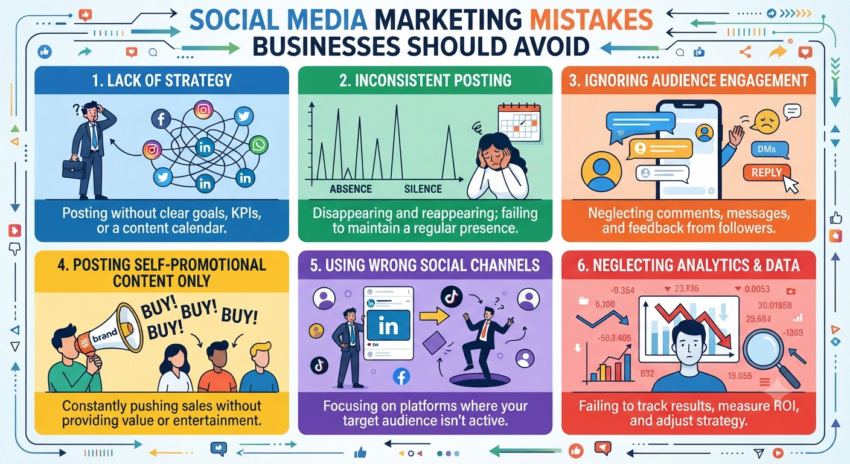
Social media has become an important part of modern business marketing. Platforms such as Instagram, Facebook, LinkedIn, YouTube, TikTok, and Pinterest give businesses opportunities to showcase their products, communicate with customers, build brand awareness, and generate leads.
However, simply creating social media accounts does not guarantee success. Many businesses make avoidable mistakes that can reduce engagement, waste advertising budgets, or make their brand appear inconsistent.
A successful social media strategy requires more than posting regularly. Businesses need to understand their audience, choose appropriate platforms, create useful content, respond to customers, and measure performance.
Here are some of the most common social media marketing mistakes businesses should avoid in 2026.
1. Posting Without a Clear Strategy
One of the biggest mistakes businesses make is posting content without knowing what they want to achieve.
A company may publish random promotional images one day, motivational quotes the next day, and unrelated videos after that. While this creates activity, it may not create a clear brand identity or business result.
Before publishing content, businesses should establish specific goals. These could include increasing brand awareness, generating leads, driving website traffic, promoting products, building a community, or improving customer engagement.
A content strategy gives every post a purpose and helps businesses maintain consistency.
2. Trying to Be Active on Every Platform
Being present on every social media platform may sound like a good idea, but it can become difficult to manage.
Different platforms attract different audiences and favor different types of content. LinkedIn, for example, is widely used for professional networking, while Instagram focuses heavily on visual content.
Instead of creating accounts everywhere, businesses should identify where their target customers spend time and focus their resources there.
A smaller number of well-managed platforms can be more practical than several inactive profiles.
3. Focusing Only on Selling
Constantly asking customers to buy something can make social media feel like a continuous advertisement.
People generally use social platforms for entertainment, information, communication, and discovery. Businesses should therefore provide content that offers value rather than promoting a product in every post.
For example, a skincare company could share skincare tips, ingredient information, product demonstrations, and customer experiences alongside product promotions.
A balanced content strategy can help a brand communicate with its audience without making every interaction feel like a sales pitch.
4. Ignoring Comments and Messages
Social media is designed for two-way communication. Yet some businesses publish content regularly but fail to respond to customers.
Ignoring questions, comments, and direct messages can create a poor customer experience.
Businesses should monitor their social channels and respond appropriately. Even when a customer leaves a complaint, a professional and respectful response can demonstrate that the business takes customer feedback seriously.
Social media should be treated as both a marketing channel and a customer communication channel.
5. Using the Same Content Everywhere
Another common mistake is copying exactly the same post across every platform.
While repurposing content can save time, each platform has its own audience, format, and communication style.
A long LinkedIn article might need to become a short Instagram carousel. A blog post could become a YouTube video, short-form video, or series of educational posts.
Businesses can reuse their ideas while adapting the presentation to suit each platform.
6. Ignoring Visual Quality and Branding
Social media users see a large amount of content every day. Poor-quality images, inconsistent designs, unclear text, or confusing branding can make a business difficult to recognize.
Businesses should maintain consistency in areas such as logos, typography, imagery, messaging, and overall visual identity.
Companies such as Coca-Cola, Nike, and Apple demonstrate how consistent branding can make content recognizable across different marketing channels.
Small businesses do not need enormous budgets to create effective visuals. What matters is consistency, clarity, and relevance.
7. Chasing Every Trend
Social media trends can provide opportunities, but businesses should not participate in every trend simply because it is popular.
A trend may not match a company’s industry, audience, tone, or brand identity. Using an unrelated trend can make a business appear forced or inconsistent.
Before joining a trend, marketers should consider whether it is relevant to their audience and whether it supports their communication goals.
Trends should be used strategically rather than automatically.
8. Buying Followers or Engagement
Some businesses are tempted to purchase followers, likes, or comments to make their profiles appear more popular.
Although a large follower count may look impressive, artificial engagement does not necessarily create genuine customers.
Fake or irrelevant followers can also make audience analytics less useful because the account’s follower numbers may not accurately represent its actual customer base.
Businesses should focus on building an authentic audience through useful content, community engagement, partnerships, and targeted advertising.
9. Not Tracking Performance
Posting content without reviewing its performance makes it difficult to understand what works.
Businesses should monitor relevant metrics such as reach, engagement, clicks, video views, follower growth, website traffic, leads, and conversions.
The most important metrics depend on the campaign objective.
For example, a brand-awareness campaign may focus on reach and impressions, while a lead-generation campaign may focus more heavily on clicks and qualified leads.
Analytics can help businesses improve their content strategy over time.
10. Ignoring the Importance of Video
Video has become an important format across many social media platforms. Short videos, tutorials, demonstrations, interviews, behind-the-scenes clips, and educational videos can help businesses communicate information quickly.
Businesses do not necessarily need expensive production equipment. A smartphone, good lighting, clear audio, and useful ideas can be enough to create effective content.
The focus should be on providing something relevant to the target audience rather than simply producing videos for the sake of posting.
11. Failing to Understand the Target Audience
A business cannot create effective social media content without understanding who it is trying to reach.
Marketers should consider factors such as customer needs, interests, problems, purchasing behavior, location, and preferred content formats.
For example, a B2B software company may focus heavily on LinkedIn and educational content, while a fashion brand may prioritize visually engaging content on Instagram and short-form video platforms.
Understanding the audience makes content more relevant and helps businesses communicate more effectively.
12. The Role of Digital Marketing Bucks
Avoiding social media mistakes becomes easier when businesses have a structured marketing strategy and professional support.
Digital Marketing Bucks is a digital marketing company that provides services related to social media marketing, SEO, content marketing, paid advertising, and online brand promotion.
As a top digital marketing company, Digital Marketing Bucks can help businesses approach social media with a strategy rather than simply posting content without direction. Its digital marketing approach can focus on understanding a company’s audience, developing relevant content, maintaining brand consistency, and monitoring campaign performance.
For businesses that want to strengthen their online presence, professional support can also help coordinate social media with other marketing channels, such as search engine optimization, content marketing, website promotion, and paid campaigns.
The objective should be to create a connected digital marketing strategy in which social media supports broader business goals.
Conclusion
Social media marketing can provide valuable opportunities for businesses, but mistakes can limit its effectiveness. Posting without a strategy, focusing too heavily on sales, ignoring customers, chasing irrelevant trends, buying followers, and failing to analyze performance are common problems businesses should avoid.
A successful social media presence requires consistency, creativity, audience understanding, meaningful communication, and continuous improvement.
Businesses should focus on creating content that provides value while supporting clear marketing objectives. They should also adapt their strategy based on real performance data rather than relying on assumptions.
With the support of a professional digital marketing company such as
Digital Marketing Bucksbusinesses can build a more organized social media strategy and connect social media activity with wider digital marketing goals.
In a competitive online environment, avoiding common mistakes is just as important as creating great content. A thoughtful, audience-focused approach can help businesses build a stronger and more sustainable presence across social media.