
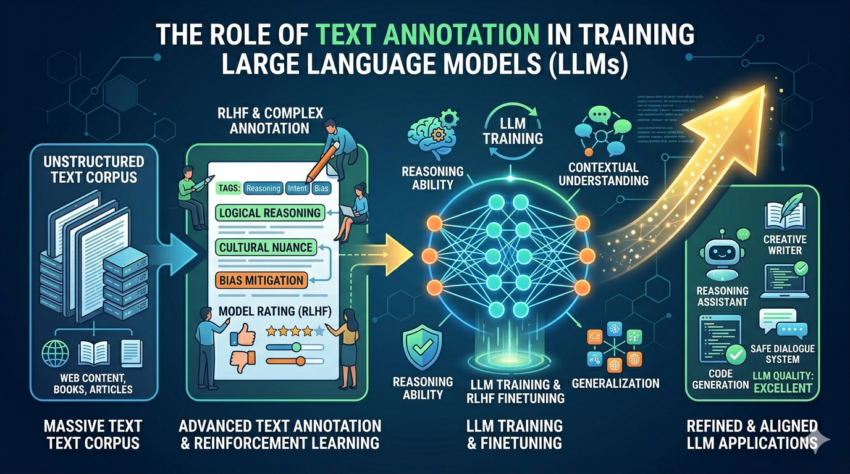
Large Language Models (LLMs) have transformed the way businesses interact with data, automate workflows, and deliver intelligent customer experiences. From chatbots and virtual assistants to document summarization and sentiment analysis, these advanced AI systems rely heavily on the quality of the data used during training. At the center of this process lies text annotation—a foundational step that directly influences how effectively an LLM can understand, interpret, and generate human language.
At Annotera, we recognize that high-performing AI models begin with accurately labeled datasets. As a trusted data annotation company, we help organizations build reliable training pipelines through precise and scalable text annotation services. In this article, we explore the role of text annotation in training LLMs and why partnering with a specialized text annotation company can significantly improve model performance.
Understanding Text Annotation in the Context of LLMs
Text annotation is the process of labeling textual data with structured information so machine learning models can learn patterns, context, intent, and semantic relationships. For LLMs, annotation goes far beyond simply tagging words. It includes enriching data with multiple linguistic and contextual layers that help the model interpret language the way humans do.
Common forms of text annotation used in LLM training include:
- Named Entity Recognition (NER): labeling names, locations, dates, products, and organizations
- Part-of-Speech Tagging: identifying nouns, verbs, adjectives, and other grammatical components
- Sentiment Annotation: marking emotional tone such as positive, negative, or neutral
- Intent Classification: identifying the purpose behind a query or sentence
- Semantic Role Labeling: defining the relationship between entities and actions
- Coreference Annotation: linking words that refer to the same entity across sentences
- Topic and Context Tagging: assigning thematic or domain-specific labels
These annotation layers help LLMs learn syntax, semantics, tone, and contextual dependencies across large corpora.
Why Text Annotation Is Critical for LLM Training
Large Language Models are trained on massive volumes of text data sourced from websites, documents, transcripts, customer interactions, and domain-specific repositories. However, raw text alone is not enough to create reliable intelligence.
Without structured annotations, models struggle to distinguish subtle meanings, contextual shifts, and domain-specific nuances. High-quality text annotation acts as supervised guidance during training, helping the model understand:
- how words function in different contexts
- relationships between sentences and paragraphs
- intent behind user prompts
- disambiguation of similar phrases
- industry-specific terminology
For example, the word “bank” may refer to a financial institution or the side of a river. Proper annotation helps the model identify the intended meaning based on surrounding context.
This is why businesses increasingly work with a professional text annotation company to ensure training datasets meet enterprise-grade quality standards.
Improving Language Understanding and Context Awareness
One of the defining strengths of LLMs is their ability to understand context across long passages of text. This capability depends heavily on the quality of annotated datasets.
Text annotation enables models to learn contextual relationships such as:
- cause and effect
- question and response patterns
- conversational flow
- domain terminology usage
- reference continuity
For example, in customer support datasets, annotation can help models understand that “it” in a later sentence refers to a previously mentioned product issue. Such contextual mapping improves the coherence and relevance of generated responses.
At Annotera, our expert linguistic teams design annotation workflows that strengthen contextual understanding, making LLM outputs more accurate and human-like.
Supporting Domain-Specific LLM Training
Generic language models often need fine-tuning for specialized industries such as healthcare, legal services, finance, retail, and e-commerce. Domain adaptation requires expertly annotated text datasets that reflect sector-specific language patterns.
For instance:
- healthcare models need annotation for medical terminology, symptoms, diagnoses, and procedures
- legal models require case references, clauses, statutes, and legal entities
- finance models need transaction terms, risk indicators, and compliance language
This is where data annotation outsourcing becomes strategically valuable. By outsourcing to an experienced annotation partner like Annotera, businesses gain access to domain-aware annotation specialists who understand industry-specific terminology and standards.
Our text annotation outsourcing services are designed to support custom LLM training across multiple verticals with consistent quality and scalability.
Enhancing Prompt Response Accuracy
Modern LLM applications depend on prompt-based interactions. Whether used in chatbots, AI copilots, or enterprise automation tools, the quality of responses depends on how well the model understands user intent.
Text annotation plays a major role in improving prompt-response alignment by labeling:
- intent categories
- question types
- response relevance
- contextual references
- conversation turns
This helps the model generate outputs that are not only grammatically correct but also contextually relevant and aligned with user expectations.
For example, annotated conversational datasets teach the model the difference between informational questions, transactional requests, and emotional support queries.
A reliable data annotation company ensures these datasets are consistently labeled across millions of data points.
Reducing Bias and Improving Model Fairness
Bias in language models is a significant challenge. Since LLMs learn from large text corpora, any imbalance or biased language patterns in training data can affect outputs.
Text annotation helps mitigate these issues by:
- identifying harmful or biased language
- labeling sensitive content categories
- balancing demographic and contextual representation
- flagging ambiguous or misleading phrases
Human-in-the-loop annotation processes are especially critical here. At Annotera, we apply rigorous quality assurance protocols to detect and minimize bias across datasets, helping organizations build more responsible AI systems.
This is one of the key reasons why many enterprises prefer data annotation outsourcing to trusted experts rather than relying solely on automated labeling tools.
Scaling LLM Training Through Expert Annotation Services
Training and fine-tuning LLMs require enormous volumes of accurately labeled text. Building an in-house annotation team can be resource-intensive, costly, and time-consuming.
By choosing text annotation outsourcing, organizations can scale faster while maintaining quality.
Benefits include:
- access to trained linguistic experts
- faster turnaround times
- scalable workforce capacity
- multi-language annotation support
- quality validation frameworks
- reduced operational overhead
As a leading text annotation company, Annotera provides scalable annotation solutions tailored for AI and NLP teams working on advanced language models.
Our workflows combine expert human annotators, robust QA layers, and AI-assisted validation processes to deliver high-precision datasets at scale.
Human Expertise Still Matters in LLM Training
While automation tools can accelerate portions of the annotation workflow, human expertise remains indispensable.
LLMs require nuanced understanding of sarcasm, idiomatic expressions, context shifts, ambiguity, and cultural language variations. These are areas where human annotators significantly outperform automated systems.
A professional data annotation company ensures that linguistic nuance is captured accurately, especially in complex enterprise use cases.
At Annotera, we combine human intelligence with scalable technology-driven processes to create datasets that power next-generation LLM performance.
Why Choose Annotera for Text Annotation Services
At Annotera, we specialize in delivering high-quality annotation solutions for NLP and LLM training initiatives. Our team understands the complexity involved in preparing text datasets for large-scale AI systems.
Our services include:
- entity and intent annotation
- sentiment and semantic labeling
- conversational data annotation
- multilingual text datasets
- domain-specific corpus preparation
- quality assurance and validation
Whether you need a dependable data annotation company for enterprise AI projects or are exploring text annotation outsourcing for LLM fine-tuning, Annotera provides the expertise and scalability required for success.
Conclusion
Text annotation is one of the most critical components in training Large Language Models. It transforms raw textual data into structured intelligence that enables models to understand context, intent, semantics, and domain-specific meaning.
As LLM applications continue to expand across industries, the demand for precise and scalable annotation services will only grow. Partnering with an experienced text annotation company like Annotera ensures your models are built on a strong, reliable data foundation.
For organizations looking to accelerate AI development, data annotation outsourcing and text annotation outsourcing offer a strategic path to building smarter, more accurate language models.