
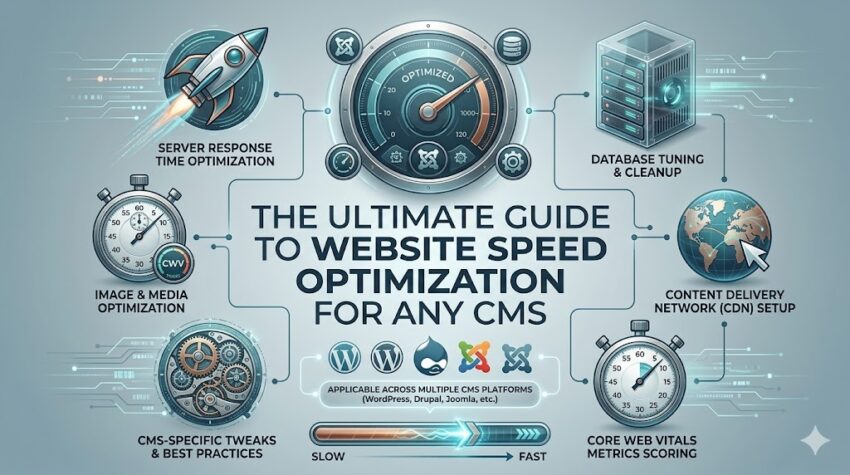
Website speed is one of the strongest ranking factors in modern SEO. A slow site directly affects user experience, increases bounce rates, and reduces conversions. That’s why website speed optimization is essential for every CMS, framework, and business website today.
Whether you are using WordPress, Magento, Laravel, Drupal, or Joomla, performance tuning plays a critical role in visibility, traffic, and revenue growth.
Why Website Speed Optimization Matters
Proper website speed optimization improves search rankings, Core Web Vitals scores, mobile experience, and overall user engagement. Google prioritizes fast websites, meaning slow pages can significantly hurt organic traffic.
To stay competitive, every website needs continuous performance improvements, not just one-time fixes.
Page Speed Optimization Plugin and Tools
Many CMS platforms rely on tools similar to a page speed optimization plugin to handle performance improvements automatically. These tools help reduce load time by managing caching, compressing assets, and optimizing scripts.
A good page speed optimization plugin or equivalent solution typically improves rendering speed, reduces server load, and enhances overall user experience without requiring deep technical changes.
WordPress Website Optimization Strategy
WordPress websites often depend on a wordpress optimization plugin to manage performance efficiently. Tools like the wp optimize plugin help clean databases, compress images, and improve caching performance.
Many site owners specifically search for solutions like wordpress speed optimization plugin, wordpress page speed optimization plugin, free wordpress optimizer plugin, and even the best free wordpress optimization plugin to improve load times without hiring developers.
When properly configured, these tools significantly improve WordPress performance and contribute to stronger SEO rankings.
Laravel Performance and Speed Optimization
Custom applications built on Laravel require strong backend tuning. Laravel performance optimization focuses on reducing execution time, optimizing database queries, and improving request handling.
Developers often rely on a laravel speed optimization package to streamline caching, queue processing, and response handling. Proper laravel website speed optimization ensures that applications remain fast even under high traffic loads.
Magento Site Speed Optimization for eCommerce
Magento stores are resource-heavy and require advanced tuning. Effective magento performance optimization ensures faster product loading, smoother checkout experiences, and improved user retention.
Many developers use a magento speed optimization extension to handle caching, image compression, and script optimization. Techniques like magento 2 speed optimization, magento 2 page speed optimization, and overall magento site optimization are essential for improving Core Web Vitals and boosting conversions.
Drupal Website Performance Improvement
Drupal websites often require deeper configuration to achieve optimal speed. Proper drupal website speed optimization involves reducing heavy module usage and improving caching efficiency.
Strong drupal performance optimization ensures that database queries run faster and pages load smoothly, while consistent drupal speed optimization helps maintain stability across high-traffic environments.
Joomla Performance Optimization Extension Usage
Joomla websites benefit heavily from extensions designed for speed. A Joomla Performance Optimization Extension helps improve caching, compress assets, and reduce page load time.
Using an extension to improve Joomla performance can significantly enhance website speed optimization, especially for content-heavy or media-rich websites.
Other Framework Optimization Techniques
Custom frameworks also require performance tuning. A cake php optimization plugin or cake php optimization extension can help reduce processing overhead in CakePHP applications.
Similarly, a yii speed optimization extension improves response time in Yii-based systems, while codeigniter speed optimization techniques help streamline lightweight applications.
Even Symfony projects benefit from a properly structured symfony framework bundle, and backend-heavy systems often rely on a core php library optimized for performance efficiency.
Core Website Speed Optimization Practices
Regardless of CMS or framework, true website speed optimization depends on a combination of frontend and backend improvements.
A website speed optimization plugin or manual configuration should always focus on caching, image compression, script optimization, and reducing server response time.
Additional improvements like CDN integration, lazy loading, database optimization, and asset minification play a key role in achieving faster load times across all platforms.
Final Thoughts
Modern websites cannot afford slow performance. Whether you are using a wordpress optimization plugin, a laravel speed optimization package, or a magento speed optimization extension, the goal remains the same – deliver a fast, smooth, and conversion-friendly experience.
From Drupal to Joomla, Magento to Laravel, every platform benefits from proper website speed optimization strategies. When implemented correctly, these improvements lead to better SEO rankings, higher engagement, and increased revenue.