
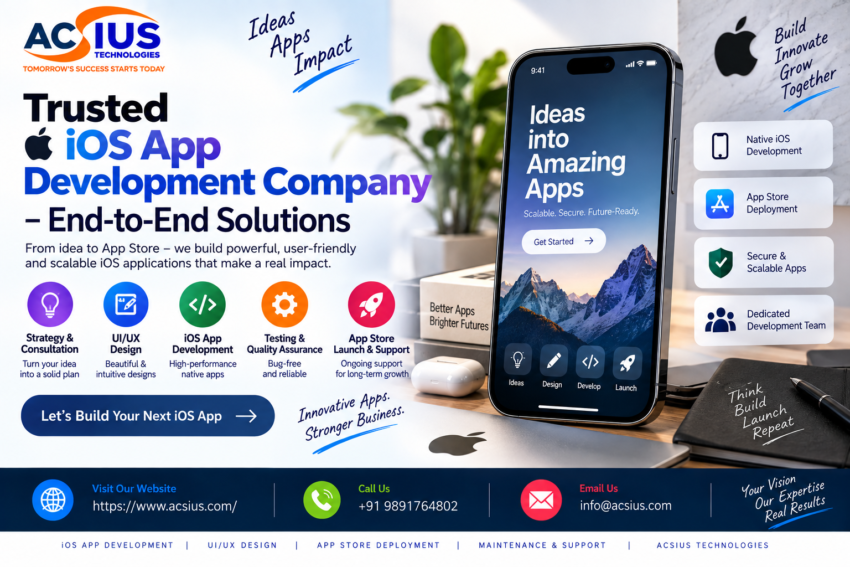
Apple’s ecosystem runs on a different set of expectations than the rest of the mobile world. iOS users tend to be less price-sensitive, more engaged, and quicker to abandon an app that feels slow, buggy, or visually inconsistent with the polish Apple has trained them to expect. If you’re planning to launch on the App Store, the margin for error is thinner than it looks — a beautiful concept can still fail commercially if the execution doesn’t match the platform’s standards for performance, design, and reliability.
That’s why choosing the right development partner for your iOS app isn’t just a technical decision, it’s a business decision that affects your launch timeline, your App Store approval odds, and ultimately your users’ first impression of your product. With so many agencies claiming iOS expertise, it helps to know exactly what separates a genuinely capable team from one that will leave you with a shaky, half-finished product six months and a drained budget later. Here’s what to actually look for.
Look for True End-to-End Capability, Not Just Coding
Building a successful iOS app involves far more than writing Swift code. A genuinely capable ios app development company should be able to guide you through the entire lifecycle: product strategy and discovery, UI/UX design tailored to Apple’s Human Interface Guidelines, development, rigorous QA testing across device types, App Store submission and compliance, and post-launch support and updates. If an agency’s pitch focuses purely on “we write clean code” without mentioning design collaboration, testing rigor, or App Store review strategy, you’re likely getting a narrow slice of what a full launch actually requires. Ask them directly to walk you through their process from initial concept to a live App Store listing, and pay attention to how thorough — or vague — their answer is.
Ask About Their Experience With App Store Review and Compliance
One of the most underestimated parts of iOS development is navigating Apple’s App Store review process, which has strict and sometimes unpredictable guidelines around privacy, in-app purchases, data collection, and design consistency. A rejected submission can add weeks to your launch timeline if the underlying issues aren’t caught early. Ask potential partners how many apps they’ve successfully submitted and approved, what common rejection reasons they’ve encountered, and how they proactively design around Apple’s guidelines rather than discovering problems only after submission. Experienced teams build compliance considerations into the development process from day one, not as an afterthought right before launch.
Consider Whether You’ll Need a Windows Presence Too
Depending on your business model, your audience might not be limited to mobile devices alone. If your product involves internal tools, enterprise dashboards, or desktop-based workflows alongside your consumer-facing iOS app, it’s worth checking whether your development partner can support that too. Working with a team that also offers strong Windows App Development Company expertise means you can build a consistent, connected experience across platforms without juggling multiple vendors who may not coordinate well on shared backend logic or design consistency. Even if a Windows app isn’t part of your immediate plan, having that capability available under one roof can save significant time if your roadmap expands later.
Don’t Overlook Android If Your Growth Plans Include It
iOS often gets prioritized first because of stronger monetization potential in many markets, but the overwhelming majority of smartphone users globally are on Android. If you plan to expand beyond iOS eventually — and most successful apps do — it makes sense to evaluate whether your development partner can also handle that expansion smoothly. A team that operates as a genuine android development company alongside their iOS work can build both platforms with shared design language, consistent backend integration, and coordinated release timing, rather than forcing you to onboard an entirely separate vendor and rebuild institutional knowledge about your product from scratch. Ask upfront about their Android capabilities even if your immediate focus is iOS-only, since it directly affects how easily you can scale later.
Review Their Design Process Closely
On iOS especially, design isn’t a cosmetic layer added after development — it’s central to whether users trust and enjoy your app. Ask to see the agency’s design process: do they create detailed wireframes and interactive prototypes before writing code? Do they test designs with real users, or rely purely on internal opinions? Do they have designers who specifically understand Apple’s design language, gestures, and interaction patterns, or do they treat iOS design the same as any other platform? A generic, cross-platform design approach often results in an app that feels technically functional but subtly “off” to iOS users who are used to a very particular look and feel.
Ask About Testing Rigor and Device Coverage
Apple’s device ecosystem is more controlled than Android’s fragmented hardware landscape, but that doesn’t mean testing is simple. Different iPhone models, screen sizes, iOS versions, and accessibility settings can all surface bugs that only appear on specific configurations. Ask how the agency approaches quality assurance — do they test manually, use automated testing frameworks, or both? How many device and OS version combinations do they typically test against before submission? A team that treats QA as a genuine discipline, rather than a quick pass right before launch, will catch issues that would otherwise surface as one-star reviews after your app goes live.
Evaluate Communication and Project Management
A strong technical team can still deliver a frustrating experience if communication is unclear or inconsistent. Ask how the agency structures updates — do you get regular demos, sprint reviews, or written progress reports? Will you have a single point of contact, or will you be shuffled between different people throughout the project? Ask how they handle scope changes, since most projects evolve as development progresses, and you want a partner who handles that flexibly and transparently rather than treating every change request as a battle over the contract.
Check Their Post-Launch Support Model
Launching your app on the App Store is the beginning of its lifecycle, not the end. You’ll need ongoing bug fixes, compatibility updates for new iOS versions, performance monitoring, and eventually new features as your user base grows and gives feedback. Ask what post-launch support looks like: is there a maintenance retainer available, how quickly do they respond to critical bugs, and do they proactively monitor for issues related to new iOS releases rather than waiting for you to report a problem? Apple updates iOS regularly, and an app that isn’t actively maintained can break unexpectedly when a new OS version rolls out.
Look at Real Client Feedback, Not Just Portfolio Screenshots
Portfolios show finished products, but they rarely reveal what the actual working relationship was like. Look for independent reviews beyond what’s featured on the agency’s own site, and if possible, speak directly with a past client whose project was similar in scope to yours. Ask about communication quality, whether timelines were realistic and met, and how the team handled unexpected challenges along the way. This kind of firsthand insight tells you far more about what to expect than any polished case study.
Trust the Relationship, Not Just the Pitch
At the end of the day, the agency you choose should feel like a genuine partner invested in your app’s success, not just a vendor executing a spec document. Pay attention to how thoughtfully they engage with your questions during initial conversations, how honestly they discuss trade-offs and realistic timelines, and how confident you feel handing them a project that matters to your business.
Building a trusted, high-quality iOS app takes more than technical skill alone — it requires design sensitivity, deep familiarity with Apple’s ecosystem, rigorous testing, and a genuine commitment to supporting your product long after launch. Take the time to ask detailed questions, review real client experiences, and choose a partner who can demonstrate true end-to-end capability rather than just a slice of the process.
If you’re looking for a partner that can deliver polished, reliable applications across iOS, Windows, and Android under one roof, ACSIUS is worth a conversation. With a track record of guiding products from concept through App Store launch and beyond, ACSIUS focuses on building end-to-end solutions designed around your specific goals — so the app you launch is one your users genuinely trust.