
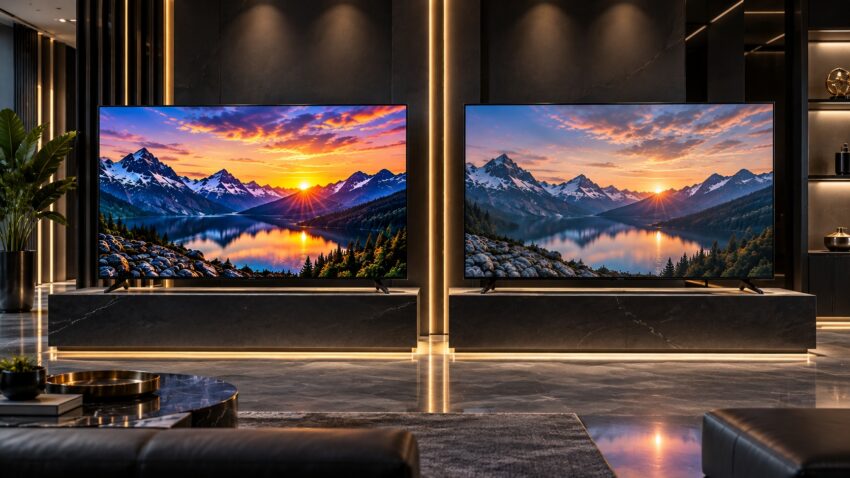
Buying a TV has become slightly confusing.
A few years ago, the decision was fairly simple. You looked at the screen size, checked the price, compared a couple of brands and made your choice.
Today, you get LED, QLED, Mini LED, OLED, 4K, HDR, different picture processors, gaming modes and a long list of other features.
And then comes the obvious question:
If two TVs are both 4K, why does one cost more than the other?
That’s exactly where the conversation around the VU Glo Mini LED TV gets interesting.
But I’m not going to tell you that Mini LED is automatically the right choice for everyone. It isn’t.
A regular LED TV can still be a very good television.
The better question is what you’re actually gaining by moving from LED to Mini LED—and whether you’ll notice that difference in your own room.
What is actually different between Mini LED and LED TV?
The easiest way to understand it is to forget the marketing names for a moment.
Both televisions use an LCD panel. The major difference is what’s happening behind that panel.
A traditional LED TV uses LEDs as its backlight. Mini LED uses much smaller LEDs, giving the display more control over how light is distributed behind the screen.
You don’t see those LEDs directly.
What you see is the result.
That can affect:
- How dark a black scene looks
- How bright highlights appear
- How much contrast you see
- How HDR content feels
- How much depth an image has
- How the screen behaves in a bright room
So Mini LED TV vs LED TV isn’t really a fight between two different resolutions.
It’s more about how well the display manages the picture you’re already getting from those pixels.
Will you notice the difference when you watch TV every day?
This is where I’d be careful with expectations.
You won’t necessarily sit down on day one and think, “Wow, everything looks completely different.”
Some content simply doesn’t show the difference very well.
A normal TV channel, an old YouTube video or compressed online content may look fairly similar on both displays.
The difference becomes easier to see when the content itself is good enough to reveal it.
For example:
- A movie with dark scenes
- A high-quality OTT stream
- HDR content
- A cricket or football match
- A detailed nature documentary
- A game with lots of movement and lighting effects
That’s why I prefer judging a TV with real viewing situations, rather than relying entirely on a showroom demo.
If you watch cricket every weekend, test cricket.
If you’re a movie person, watch a movie scene.
It sounds obvious, but people often forget to do it.
Why do dark scenes look different?
This is probably one of the first areas where you can appreciate better backlight control.
Picture a scene from a thriller.
It’s late at night. The room is almost completely dark. There’s one small lamp in the background and a character standing nearby.
The scene has very bright and very dark elements sitting close together.
A display with less precise backlight control may make the darker areas look slightly lifted. Instead of looking properly dark, they can take on a greyish appearance.
With Mini LED technology, the smaller LEDs allow the backlight to be controlled more precisely.
That can help create:
- Deeper-looking dark areas
- Better separation between light and shadow
- More visible detail in darker scenes
- A stronger sense of depth
You may not care about this if you mostly watch daytime television.
But if you enjoy movies, especially darker ones, it’s a difference worth paying attention to.
Is a brighter TV automatically a better TV?
Not really.
This is one of those specifications that can be misunderstood.
Nobody wants to watch television with the entire screen blasting at maximum brightness all the time.
What matters is how the TV handles bright and dark areas together.
Take a simple sunset scene.
There’s the bright sun, a colourful sky, buildings in the distance and darker objects in the foreground.
You don’t want the sun to look good at the expense of everything around it.
You want the TV to maintain the different levels of light in the same image.
This becomes especially useful in rooms with lots of natural light.
If your TV is sitting opposite a large window, for example, a display with stronger brightness can be much easier to live with during the day.
Will colours look noticeably better?
Maybe but don’t give Mini LED all the credit for that.
Mini LED mainly changes how the backlight works. Colour performance depends on other parts of the display too.
Panel technology, processing, calibration and picture settings all play a role.
What better backlight control can do is give the picture a stronger foundation.
When bright colours appear against darker areas, for example, the image can feel more pronounced.
You might notice:
- More separation between shades
- Better-looking highlights
- More depth in colourful scenes
- A stronger HDR presentation
But there’s something I personally think is more important than extremely bright colours:
Natural colours.
A TV doesn’t need to make every red, green and blue look exaggerated to produce a good picture.
If people’s skin tones look believable and the overall image feels balanced, that’s usually a much better sign.
What difference does HDR actually make?
HDR sounds impressive on a specification sheet.
But simply having HDR support doesn’t tell you how good the HDR experience will be.
Think about what HDR is trying to show you: very bright highlights alongside much darker parts of the image.
For the TV to reproduce that properly, several things need to work together.
These include:
- Brightness
- Contrast
- Backlight control
- Image processing
- HDR content quality
So if you’re comparing a VU Mini LED TV with a regular LED model, don’t stop at the words “HDR supported.”
Look at the actual picture.
Does the bright part of the scene stand out?
Can you still see detail in the shadows?
Does the image look balanced rather than washed out?
Those are the questions that matter.
What about a bright living room or office?
This is one situation where your room can make a surprisingly big difference.
A television may look fantastic in a dark showroom and then feel less impressive once you put it in a room with sunlight coming through the windows.
Before choosing a VU Glo Mini LED TV, have a look around the space where you’re going to install it.
Ask yourself:
- Is there direct sunlight on the screen?
- Are there large windows nearby?
- Do ceiling lights reflect on the panel?
- Will people sit directly in front of it?
- Will people view it from the sides?
- Will the TV be used mostly during the day?
These aren’t glamorous questions, but they’re useful ones.
The best display on paper won’t feel like the best display if reflections constantly distract you.
Does the difference become more obvious on a big screen?
Usually, yes.
The larger the screen, the more attention you naturally pay to the picture.
On a large display, weaknesses that were barely noticeable on a smaller TV can become much easier to spot.
You might notice:
- Weak contrast
- Uneven brightness
- Reflections
- Poor upscaling
- Motion problems
- Lack of fine detail
This is particularly relevant for businesses.
A large screen in a reception area, boardroom, showroom or executive office isn’t being viewed by just one person sitting directly in front of it.
People may be standing, walking past or sitting at different angles.
In that situation, the overall quality of the display matters more.
Does Mini LED make a difference for sports and gaming?
It can, depending on what you’re looking for.
Sports are a good example because there is a lot happening on the screen at once.
Think about a cricket match:
- Bright stadium lights
- Fast-moving players
- Green grass
- Large areas of colour
- Darker sections in the stands
A display needs to handle all of that without making the image look messy.
Gaming can reveal different strengths.
Fast movement, response and clarity become more important, particularly when you’re playing visually demanding games.
So if the TV is going to be used for more than casual viewing, a VU 4K Mini LED TV can be worth investigating.
But again, use your own priorities as the filter.
Does everyone need a Mini LED TV?
No and I think this is an important point.
There’s nothing wrong with choosing a regular LED TV if it already does what you need.
A conventional LED model can make sense when:
- You mainly watch regular TV channels.
- The television isn’t used very often.
- You’re working with a strict budget.
- You don’t watch much HDR content.
- Premium picture quality isn’t a major priority.
Spending more only makes sense when you can identify what you’re getting in return.
If you won’t notice the improvement, there’s little reason to pay for it.
When does upgrading to Mini LED make more sense?
I’d consider Mini LED more seriously if several of these sound familiar:
- You watch a lot of movies and OTT content.
- You prefer a larger screen.
- Your room gets quite bright.
- Dark-scene performance matters to you.
- You regularly watch HDR content.
- Sports or gaming are important.
- You’re building a premium entertainment setup.
- The TV will be used heavily for several years.
For a business, there is one additional question:
How many hours will the screen actually be used?
If it’s running regularly in a reception area, client lounge, showroom or executive office, the viewing experience has more value than it would on a screen that gets switched on once or twice a week.
That’s where ROI thinking becomes useful.
What should you check before buying?
Don’t make the decision simply because one TV says “Mini LED” and another says “LED.”
Look at the complete setup.
Before buying, consider:
- Room lighting – Bright room or dark room?
- Screen size – Does it suit the space?
- Viewing distance – How far will people sit?
- Content – Movies, sports, gaming, TV channels or presentations?
- Picture quality – How does the actual image look?
- Connectivity – Will your existing devices work comfortably?
- Installation – Wall mounting and placement matter.
- Budget – What is the sensible spending limit?
- Usage – Occasional viewing or several hours every day?
- Long-term value – Will you still appreciate the upgrade a few years from now?
This checklist is much more useful than comparing one impressive number against another.
So, is Mini LED actually better than LED?
In certain areas, it can provide a better viewing experience.
But “better” doesn’t automatically mean “better for you.”
A regular LED TV may be exactly what someone needs.
A Mini LED display starts making more sense when you care about things such as contrast, bright-room performance, dark scenes, HDR and large-screen viewing.
And that’s really the point.
The decision shouldn’t be:
“Mini LED is newer, so I should buy it.”
It should be:
“Will I actually benefit from what Mini LED offers?”
Final Thoughts
The VU Glo Mini LED TV is worth considering if you’re looking beyond basic 4K resolution and want to understand what you’re getting from the display technology itself.
But don’t buy it just because the name sounds more advanced.
Look at your room.
Think about what you watch.
Consider how often the TV will be used.
And most importantly, compare the picture with content that actually matters to you.
For a home, that could be movies and OTT shows.
For a business, it could be presentations, client-facing content or a premium reception environment.
At the end of the day, the best television isn’t necessarily the one with the longest specification sheet.
It’s the one where you can actually see the difference and feel that the extra money was worth it.