

The way people search for information online continues to evolve. For many years, typing keywords into a search engine was the primary way people discovered websites, products, services, and local businesses. Today, voice-enabled technology is adding another layer to the search experience.
People can ask questions using smartphones, smart speakers, cars, and other connected devices. Instead of typing a short phrase such as “best restaurant Kolkata,” a user might ask, “What are the best restaurants near me that are open tonight?”
This change in search behavior creates new opportunities for businesses. Voice search SEO focuses on making online content easier for search engines and voice-enabled systems to understand when people use conversational queries.
Businesses that begin adapting their SEO strategies to conversational and question-based searches can create a stronger foundation for changing search habits.
What Is Voice Search SEO?
Voice search SEO is the process of optimizing a website and its content for searches made through voice commands.
Traditional searches often contain only a few words. Voice searches tend to be more conversational and may resemble complete questions.
For example:
Traditional search: “digital marketing company Kolkata”
Voice-style search: “Which digital marketing companies in Kolkata can help my business grow online?”
This difference matters because businesses need to understand not only the keywords people use but also the intent behind those searches.
Voice SEO is therefore closely connected with conversational content, local search, mobile optimization, structured information, and clear answers to common questions.
Why Voice Search Matters for Businesses
Voice-enabled technology has become part of many everyday digital experiences. Smartphones and smart devices allow users to search for information without manually typing.
Companies such as Google, Amazon, and Apple have developed technologies and devices that support voice-based interactions.
For businesses, this means search optimization increasingly needs to consider how customers naturally ask questions.
A local customer might ask:
-
“Where is the nearest pharmacy?”
-
“What time does this store open?”
-
“Who provides digital marketing services near me?”
-
“Which restaurants are open now?”
Businesses that provide clear, accurate, and easily accessible information can improve their chances of being useful for these types of searches.
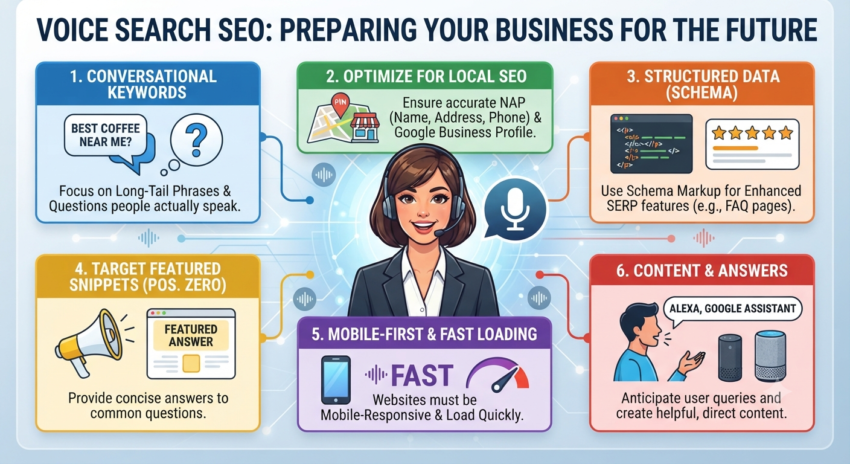
1. Focus on Conversational Keywords
One of the first steps toward voice search optimization is understanding conversational search terms.
People often use natural language when speaking. Instead of targeting only short keywords, businesses can identify longer phrases and questions related to their products or services.
For example, a fitness center could target questions such as:
“Where can I find a personal trainer near me?”
“What exercises are suitable for beginners?”
“What time does the gym open?”
These questions can become topics for website pages, blog posts, FAQs, and other useful content.
2. Create Question-Based Content
Voice searches frequently take the form of questions.
Businesses can create dedicated FAQ sections that answer common customer questions directly. Blog posts can also be structured around questions relevant to a particular industry.
For example, a web development company could create articles covering:
-
How much does a business website cost?
-
How long does website development take?
-
What features should a business website have?
-
How can a website generate leads?
Providing direct and useful answers can make content more valuable to both users and search systems.
3. Improve Local SEO
Voice search and local SEO can work closely together because many voice searches have local intent.
Users frequently search for businesses, services, opening hours, directions, and locations.
Businesses should make sure their name, address, phone number, website, business category, and opening hours are accurate across relevant online listings.
A properly maintained Google Business Profile can also help a local business provide important information to potential customers.
Restaurants, salons, clinics, retailers, repair services, and other location-based businesses can particularly benefit from maintaining accurate local information.
4. Make Websites Mobile-Friendly
Many voice searches happen through mobile devices. This makes mobile website performance an important part of a broader SEO strategy.
A mobile-friendly website should be easy to navigate, readable on smaller screens, and reasonably fast.
Businesses should also make important information easy to find. Contact details, location information, services, pricing information, and frequently asked questions should not be unnecessarily difficult to access.
A positive mobile experience can benefit users regardless of whether they arrive through voice search or traditional search.
5. Improve Website Speed
Website speed affects user experience. If a website takes too long to load, visitors may leave before finding the information they need.
Businesses should review large images, unnecessary scripts, hosting performance, caching, and other technical factors that can affect page speed.
Improving website performance is not exclusively a voice SEO tactic. It is part of creating a better overall website experience.
6. Use Structured Information
Search engines need to understand what a website is about. Structured data can provide additional information about certain types of content in a machine-readable format.
Depending on the business, structured data may be relevant for information such as products, organizations, events, articles, recipes, or local businesses.
Correct implementation should follow search engine guidelines and be based on the actual content available on the page.
7. Provide Clear and Direct Answers
When users ask questions, they generally want useful answers rather than complicated explanations.
Businesses can structure some content around concise answers followed by additional detail.
For example, an article about “How long does SEO take?” could begin with a short explanation and then provide a detailed discussion of the factors that influence SEO performance.
This format can make content easier for visitors to understand while also organizing information clearly.
8. Understand Search Intent
Keywords alone do not explain why someone is searching.
A person searching “running shoes” could be looking for product information, reviews, prices, or a place to purchase shoes.
A person asking “Where can I buy running shoes near me?” has a much stronger local and transactional intent.
Businesses should therefore create content that matches different stages of the customer journey.
Understanding search intent can make an SEO strategy more useful across both traditional and conversational searches.
9. Keep Business Information Accurate
For local businesses, incorrect information can create confusion.
Imagine a customer asking a voice assistant for a nearby store and receiving an outdated address or incorrect opening time.
Businesses should regularly review their online listings and update important details when something changes.
Consistency across business directories, websites, and social profiles can help customers find accurate information.
10. The Role of Digital Marketing Bucks
Preparing for changing search behavior requires more than adding a few conversational keywords to a website.
Digital Marketing Bucks is a digital marketing company that can help businesses develop strategies across SEO, local SEO, content marketing, social media marketing, paid advertising, and online brand promotion.
As a top digital marketing company, Digital Marketing Bucks can help businesses evaluate their existing online presence and develop content around relevant customer questions, search intent, local visibility, and website experience.
The company can also integrate voice-search considerations into a broader SEO strategy instead of treating voice search as a completely separate marketing activity.
For businesses that want to prepare their online presence for evolving search behavior, Digital Marketing Bucks can provide a structured approach that combines SEO fundamentals with newer digital marketing opportunities.
The Future of Voice Search SEO
Voice technology is continuing to develop alongside artificial intelligence, mobile technology, smart devices, and conversational search.
Businesses should not treat voice search as a replacement for traditional SEO. Instead, voice optimization can be viewed as an extension of good SEO practices.
Creating useful content, answering customer questions, maintaining accurate business information, improving website performance, and understanding search intent can benefit users regardless of how they search.
Conclusion
Voice search is changing how people interact with search technology. Instead of relying exclusively on short typed keywords, users can ask complete questions and expect quick, relevant information.
Businesses can prepare by creating conversational content, answering common questions, improving local SEO, maintaining accurate business information, optimizing websites for mobile users, and focusing on search intent.
Voice search SEO is not about predicting every question a customer might ask. It is about building an online presence that is useful, accessible, technically sound, and easy to understand.
With professional support from a digital marketing company such as
Digital Marketing Bucks, businesses can incorporate voice-search considerations into their wider SEO strategy and prepare their online presence for the continuing evolution of search.