

Why the Accommodation Format Matters More Than Most Travellers Realise
There is a version of every India trip — the work relocation, the family move, the luxury holiday, the extended project — where the accommodation choice is the decision that quietly determines whether the whole experience works or doesn’t. Not the flight, not the city, not even the budget. The format of where you stay, and whether it actually fits the purpose of the trip, shapes every day that follows in ways that only become obvious once you’re living them.
A professional on a four-month Mumbai assignment who books a hotel because it’s the fastest option will, somewhere around week three, start calculating what those nightly rates add up to across sixteen weeks and then look at the kitchen-less room they’re living in and understand something important about the difference between a place to sleep and a place to live. A family relocating to Gurgaon who picks a two-bedroom apartment without checking which side of the city their children’s school is on will spend the next year adding forty minutes to every school run. A group of friends who books hotel rooms in Goa when a private villa would have cost the same per person will spend a week sharing pool hours with strangers instead of having a home they can disappear into.
These are not rare mistakes. They are extremely common ones, and they share a single cause: choosing accommodation before understanding which format the trip actually requires.
Mumbai: Three Different Trips, Three Different Needs
Mumbai draws more distinct types of long-stay visitors than almost any other Indian city, and the accommodation that works for one type frequently doesn’t work for another. Understanding this before booking saves significant money and frustration.
The corporate or financial services assignment is the most common driver of long-stay accommodation demand in Mumbai. Senior professionals arriving for six to eighteen months from other cities or from abroad need something fundamentally different from a hotel room — a private, properly equipped space where they can decompress after demanding days without the ambient noise and constrained square footage of even a premium hotel. Serviced apartments in Mumbai solve this problem directly: real kitchens, separate bedrooms, dedicated workspace, housekeeping on a schedule, and monthly lease terms that make financial sense for a stay that will last most of a year.
What makes Mumbai specifically demanding from an accommodation perspective is the city’s traffic. Mumbai is linear and dense in a way that means location selection is more consequential here than in most other Indian cities. The distance between Bandra Kurla Complex — the city’s primary financial district — and Lower Parel, another major office cluster, looks manageable on a map and is not manageable at 9am on a Monday. Professionals seeking corporate serviced apartments in Mumbai who pick a neighbourhood based on general appeal rather than specific commute distance from their office can easily add an hour to their daily travel that never needed to be there. BKC-anchored professionals belong in Bandra or nearby. Lower Parel professionals are better served by Worli or Prabhadevi. Powai suits IT professionals whose offices are in the eastern technology cluster around IIT Bombay.
The relocation for a long stay follows a different logic. A family moving to Mumbai on a multi-year assignment needs proximity to international schools, access to good hospitals, and enough space that adults and children aren’t occupying the same room for different purposes simultaneously. Serviced apartments in Mumbai for long stay at the 2 BHK and 3 BHK level, in areas like Bandra and Andheri that have concentrated the city’s international school infrastructure, address this differently from the solo professional’s studio or 1 BHK requirement. The kitchen stops being a nice-to-have and becomes essential for managing children’s meal schedules. The second bedroom stops being a space optimisation and becomes a fundamental requirement for maintaining any sense of daily normality.
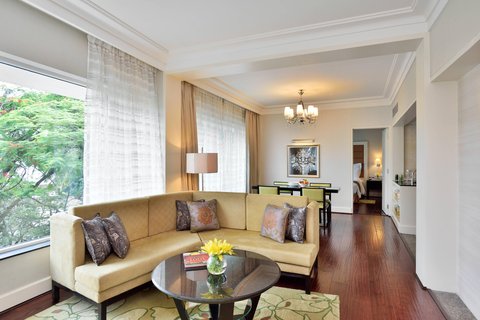
The luxury extended stay — a senior executive, an expat couple without children, a professional who simply wants a premium experience for a six-month posting — has its own requirements. Luxury serviced apartments in Mumbai at this level provide the finish quality and management standard of a five-star hotel alongside the domestic functionality of a private apartment: premium kitchen equipment, high-quality linen and furnishings, concierge-level villa management, and a location in the city’s most desirable neighbourhoods. For this profile, the comparison isn’t hotel versus apartment — it’s what kind of apartment, and at what level of finish and service, delivers the right daily experience for a stay that will define a significant period of someone’s professional life.
Gurgaon: Why Location Within the City Is the Only Question That Matters
Gurgaon’s accommodation market is shaped almost entirely by the city’s geography, and the geography is less obvious than it appears. The city is not one neighbourhood with different price points — it is a series of distinct business and residential corridors that function almost independently of each other, connected by roads that carry varying levels of congestion at different times of day.
Serviced apartments in Gurgaon for rent cluster most heavily around the corridors that draw the most sustained professional demand — Golf Course Road, DLF Phase 1, MG Road, Sector 38, Sushant Lok Phase 1, and the areas immediately adjacent to DLF Cyber Hub. Each of these suits a slightly different professional profile. Cyber Hub and MG Road suit professionals whose offices are in the city’s central corporate belt. Sector 38 sits adjacent to Medanta — the right choice for professionals or families in Gurgaon for extended medical care. Golf Course Road and Sushant Lok serve senior professionals and expat families who need proximity to international schools and premium healthcare alongside office access.
Serviced apartments in Gurgaon at the standard level — studios and 1 BHKs for solo professionals on short to medium assignments — provide the fundamental advantages of the format at accessible price points: real kitchen, proper bedroom, housekeeping, flexible monthly terms. At the luxury level, the same format upgrades to premium finishes, larger configurations, and higher-specification kitchen and bathroom equipment. Luxury serviced apartments in Gurgaon serve senior professionals and expat families who need the apartment to function as a genuinely high-quality home rather than a functional base — properties where the design, the finish, and the management standard are comparable to five-star hotel standards while the format remains domestic rather than institutional.
For families specifically, 2 BHK serviced apartments in Gurgaon represent the most practical configuration — enough space for adults and children to inhabit separately, a kitchen adequate for daily family meal preparation, and a living area where the family can actually spend time together without the entire domestic life of the household happening in one room. The specific neighbourhoods that suit families most — Sushant Lok Phase 1, South City, DLF Phase 4 — are determined primarily by school location rather than office proximity, which means the school decision should drive the accommodation decision rather than the reverse.
Pune: The City That Rewards Whoever Maps Their Route First
Pune has become one of India’s most significant technology and manufacturing cities, and its accommodation market has developed in direct response to the professional demand that growth has generated. The challenge, as with Gurgaon, is geography — but Pune’s version of the problem is different.
Where Gurgaon’s corridors are broadly linear, Pune’s key business districts sit at opposite ends of a city large enough that crossing it during peak traffic takes far longer than the map suggests. Hinjewadi’s IT parks sit on the western edge. Kharadi’s growing technology cluster is in the east. Kalyani Nagar, Koregaon Park, and Viman Nagar occupy the middle ground in terms of geography but not necessarily in terms of commute, because “middle ground” on a map doesn’t mean equidistant from both ends in traffic conditions.
Serviced apartments in Pune — or service apts in Pune as many professionals searching locally refer to them — are most useful when the location decision has been made correctly before the property is chosen. A professional with an office in Hinjewadi who books accommodation in Kalyani Nagar because it seems central will spend their Pune assignment adding an hour or more to their daily travel that the right location decision would have entirely avoided. The rule in Pune is simple and inflexible: identify the office address first, map the real traffic commute from three or four candidate neighbourhoods, and then begin looking at apartments. Every other criterion — price, finish level, pool, gym — is secondary to getting this right.
For expats and families specifically, Kalyani Nagar and Koregaon Park offer the combination of international schools, good hospitals, premium restaurants, and residential quality that makes a multi-year Pune posting genuinely liveable rather than merely manageable. These areas attract the highest demand from long-stay international professionals, which means accommodation here books faster and prices run higher — but for families relocating with children and a defined school requirement, the location premium is usually worth paying rather than saving money on rent and spending it on time.
Goa and Jaipur: When the Holiday Itself Becomes the Accommodation
The serviced apartment format serves a very specific purpose — it solves the long-stay professional accommodation problem by providing a private, managed, domestic space in a city context. But there is another kind of trip entirely where neither a hotel nor a serviced apartment is actually the right answer.
A group of eight friends taking a ten-day Goa holiday doesn’t need a managed apartment in a city — they need a complete private property with its own pool, their own outdoor space, a cook who prepares meals when the group wants them, and a villa manager who handles logistics so nobody has to. Luxury villas in Goa, particularly in the northern coastal belt around Morjim, Assagao, and Vagator, deliver this in a way that hotels and serviced apartments structurally cannot — the privacy is complete, the space is genuine, and the experience of the holiday changes fundamentally from “staying somewhere nice” to “living somewhere extraordinary for ten days.”
The economics of this format work most powerfully for groups. A villa sleeping eight or ten people, at rates that look significant in absolute terms, often works out cheaper per person than two or three premium hotel rooms during peak Goa season — while delivering an experience that has no hotel equivalent. The pool belongs to your group. The terrace belongs to your group. The morning does not involve navigating a breakfast buffet or queuing for sunbeds that someone else has reserved with a towel at 7am.
Jaipur offers the same format in a completely different aesthetic register. Luxury villas in Jaipur — heritage havelis with original Rajasthani courtyard architecture, palace annexes from the Rajputana period, and purpose-built properties in the city’s distinctive pink-stone vocabulary — provide the villa experience within one of India’s most culturally and architecturally rich cities. Where a Goa villa is built around the rhythm of the coast, a Jaipur villa is built around cultural immersion — the Amber Fort, the City Palace complex, the old city’s textile and jewellery markets, and a restaurant scene that has developed significantly over the last decade. The villa becomes a private base from which the city gets explored, with all the advantages of complete privacy and dedicated staff alongside proximity to everything that makes Jaipur worth visiting.
AdoPremium manages properties across all four of these destinations — serviced apartments in Mumbai, Gurgaon, and Pune, and luxury villas in Goa and Jaipur — under a consistent management standard that makes cross-destination comparison straightforward for anyone planning a trip that involves more than one of these locations, or simply trying to understand what the category benchmark looks like before beginning a broader search.
Conclusion
The accommodation decision that works for a four-month corporate posting in Mumbai is not the accommodation decision that works for a ten-day group holiday in Goa. The apartment configuration that suits a solo consultant in Gurgaon is not the configuration that suits a family relocating with two school-age children. Getting this right starts not with browsing listings but with an honest understanding of what the trip is actually for.
Serviced apartments in Mumbai, Gurgaon, and Pune exist to solve the long-stay professional accommodation problem — providing private, managed, domestic space in city contexts where hotels become unsustainable and standard leases are inflexible. Luxury villas in Goa and Jaipur exist to solve a completely different problem — providing complete private properties for group holidays where the accommodation is itself a meaningful part of the experience.
Both formats deliver significantly better outcomes than their default alternatives — hotel rooms for long stays, resort bookings for group holidays — when chosen correctly and with the specific requirements of the trip clearly in mind. The guests who are most satisfied with their accommodation choices are almost always those who spent time understanding what format they actually needed before they started comparing individual properties. That single step, done honestly and before any booking commitment is made, changes the quality of the experience that follows more than any individual property feature ever could.