
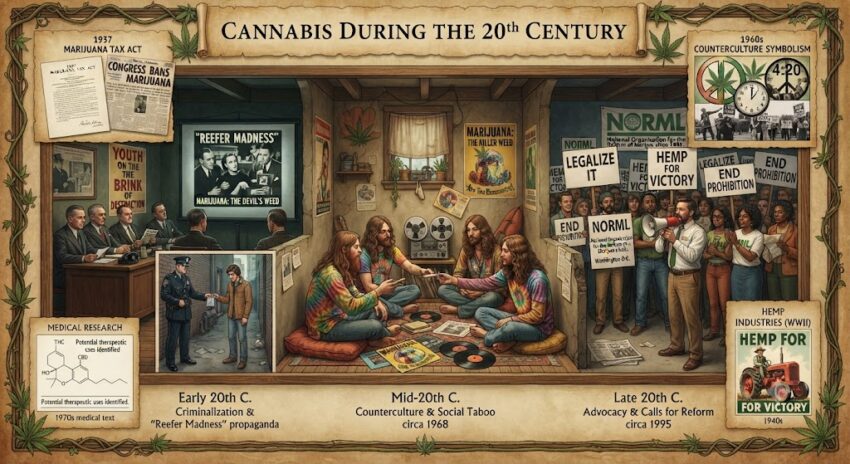
Cannabis During the 20th Century
SEO Title
Cannabis During the 20th Century: Prohibition, Culture, Research, and Legal Change
Meta Description
Explore cannabis during the 20th century, including traditional uses, prohibition, cultural movements, scientific research, changing public attitudes, and early legal reforms.
Focus Keyword
Cannabis During the 20th Century
URL Slug
cannabis-during-the-20th-century
Cannabis underwent major social, political, cultural, and scientific changes during the 20th century. At the beginning of the century, cannabis was known in different regions for agricultural, industrial, and traditional uses. Over the following decades, governments introduced increasingly restrictive policies, while researchers continued investigating the plant and its chemical compounds.
By the end of the century, cannabis had become the subject of renewed scientific interest, public debate, political activism, and early legalization efforts. Understanding cannabis during the 20th century helps explain many of the regulatory and cultural developments that continue to influence the industry today.
Cannabis at the Beginning of the 20th Century
At the start of the 1900s, cannabis was already known in different parts of the world.
Its historical roles included:
-
Agricultural production
-
Hemp fiber
-
Traditional plant practices
-
Seed and oil production
-
Textile manufacturing
The plant’s role varied significantly between countries and cultures.
The Growth of Cannabis Restrictions
During the early decades of the 20th century, governments in several countries introduced laws controlling cannabis and other substances.
These policies affected:
-
Cultivation
-
Possession
-
Distribution
-
Medical access
-
Commercial production
The reasons for these policies differed between jurisdictions and were influenced by public health concerns, political developments, social attitudes, and international drug-control efforts.
International Drug-Control Policies
International agreements increasingly influenced national approaches to controlled substances during the 20th century.
Governments developed systems involving:
-
Drug scheduling
-
Licensing
-
Restrictions on cultivation
-
Import and export controls
-
Law-enforcement measures
These policies contributed to a more restrictive international environment for cannabis.
Cannabis Prohibition in the United States
Cannabis regulation became increasingly restrictive in the United States during the 20th century.
Federal legislation and enforcement policies contributed to significant changes in how cannabis was cultivated, distributed, researched, and discussed.
The regulatory environment also influenced public perceptions and contributed to the growth of illicit markets.
The Marihuana Tax Act
The Marihuana Tax Act of 1937 became an important milestone in the history of U.S. cannabis policy.
The law imposed federal controls and taxation requirements that significantly affected cannabis-related activities.
Its passage marked an important stage in the development of restrictive federal cannabis policies.
The Controlled Substances Act
A major shift occurred in the United States with the Controlled Substances Act of 1970.
Cannabis was placed in Schedule I under the federal system, alongside other substances considered to have a high potential for abuse and no accepted medical use under federal law at that time.
This classification had long-lasting effects on cannabis research and policy.
Cannabis and Scientific Research
Scientific research continued throughout the 20th century despite regulatory restrictions.
Researchers increasingly investigated:
-
Cannabis chemistry
-
Cannabinoids
-
Pharmacology
-
Toxicology
-
Biological effects
-
Potential therapeutic applications
These studies gradually provided a more detailed scientific understanding of the plant.
The Discovery of THC
One of the most important developments in cannabis research occurred in the 1960s, when researchers isolated and characterized delta-9-tetrahydrocannabinol, commonly known as THC.
The identification of THC helped scientists better understand the chemical basis of cannabis effects and encouraged further cannabinoid research.
The Discovery of the Endocannabinoid System
Research into cannabinoids eventually contributed to the discovery of the endocannabinoid system.
Scientists identified important components including:
-
Cannabinoid receptors
-
Endogenous cannabinoids
-
Related enzymes
-
Signaling pathways
This work expanded scientific interest in how cannabinoids interact with biological systems.
Cannabis and Counterculture
During the 1960s and 1970s, cannabis became strongly associated with counterculture movements in parts of the Western world.
It appeared alongside discussions about:
-
Music
-
Art
-
Social change
-
Political activism
-
Personal freedom
This association contributed to a cultural image that differed from official government messaging.
Cannabis in Music and Popular Culture
Cannabis became increasingly visible in music, film, literature, and other forms of popular culture.
Its portrayal varied widely and included:
-
Comedy
-
Rebellion
-
Social commentary
-
Counterculture imagery
-
Political expression
Popular culture helped shape public discussions about cannabis, particularly among younger generations.
The War on Drugs
During the latter part of the 20th century, governments expanded drug-control campaigns.
In the United States, the War on Drugs contributed to increased enforcement and criminal penalties related to controlled substances.
These policies had significant social and legal consequences and remain an important subject of historical and policy research.
Cannabis and Medical Research
Despite restrictions, researchers continued investigating possible medical applications.
Scientific interest included research into:
-
Cannabinoid pharmacology
-
Pain-related mechanisms
-
Neurological conditions
-
Appetite regulation
-
Other potential therapeutic applications
The evidence and legal status of specific medical uses varied considerably.
The Emergence of Medical Cannabis Reform
Toward the end of the 20th century, some jurisdictions began reconsidering cannabis policies.
In the United States, California became the first state to establish a medical cannabis initiative when voters approved Proposition 215 in 1996.
Other jurisdictions subsequently introduced their own medical cannabis policies.
Changing Public Attitudes
Public attitudes toward cannabis began changing in some countries during the later decades of the century.
Factors included:
-
Scientific research
-
Medical cannabis advocacy
-
Social movements
-
Generational changes
-
Policy debates
-
Media coverage
However, attitudes remained highly divided across communities and countries.
The Growth of Cannabis Advocacy
Cannabis advocacy organizations became increasingly active during the second half of the century.
Advocacy efforts often focused on:
-
Legal reform
-
Medical access
-
Criminal justice
-
Research restrictions
-
Public education
These movements helped bring cannabis policy into broader political discussions.
Cannabis and the Early Legal Market
By the end of the 20th century, legal cannabis markets were still limited compared with today’s industry.
However, early medical reforms established foundations for later developments involving:
-
Licensed cultivation
-
Regulated distribution
-
Medical dispensaries
-
Product standards
-
Cannabis business regulation
These early systems provided experience that influenced later legalization efforts.
Cannabis at the End of the 20th Century
By the year 2000, cannabis had developed a complex modern identity.
It was simultaneously associated with:
-
Criminal law
-
Medical research
-
Political reform
-
Counterculture
-
Agriculture
-
Emerging regulated markets
The developments of the century created many of the conditions that would shape cannabis policy and commerce in the 21st century.
Lessons From 20th-Century Cannabis History
The history of cannabis during the 20th century demonstrates how scientific knowledge, cultural attitudes, and government policies can change over time.
It also shows the importance of distinguishing between:
-
Historical claims
-
Personal experiences
-
Political arguments
-
Scientific evidence
-
Legal requirements
This distinction remains important in modern cannabis discussions.
Weed Roads
For consumers looking for quality cannabis products, Weed Roads focuses on quality, transparency, and customer education. Understanding cannabis during the 20th century provides valuable historical context for today’s changing regulations, consumer expectations, research, and legal cannabis markets.
Conclusion
Cannabis during the 20th century was shaped by dramatic changes in regulation, science, culture, and public opinion. The century saw the expansion of prohibition, the development of international drug-control systems, growing counterculture associations, major scientific discoveries, and the beginning of modern cannabis reform.
By the final decades of the century, scientific research and changing public attitudes were challenging some long-standing assumptions about cannabis. Early medical cannabis reforms also established foundations for the regulated markets and policy changes that would expand significantly in the 21st century.
#CannabisHistory
#20thCenturyHistory
#CannabisResearch
#CannabisPolicy
#CannabisCulture