

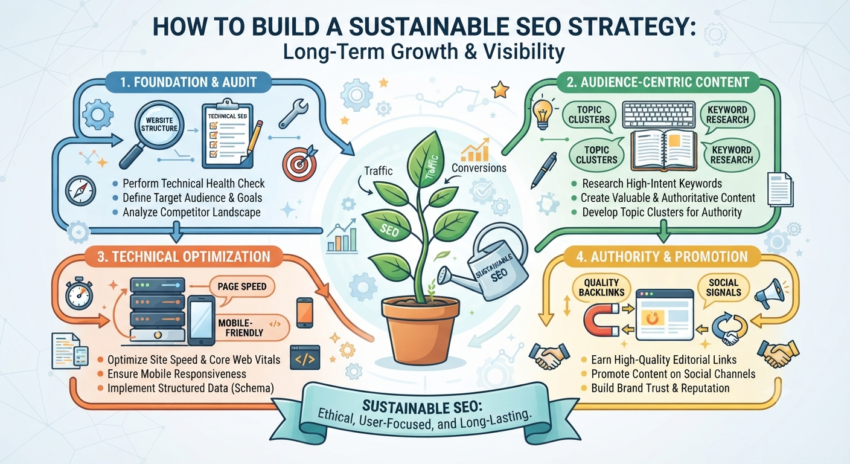
Search engine optimization is often viewed as a way to increase website traffic, but sustainable SEO is about much more than chasing higher rankings. Search engines continually evolve, competitors publish new content, and customer search behavior changes over time. Because of this, businesses need an SEO strategy that can adapt while consistently delivering useful information to their audiences.
A sustainable SEO strategy focuses on valuable content, technical website health, user experience, relevant keywords, trustworthy authority, and continuous measurement. Instead of looking for quick shortcuts, businesses can build a strong digital foundation that supports organic visibility over the long term.
What Is a Sustainable SEO Strategy?
A sustainable SEO strategy is a long-term approach to improving a website’s organic search presence without depending on manipulative tactics or temporary trends.
It combines several areas of SEO, including:
-
Keyword research
-
Content creation
-
Technical SEO
-
On-page optimization
-
Internal linking
-
Backlink development
-
Local SEO
-
User experience
-
Performance analysis
The objective is to create a website that is useful to visitors and easy for search engines to understand.
1. Start With Clear Business Goals
SEO should support broader business objectives.
Before creating an SEO plan, businesses should decide what they want organic search to accomplish.
Possible goals include:
-
Increasing qualified website traffic
-
Generating leads
-
Increasing online sales
-
Growing local visibility
-
Building brand awareness
-
Promoting specific services
-
Increasing content engagement
For example, an online store may focus on product and category visibility, while a local service provider may prioritize location-based searches.
Clear objectives make it easier to choose appropriate keywords and measure progress.
2. Understand Your Target Audience
Sustainable SEO starts with understanding the people you want to reach.
Businesses should identify the questions customers ask, problems they want to solve, products they compare, and information they need before making a purchase.
For example, someone searching for “best accounting software for small business” may be researching options, while someone searching for “buy accounting software” may be closer to making a purchase.
Understanding these differences helps businesses create content that matches different stages of the customer journey.
3. Build a Strong Keyword Strategy
Keywords help businesses understand how people search for information.
However, sustainable SEO should not focus on repeating keywords as many times as possible.
Instead, businesses should consider:
-
Search intent
-
Topic relevance
-
Long-tail searches
-
Related questions
-
Customer language
-
Commercial intent
-
Geographic relevance
A useful strategy may combine broad topics with specific questions.
For example, a website targeting “digital marketing” could also create content around SEO, social media marketing, email marketing, PPC advertising, and content strategy.
4. Create Helpful, Original Content
Content is one of the foundations of long-term SEO.
Businesses should create content that genuinely answers customer questions and provides useful information.
Examples include:
-
Detailed guides
-
Tutorials
-
Industry articles
-
Case studies
-
Research
-
Frequently asked questions
-
Product comparisons
-
Original statistics
-
Expert insights
Publishing content simply to increase the number of pages on a website is unlikely to create a strong long-term strategy.
Quality, relevance, accuracy, and usefulness should guide content development.
5. Strengthen Technical SEO
Even excellent content can struggle if a website has technical problems.
Businesses should regularly review areas such as:
-
Website speed
-
Mobile usability
-
Crawlability
-
Indexing
-
Broken links
-
URL structure
-
XML sitemaps
-
HTTPS
-
Duplicate content
-
Website architecture
Technical SEO helps search engines access and understand website content while also supporting a better user experience.
6. Create a Logical Internal Linking Structure
Internal links connect related pages within the same website.
For example, a blog about SEO basics can link to detailed articles about keyword research, technical SEO, backlinks, and internal linking.
This helps visitors discover additional information and provides search engines with more context about the relationship between pages.
A well-organized internal linking structure can also help businesses direct visitors toward important service, product, and informational pages.
7. Earn Relevant Backlinks
Backlinks are links from other websites to your website.
A sustainable backlink strategy focuses on earning relevant and legitimate references rather than obtaining large quantities of low-quality links.
Businesses can create link-worthy resources such as:
-
Original research
-
Industry reports
-
Useful tools
-
Statistics
-
Comprehensive guides
-
Expert commentary
-
Data-driven articles
Building relationships with relevant publishers and industry websites can also create legitimate opportunities for references.
Company Example: Google
Google operates one of the world’s most widely used search engines and continuously develops its search systems.
For businesses, the broader lesson is that SEO should focus on providing useful content and a positive website experience rather than attempting to exploit temporary search-engine behaviors.
A strategy built around user value is more adaptable than one dependent on a single tactic.
Company Example: HubSpot
HubSpot has developed a large library of educational resources around marketing, sales, and customer service.
Its content-driven approach demonstrates how businesses can build topic depth by publishing resources that address different questions and stages of the customer journey.
The lesson is that sustainable content strategies can develop into long-term information resources rather than relying on individual articles.
Company Example: Microsoft
Microsoft maintains extensive online documentation and educational resources covering its products and technologies.
For businesses, this demonstrates the value of creating organized, useful information that serves users over time.
Content that remains useful for months or years can continue attracting visitors when it is maintained and updated appropriately.
8. Focus on Local SEO Where Relevant
Businesses serving specific locations should include local SEO within their strategy.
Important areas can include:
-
Accurate business information
-
Google Business Profile management
-
Local landing pages
-
Customer reviews
-
Local content
-
Relevant local references
For example, a Kolkata-based restaurant and a nationwide e-commerce company will have very different local SEO requirements.
The strategy should match the actual business model and geographic audience.
9. Measure the Right Metrics
SEO performance should not be measured by rankings alone.
Businesses can monitor:
-
Organic traffic
-
Search impressions
-
Click-through rates
-
Conversions
-
Leads
-
Revenue
-
Engagement
-
Indexed pages
-
Top-performing content
For example, a page receiving fewer visitors but generating several qualified leads may be more valuable to a business than a high-traffic article that generates no meaningful actions.
10. Update and Improve Existing Content
Sustainable SEO requires ongoing maintenance.
Search intent can change, competitors can publish better resources, and information can become outdated.
Businesses should periodically review important pages and ask:
-
Is the information still accurate?
-
Are there outdated statistics?
-
Can the content answer the question better?
-
Are internal links still relevant?
-
Are there broken links?
-
Can new information improve the page?
Updating existing content can be an important part of a long-term content strategy.
11. Avoid Shortcuts and Manipulative Tactics
Sustainable SEO should not depend on tactics designed to manipulate search rankings.
Businesses should be cautious about:
-
Buying large quantities of low-quality links
-
Keyword stuffing
-
Publishing mass amounts of low-value content
-
Creating misleading pages
-
Using irrelevant backlinks
-
Copying competitors’ content
Short-term tactics can create unnecessary risks and rarely provide a dependable foundation for long-term growth.
Digital Marketing Bucks: Building Sustainable SEO Strategies
Digital Marketing Bucks is a digital marketing company that can help businesses develop long-term online marketing strategies through SEO, content marketing, social media marketing, paid advertising, website optimization, and digital consulting. As a top digital marketing company, Digital Marketing Bucks can help businesses approach SEO as an ongoing process rather than a one-time campaign. A sustainable SEO strategy can include keyword research, content planning, technical website optimization, internal linking, backlink development, local SEO, competitor research, and performance analysis. The focus can be placed on creating useful content and improving the overall website experience while aligning SEO activities with business objectives. Digital Marketing Bucks can also help businesses review existing content, identify optimization opportunities, and develop a structured approach for future content creation. By combining organic search strategies with other digital marketing channels, businesses can work toward building a stronger and more balanced online presence over time.
Create an SEO Roadmap
A clear roadmap can make SEO easier to manage.
First 30 Days
Focus on website auditing, keyword research, technical issues, competitor analysis, and identifying priority pages.
Days 31–60
Begin content optimization, internal linking, technical improvements, and development of new content.
Days 61–90
Review performance, improve existing content, develop link opportunities, and identify areas requiring further optimization.
After 90 days, SEO should continue as an ongoing process of testing, publishing, measuring, and improving.
Conclusion
Building a sustainable SEO strategy requires patience, consistency, and a commitment to providing value. Search visibility should not depend on shortcuts or temporary techniques. Instead, businesses can build a stronger foundation through useful content, technical SEO, relevant keywords, internal linking, legitimate backlinks, local optimization, and continuous measurement.
Companies such as Google, HubSpot, and Microsoft demonstrate the importance of useful, organized digital information at scale. Smaller businesses can apply the same fundamental principles while adapting them to their own industries, audiences, and resources.
SEO is not a one-time project. It is an ongoing process of understanding customers, improving websites, creating useful resources, and adapting to changes in the digital environment. A sustainable strategy can help businesses build organic visibility while creating lasting value for the people who visit their websites.