
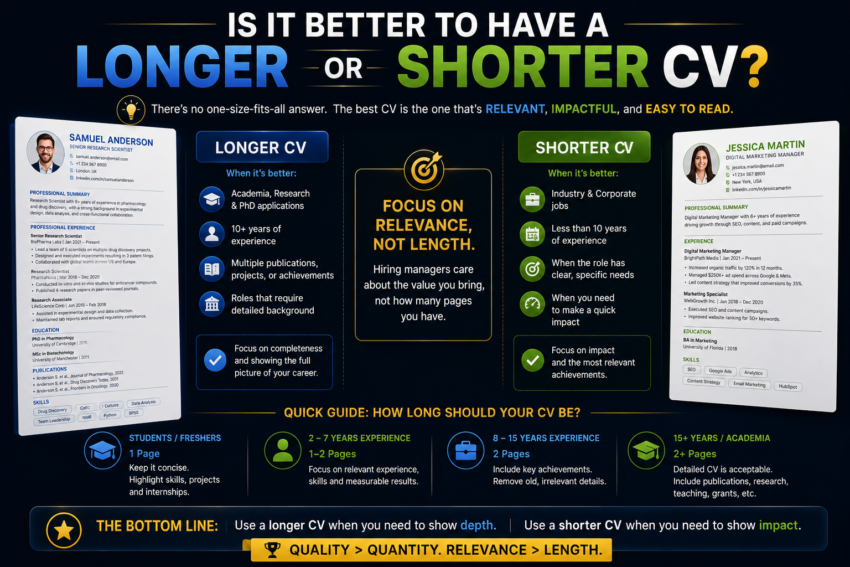
The CV is frequently the first thing that an employer reads when considering a candidate for a position. The CV serves as a professional introduction prior to an interview, prior to a skills test, prior to an evaluation of personality. That makes it difficult for many of those looking to find employment to consider whether they should submit a longer CV that includes all the information, or a shorter CV that focuses on the most relevant information. It will depend on the experience level, expectations of the industry, the applicant’s career history and so on, and on the purpose of the application. But the optimum length of a CV isn’t always short or long. That one that communicates with value in a succinct, clear and professional way.
What is the significance of the length of a CV?
There are also numerous applications that are checked by recruiters and hiring managers for the one job. This means that they’re not going to review all of the CVs in detail at this first pass. Extended resumes will get lost, especially when there are irrelevant things on them. However, a CV that is not long enough could lack the experience, skills and achievements. The length of a CV should be sufficient to be understood by the reader, so they know who the candidate is, what they can offer and why they are a suitable candidate.
CV length is important since it impacts readability. An outline CV makes it easier for the employer to find the most essential information. The candidate will look disorganized if there is too much text, or repetition, or lack of focus. The CV should be detailed because otherwise the employer wouldn’t be sure of the experience the applicant has. Thus, the intention should not be to merely increase or decrease the number of pages. The purpose should be to showcase the correct information within the proper amount of space.
. The advantages of a shorter CV.
Some CV writing is very effective when the CV is well written and concise. For recent graduates, entry level applicants or those with a few short years of experience, a one-page cover letter may be all that is required. A short CV emphasizes to the employer what is important and is able to communicate effectively. It also saves the employer time to avoid wading through unnecessary information as well.
Shorter CVs are especially beneficial to use when applying for positions that seek specific, hands-on, direct skills. Employer employers don’t want to go through irrelevant information looking for relevant qualifications, work experiences, achievements and technical skills. A short CV can be more engaging, too, as it tends to be more efficient, well-organized, and free of distractions.
However, a short CV should not be without content, or so vague that it cannot be used by anyone. Some candidates fail to include too much information and only include job titles and dates. This doesn’t make it easier for the employer to comprehend the candidate’s real value. A short CV will certainly contain quantifiable achievements, responsibilities, and abilities. It’s not a matter of writing less for less. That’s an issue of purposeful writing.
What are the advantages to a longer CV?
The longer CV is the best one to use if you have a lot of experience, are a senior applicant, an academic or a researcher, a consultant, a medical practitioner, an engineer or for someone of a specialized job. In this situation, a CV may be two pages long, as well as in academic/ research positions, which may require a longer CV, as it also includes publications, conferences, teaching experience, grants and memberships.
A CV which is a longer document will enable the candidate to demonstrate career progression, leadership experience, major projects, industry expertise and measurable results. One page might not be sufficient for a senior professional to present his years of experience. Companies may want to learn more when hiring for roles that call for responsibility, strategy or a particular skill.
The risk is the longer the CV gets, the longer it may get unfocused. A small number of candidates also put in every job duty, training course and old achievement, regardless of whether or not they are applicable. This may impact your CV negatively, rather than positively. A CV of more than two pages should be more to the point. All parts should support and illustrate the candidate’s appropriateness for the application.
One Page or 2 Pages?
Most people will want to have their resumes one-to-two pages in length. One page is the optimum length for CVs when there’s limited or no work experience. One page is the ideal length of CV for fresh graduates, students and career starters. If you’re an old pro, it’s more advisable to go with a 2-page CV and explain to them what you’ve done and what you have achieved. Most industries will generally need a 2-page resume for mid-level and senior jobs.
The trick is to make it short enough to be interesting, but not too short that it fails to demonstrate suitability. The hiring manager should have a good overview of the document and grasp the candidate’s value. If the CV is 1 page long, but does not contain important achievements, then the CV is too short. It’s too long if it’s 3 or 4 pages, repeating or old information.
Current and future applicants should also take into account countries and industry to which they are applying. While some employers opt for a brief resume, others will look at a CV that has a lot of detail. If you are applying for a position in a company, for instance, a two-page CV might be more appropriate, but an academic institution may want a more detailed CV. The people who are looking for jobs with the help of a professional service such as perfect cv maker Dubai can also be given tips on shortening or lengthening their CVs to meet the expectations of the employers in Dubai.
The optimal length of hair is more important than quality.
There is no specific number of pages for a CV. Assessed for relevance, clarity, structure and impact. A CV is not about responsibilities, it’s about successes. Instead of saying things like improved sales, managed key accounts or helped grow revenue it would be better to say that the candidate was responsible for sales. Employers want proof – not a description! Although the length of the CV is correct, it may be too general. A custom-made CV indicates that the applicant has taken the time to learn about the position which they are interested in applying for.
Formatting has an impact on quality, too. Clear headings, uniform spacing, legible font and logical and easy to read sections. An organized CV, even a two-page CV, can seem short and professional. Likewise, a one-page CV may appear weak if not formatted well and is devoid of content.
What you can do to remove a CV.
Note that candidates should not include any irrelevant, redundant or outdated information, to keep the CV to a reasonable size. If early career is shortened, it is only possible for those jobs where the intended career is no longer the related career. Candidates should also not list too many soft skills, without supporting evidence. The words are fairly common (hardworking, motivated, reliable), but they come with examples. The CV should focus on things that the candidate has done, achieved, improved, managed, created or delivered.
Conclusion
Sometimes it may be necessary to have a longer CV and sometimes a shorter one. The CV will be best if it fits the experience and expectation of the employer. The applicant may be able to submit a brief CV if he or she is an early career researcher for a focused application. Finally, it’s necessary to give CV length a meaning. A CV should be detailed enough that it will be a useful document, but not so detailed as to include irrelevant information that would detract from the reader’s ability to understand the CV. No employer wants the longest document! They desire the strongest evidence of a candidate’s competence to do the job. A CV that is short or long isn’t a successful CV. It’s to the point, convincing, well organized and geared to the opportunity.