
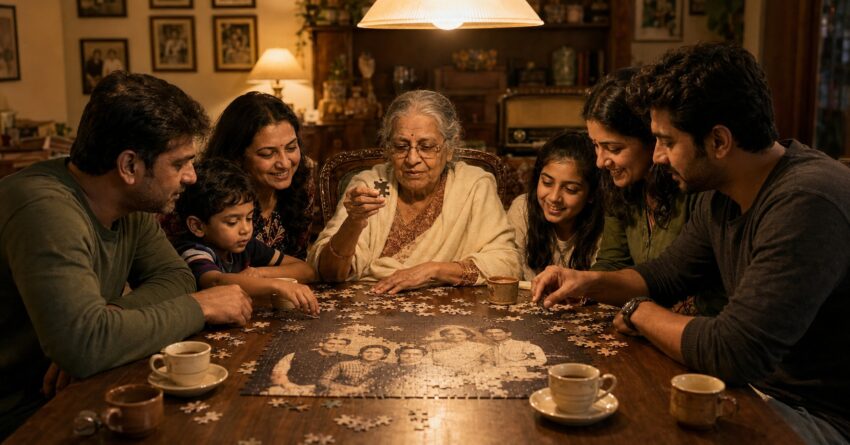
I want to tell you about a Thursday evening last December that I did not expect to change anything and ended up changing something I cannot fully explain.
My grandmother — my Dadi — has been losing her memory slowly for the last two years. Not dramatically, not all at once. The way fog comes in — gradually, in patches, some days thicker than others. She remembers some things with complete clarity and other things not at all, and the pattern of what stays and what goes is not something anyone has been able to predict.
She remembers my grandfather, who passed away eleven years ago, as clearly as if he left the room five minutes ago. She remembers certain recipes — the specific proportions of a dish she has been making for forty years — in exact detail. She remembers songs from her childhood. She sometimes does not remember my name.
I am her eldest grandchild. I have been coming to her house in Lucknow every year of my life. She has known me since before I could form sentences.
Some days she looks at me with complete recognition. Some days she looks at me with the specific careful expression of someone who knows they should know this face and is trying very hard to find it.
This is not a story about fixing that. Nothing fixes that. This is a story about one Thursday evening and a custom photo puzzle and two hours in which something came back temporarily — and what those two hours meant to everyone in the room.
The Photograph We Almost Never Found
My father has been slowly digitising the family’s old photographs for the last three years. Boxes of them — from before the era of digital cameras, the physical prints that had been sitting in albums and envelopes in various cupboards across the family for decades.
In October he found one that stopped him.
It was from approximately 1987. My grandparents’ house in Lucknow — the original one, the one that was sold in 2003, the one that exists now only in the specific sensory memory of everyone who grew up going there. The photograph showed a Diwali evening — the whole family assembled in the courtyard, diyas lit along the steps, everyone in their best clothes. My grandmother in the centre, younger than I have ever seen her in any photograph, laughing at something with her whole face. My grandfather beside her, looking at her rather than at the camera. My father as a child, maybe eight years old, holding a sparkler.
It was the family in the house that no longer exists, on an evening no one can fully recreate, everyone younger than they are now by thirty-eight years.
My father sent it to the family WhatsApp group late one night with no message. No caption. Just the photograph.
We all looked at it for a long time.
What I Decided to Do With It
I had been thinking about what to give Dadi for her birthday in December. This is a question that gets harder every year — not because she is difficult to please, but because the things that reach her most clearly now are not objects or experiences in the conventional sense. They are sensory things. Familiar things. Things that connect to memory through texture and smell and sound rather than through novelty.
I wanted to give her something with that photograph. The 1987 Diwali courtyard. All of them in the house that no longer exists.
I thought about a framed print. But a frame is something you hang and occasionally look at. I wanted something the family could do together — something that would put everyone in the same room with the photograph for an extended period of time, working on it, talking about it, remembering it piece by piece.
I found Zingy Gifts and their custom photo jigsaw puzzle — a personalised puzzle made from any photograph you upload, printed with vibrant quality, cut into pieces, arriving in a gift-ready box with the complete image on the lid so you know what you are building toward.
I uploaded the 1987 Diwali photograph. I ordered the puzzle.
When it arrived — the pieces in the box, the complete image on the lid showing the courtyard and the diyas and my grandmother laughing and my grandfather looking at her — I held it for a moment before wrapping it.
It felt exactly right.
The Thursday Evening in December
We gave it to Dadi on her birthday evening — the whole family together in her flat, three generations in the same room, the kind of gathering that happens fewer times each year than it used to.
She opened the box carefully, the way she opens everything — methodically, without rushing. When she saw the image on the lid, she went completely still.
She looked at it for a long time. The courtyard. The diyas. My grandfather looking at her.
She said — yeh hamaara ghar hai.
That is our house.
She said it with complete clarity. No searching. No trying to locate the memory. The photograph put her directly in it.
We spread the puzzle pieces on the dining table and started. All of us — my father, my aunts and uncles, my cousins, me. Someone made chai. Someone put on old film songs from the same era as the photograph. The room settled into the specific quiet of people working on something together, talking without needing to direct the conversation, comfortable with the shared purpose.
Dadi sat at the head of the table and looked at the pieces.
Then she picked one up.
She turned it in her hands, looking at the image printed on it — a fragment of the courtyard step, part of a diya, a sliver of someone’s sari. She found where it went and placed it with the specific satisfaction of someone who has just solved something small and real.
She kept going.
For two hours, Dadi sat at that table and found pieces. Not all of them. Not quickly. But steadily, methodically, with a focus that I had not seen on her face in longer than I wanted to remember. She talked while she worked — about the courtyard, about the Diwali evenings she remembered, about the specific recipe for the mithai my grandfather used to like that she had made every year without fail. She talked about things none of us had heard before. Details from 1987, from 1983, from the years before my father was old enough to remember them himself.
The puzzle was not finished by the end of the evening. It was about two-thirds complete when the night got late and people started to leave.
But Dadi asked that it be left on the table.
She wanted to finish it.
What Happened the Next Morning
My father called me the next morning. He said — she finished it.
He said that when he had gone to check on her in the morning, the puzzle was complete on the dining table. The 1987 Diwali courtyard, fully assembled. My grandmother and my grandfather in the centre, the diyas along the steps, the whole family in the house that no longer exists.
He said she had told him she had worked on it after everyone left. That she had not wanted to stop.
He did not say anything else for a moment.
Then he said — she remembered his name this morning. Without being asked. She just said his name.
I did not say anything for a moment either.
What I Have Been Thinking About Since
I am not going to claim that a custom photo puzzle restored my grandmother’s memory. It did not. The fog came back the next day, as it always does, in its own pattern that follows no logic anyone has found.
What I will say is this: that Thursday evening in December, for two hours, my grandmother sat at a dining table with three generations of her family and found pieces of a photograph from 1987 and talked about things she had not talked about in years. She was present in a way that she is not always present. She was connected — to the memory, to the photograph, to the people in the room.
The puzzle did not create that. But it created the conditions for it. It gave everyone a shared purpose that was slow and tactile and connected to a specific memory. It put the photograph in her hands rather than on a wall. It gave her something to build rather than something to look at.
A gift that brings people together around a shared experience is a different kind of gift than one that is received and placed somewhere. It creates an evening. It creates a conversation. It creates the conditions in which something might return, even temporarily, to someone who is slowly letting things go.
The puzzle is framed now. My father had it mounted after Dadi completed it — the assembled pieces, the 1987 Diwali courtyard, exactly as she left it that morning.
It is on the wall in her flat. She looks at it every day.
Some days she knows exactly what it is. Some days she just looks at it with the expression of someone who knows it matters even if they cannot fully say why.
Both of those things are enough.
If You Have a Photograph That Deserves More Than a Frame
If there is a photograph in your family — in an album, in an old envelope, on someone’s phone — that carries a whole world inside it, this is what I would tell you:
Do not just frame it. Build it. Put it on a table with the people who are in it or who remember it. Give everyone a piece. Let the conversation happen around the assembly rather than in front of a finished thing.
A custom photo puzzle is not just a gift. It is an evening. It is the specific quality of attention that comes from working on something together, piece by piece, while the memory reassembles itself in the room.
Some photographs deserve to be built, not just displayed.
The right puzzle gives you both.
Written by Suhail Khan, who will not forget the sound of puzzle pieces on a dining table in December while old film songs played and his grandmother talked about things no one had heard in years.