
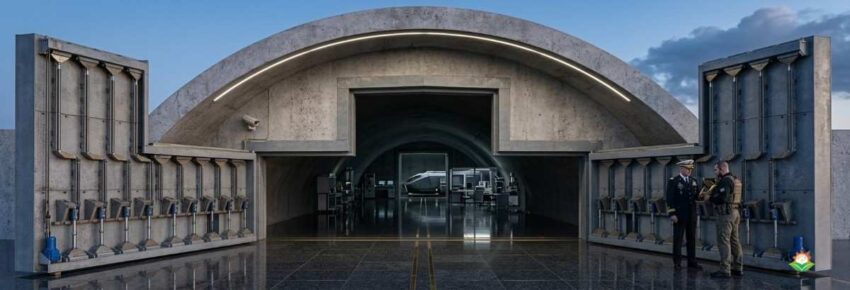
A helicopter operator at a private facility near Delhi noticed their bi-fold hangar door had been taking progressively longer to open over the past two monsoon seasons. What used to be a 45-second cycle was stretching to nearly two minutes, with an audible strain on the drive motor in the final phase. The door was still operational — technically — so the maintenance team kept deferring investigation. Six weeks later, the drive motor burned out on a Monday morning, grounding the aircraft for three days while emergency replacement parts were sourced.
A slow hangar door is not a minor operational inconvenience. It is a fault signal. Understanding what causes progressive slowdown — and what it predicts — is fundamental to managing aviation facility access systems before they fail at operationally critical moments.
Why Cycle Time Matters Beyond Operational Convenience
In high-tempo operations — military airbases, commercial MRO facilities, offshore helicopter hangars — door cycle time directly affects aircraft availability. A door that opens in 45 seconds versus two minutes may seem trivial in isolation. Across multiple movements per day, over weeks of operation, the cumulative difference is measurable in aircraft utilisation.
More importantly, progressive slowdown is almost always a symptom of an underlying mechanical condition that is getting worse. The door that takes two minutes today will take longer next month — and eventually will not open at all, typically at the worst possible moment.
The Most Common Causes of Hangar Door Slowdown
Working Through the Mechanical Causes Systematically
Track contamination and wear is the single most frequent cause of slowing in bottom-rolling sliding doors. Ground tracks accumulate debris — dust, grit, tyre rubber, hydraulic fluid residue — that increases rolling resistance across the full travel of the door. As contamination builds, the drive motor works harder to maintain speed, drawing more current and generating more heat. Unaddressed, this progression leads to motor thermal overload protection triggering — which manifests as the door stopping partway through a cycle, often misdiagnosed as a control system fault.
Track wear compounds the contamination effect. As the running surface of the track deteriorates, wheel contact becomes uneven, creating resistance spikes at worn sections. These spikes show up as irregular door movement — hesitation at certain points in the travel rather than consistent slowdown — which helps distinguish track wear from pure contamination.
Lubrication failure is closely related and often co-presents with track contamination. Wheel bearings, hinge pins on bi-fold systems, and drive chain or rack-and-pinion assemblies all require lubrication to maintain design friction coefficients. When lubrication intervals are extended — a common consequence of deferred maintenance — bearing and pin friction increases, raising the torque demand on the drive system. For aircraft hangar door systems operating at high cycle frequency, lubrication intervals specified for light-duty applications may be insufficient.
Drive system degradation develops independently of the track and running gear condition. Variable-speed drives and their associated control electronics develop faults that reduce torque output without triggering fault codes. Motor windings develop partial shorts that reduce efficiency before causing complete failure. Gearbox wear increases internal losses. Each of these produces slowdown that the operator experiences as a gradual performance decline rather than a sudden fault.
Seal and weather strip friction is frequently overlooked as a cause of door slowdown. Compression seals along jambs and heads resist door movement proportionally to their compression. When seals age and take a compression set — losing their ability to return to relaxed geometry — they exert increasing friction drag on the door leaf through the full travel. In cold conditions, seal materials stiffen, compounding this effect. An airplane hangar door in a facility that experiences significant temperature variation — and northern India’s winter mornings qualify — can show notably different cycle times seasonally if seal condition is not maintained.
Structural misalignment is the most serious underlying cause and the most likely to produce rapid deterioration once it has developed. Door leaf misalignment relative to the track introduces binding at guide points, imposing structural loads on running gear components not designed for them. Foundation settlement, thermal movement in the building frame, or damage to track mounting points can all introduce misalignment progressively. The symptom is typically a door that is slow through a specific portion of its travel rather than uniformly slow across the full cycle.
Diagnostic Approach for Facility Teams
Rather than addressing symptoms, a systematic check covers: track cleanliness and surface condition, lubrication status of all specified lubrication points, current draw on the drive motor during a full cycle (elevated current indicates increased resistance somewhere in the mechanical chain), and visual inspection of door leaf alignment at the track and guide positions.
Many hangar door manufacturers in India — including established Sigma Power Tech manufacturer and service provider operations — offer service visits that include current draw testing and alignment verification as part of a structured maintenance check. This is more efficient than fault-finding individual components after a slowdown has been noticed.
For complex systems, including those with integrated automation and access control as found in defence and blast-rated installations, the diagnostic scope extends to the control system. Technical documentation covering these systems, including service requirements and fault identification, is accessible through Hangar door engineering resources that address operational performance across facility types.
The Progressive Nature of Mechanical Faults
The critical operational insight is that hangar door mechanical faults are almost never stable. A door that is slightly slow today is not going to stay slightly slow — the conditions causing the slowdown are generally self-reinforcing. A contaminated track that increases motor load causes bearing heating that accelerates bearing wear that increases motor load further.
Intervening early — when the slowdown is first noticed — is substantially cheaper and less disruptive than waiting for the fault to become obvious. The Sigma Power Tech hangar door service philosophy, like that of serious aviation infrastructure suppliers generally, is built around scheduled condition assessment rather than reactive repair.
Conclusion
A hangar door that is slow to open is a door that is telling you something. Track condition, lubrication state, drive system health, seal friction, and structural alignment are all candidates — and systematic diagnosis identifies the actual cause rather than addressing symptoms.
The aircraft operations that depend on reliable door access cannot afford three-day groundings from predictable mechanical failures. Treating progressive slowdown as an early warning signal, and investigating it promptly, is the maintenance posture that keeps aviation facilities operating to their designed performance throughout a door system’s full service life.